Fundación ProAves – por la conservación en el país de las aves

Categorías
Articles

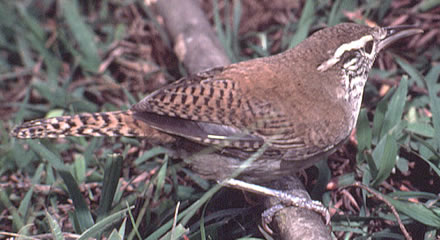
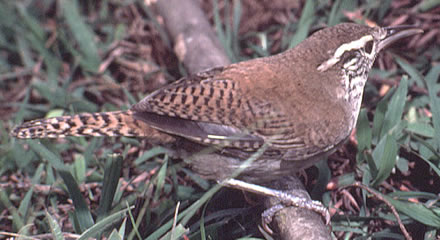
Thryothorus nicefori

niceforiNiceforo’s Wren (Thryophilus nicefori) is endemic to Colombia but is little known and considered critically endangered, registered in historical records only in riparian forests and xerophytic thickets of the municipality of San Gil (Santander).

The actions being implemented by the Foundation on this species are:

– Research in San Gil (Santander) making the first record describing the vocalization of the species. As a result of this investigation it was possible to identify habitat fragmentation as the main threat to the species and environmental education campaigns were recommended with communities in the range where the species is found.

– Studies have been conducted to find the species in new areas; studies have been conducted to determine population size, distribution and threats to the species.

Categorías
Articles

RNA El Mirador, Quindío

RNA El Mirador, Génova – Quindío.

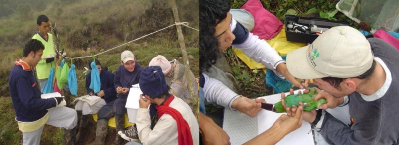
El programa de monitoreo y conservación de aves migratorias, llevó a cabo el monitoreo desde Febrero del 2005 a Febrero del 2006 en la zona, es una localidad con influencia de bosques altoandinos y sub-paramos de la Cordillera central y un punto clave de biodiversidad y fuente de agua para los municipios conlindandtes, es una zona estratégica de paso de aves migratorias entre los valles interandinos del valle del cauca y el magdalena. El monitoreo se realizó utilizando Transectos de censos de puntos y capturas, anillamiento y liberación, mediante el uso de redes de niebla.

1. DESCRIPCIÓN GEOGRAFICA Y HABITAT

Estaciones.

Reserva el Mirador (Municipio de Genová, Departamento del Quindio, 3300 msnm), caminos conocidos como guayabal y la calera. Ubicados en la Vereda Rió Gris Alto. Sus coordenadas son 4°08’ 24’’ de latitud Norte y a los 75° 44’ 17.5’’ de longitud al Oeste. La vegetación corresponde a bosque secundario bosque andino y subparamo medianamente intervenido, con gran afluencia del recurso hídrico. Predominan especies de Araliaceaes, Melastomataceaes, Helechos y especies importantes para la investigación como Podocarpus oleifolius, con un dosel promedio de 16m. Más información.

Reserva El Jardín: Ubicado en la Vereda Río Gris Alto, municipio de Génova, departamento de Quindío a 2300 m.s.n.m. Sus coordenadas son4º9’44’’N;75º45’24’’W. La vegetación se compone de bosques secundarios en regeneración natural y de plantaciones con especies nativas importantes para la conservación. La estación comprende reforestaciones y bosques secundarios en regeneración natural.

El Municipio: Ubicada en la Vereda Pedregales, municipio de Génova, departamento de Quindío a 1550 msnm. El lugar se conoce como Pedregales bajo. La vegetación está compuesta por Cafetales con sombrío utilizando especies como Guamo, Platano, y rodeado por otros cultivos.


2. EQUIPO Y PERSONAL ASIGNADO 

El investigador titular realizó jornadas de educación ambiental con las comunidades adyacentes y los hacen participes activos en su región con la finalidad de divulgar la importancia de la Conservación de las Aves silvestres y migratorias en sus hábitat naturales.

Investigadores titulares:

Duvier Yesid Ramírez (Coordinador de campo- Anillador)

Asistentes de Campo y colaboradores:

Fabian Guzman, Diego Caranton, Adriana Mayorquin, Nicolai Osorno, Ingrid Rodríguez, Querubín Rodríguez, Jeison Sanabria, Carmen Sepúlveda y Adriana Tovar.

3. ESPECIES DE INTERES

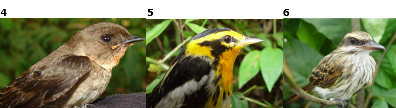
Guala Cabecirroja (Cathartes aura) Migratorio boreal 

Sirirí Rayado (Myiodynastes maculatus) Migratorio boreal y aust. (foto 6)

Golondrina Blanquiazul (Notiochelidon cyanoleuca) Migratorio austral

Golondrina Barranquera (Stelgidopteryx ruficollis) Migratorio boreal (foto 4)

Zorzal Buchipecoso (Catharus ustulatus) Migratorio boreal 

Verderón Ojirrojo (Vireo olivaceus) Migratorio boreal y aust.

Reinita Gorginaranja (Dendroica fusca) Migratorio boreal (foto 5)

Reinita Pechigrís (Oporornis agilis) Migratorio boreal (foto 3)

Reinita Enlutada (Oporornis philadelphia) Migratorio boreal

Reinita de Canadá (Wilsonia canadensis) Migratorio boreal 

Cotorra Aliazul (Hapalopsittaca fuertesiCR (foto 1)

Periquito Frentirrufo (Bolborhynchus ferrugineifronsEN

Perico Paramuno (Leptosittaca branickiiVU

Terlaque Andino (Andigena hypoglaucaVU

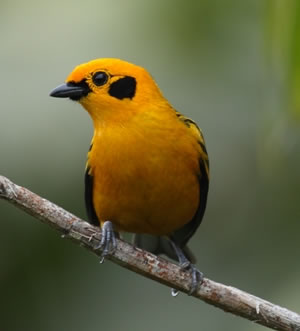
Saltador Chusquero (Saltator cinctus) VU (foto 2)

4. ESTADISTICAS DE MONITOREO DE AVIFAUNA EN LA ZONA

Actualización (Diciembre – 2006)

Numero de especies registradas por ambas metodologías: 217

Numero de individuos capturados: 2678

Número de Individuos anillados: 2219

Numero de individuos observados: 10008

5. AGRADECIMIENTOS

El programa de monitoreo agradece a la alcaldía del Municipio de Génova y la corporación autónoma regional del Quindío CRQ.

Categorías
Articles

Festival Aves Migratorias

Taller de Máscaras

Taller de Máscaras
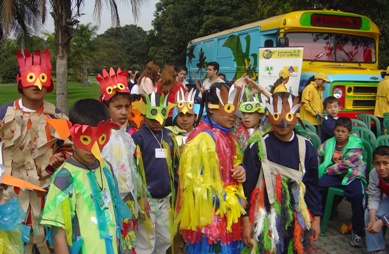
Festival de Aves Migratorias, 2005

En el marco de sus acciones la Fundación ProAves viene desarrollando El Programa Nacional de Monitoreo y Conservación de Aves Migratorias el cual tiene como uno de sus propósitos Implementar una red de monitoreo de aves migratorias a lo largo del territorio Colombiano que permita evaluar su distribución, sus movimientos y las amenazas que enfrentan para asegurar su supervivencia mediante acciones de conservación efectivas en áreas claves; sensibilizando a las comunidades, fortaleciendo la capacidad local en técnicas de monitoreo y generando alianzas estratégicas de conservación.

Concurso de Pintura

Concurso de Pintura
Festival de Aves Migratorias, Pto Boyacá 2005

En este sentido ProAves ha aunado esfuerzos con otras instituciones para consolidar una campaña de educación y comunicación ambiental a nivel nacional orientada a establecer el Festival de Las Aves Migratorias en el mes de octubre.

Este evento se ha desarrollado a nivel nacional durante cuatro años consecutivos, estableciéndose como un evento dinámico y educativo que desarrolla diferentes actividades enfocadas hacia la educación y comunicación ambiental; el objetivo es despertar el interés de la comunidad en general, especialmente en niños y jóvenes por el conocimiento de las aves migratorias y la importancia de conservar su hábitat.

El Festival de Las Aves Migratorias 2006 se celebra durante el mes de octubre, y a este evento se vinculan organizaciones como:

- Conservación Internacional
- Fondo para la Acción Ambiental y la Niñez
- Asociación Bogotana de Ornitología
- Jardín Botánico de Bogotá
- Departamento Administrativo de Medio Ambiente – DAMA
- Empresa de Acueducto y Alcantarillado de Bogotá
- Alcaldías locales e Instituciones Educativas.

Objetivos del Festival

- Consolidar a nivel nacional el Festival de Las Aves Migratorias como un evento dinámico y educativo que realice diferentes actividades enfocadas hacia conocimiento y conservación de las aves.

- Despertar el interés de la comunidad especialmente en niños y jóvenes por las aves migratorias y la importancia de conservar su hábitat.

- Fortalecer y consolidar una red de organizaciones y personas comprometidas en la conservación de las aves en el país.

Este Festival se llevará a cabo en 14 regiones del país: (Bogotá D.C. – Cundinamarca, Roncesvalles – Tolima, Jardín – Antioquia, Génova – Quindío, Falan – Tolima, Munchique – Cauca, Pangan – Nariño, San Vicente de Chucurí – Santander, Tierra Alta – Córdoba, Pto Boyacá y Pto Pinzón – Boyacá, Frontino – Antiqouia, San Lorenzo – Santa Marta, San Andrés Isla.), con diferentes actividades formativas, educativas y recreativas como recorridos de observación de aves, concursos de pintura, muestras, conferencias y presentaciones, talleres, exposiciones y caminatas guiadas.

Aula Ambiental Móvil

Aula Ambiental Móvil “Loro Bus”
Actividades del Festival de Aves Migratorias Jardín Botánico de Bogotá, 2005

Durante el desarrollo del evento contaremos con la presencia de nuestra Aula Ambiental Móvil “Loro Bus”, especialmente diseñado para la utilización de metodologías lúdicas, con elementos para la exposición de videos, exhibidores informativos y la compañía constante de personal especializado que estará encargado de guiar las actividades para los participantes.

Categorías
Articles

San Andrés Isla

San Andrés Isla.

El programa de monitoreo y conservación de aves migratorias, lleva a cabo el monitoreo desde Noviembre del 2003 hasta la actualidad, es una localidad con influencia del Mar Caribe y un punto clave estratégico de paso de aves migratorias. El monitoreo se realiza utilizando capturas, anillamiento, datos morfológicos y liberación, mediante el uso de redes de niebla.

1. DESCRIPCIÓN GEOGRAFICA Y HABITAT

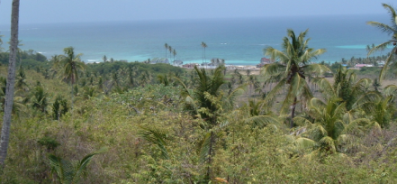
Municipio San Andrés Isla, departamento Archipiélago de San Andrés, Providencia y Santa Catalina, 0 – 60m. Isla ubicada a 720 Km. al NE de Colombia, hace parte de la reserva de Biosfera Seaflower designada a su vez como Área Importante para la Conservación de las Aves – IBA. Las estaciones de monitoreo ubicadas a lo largo de la isla incluyen vegetación de Manglar, Bosque Ralo asociado a palmas y Arbustos.

Las estaciones de monitoreo fueron seleccionados a lo largo de la isla en vegetación de Manglar, Bosque Ralo asociado a palmas y Arbustos así:

Estaciones

Bosque Ralo (Municipio de San Andrés Isla, Departamento Archipiélago, 100 m, 2004) Pepper Hill. Bosque Ralo, en la cima de la loma en el costado norte de la carretera que conduce al Radar del Ejército y comunica al poblado de Sound Bay-San Luis con West View. Big Pond laguna de agua dulce, ubicada en el centro de la isla.

Manglar (Municipio de San Andrés Isla, Departamento Archipiélago, 40 m) Smith Channel, Borde de Manglar. Mangle Rojo (Rizhophora mangle) en fragmento ubicado en el costado este de la isla al sur de la via Tom Hooker. Orange Hill, Borde de Manglar. Fragmento de manglar de tamaño considerable en la parte central de la isla perpendicular a la vía denominada Orange Hill 400m al sur.

Arbustos Aquí es más allá. (Municipio de San Andrés Isla, Departamento Archipiélago, 40 m, Febrero 22 -Octubre 31 2004) Zona de vegetación arbustiva Vía que atraviesa la isla de este a oeste mas al sur de la vía Tom Hooker.

2. EQUIPO Y PERSONAL ASIGNADO

En las jornadas de investigación, el investigador titular realiza jornadas de educación ambiental con las comunidades adyacentes y los hace participes activos en su región con la finalidad de divulgar la importancia de la Conservación de las Aves silvestres y migratorias en sus hábitat naturales.

Investigadores titulares:

Andrea Pacheco (Coordinador de campo- Anillador)

Asistentes de Campo y anilladores temporales:

3. ESPECIES DE INTERES

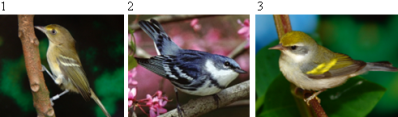
Verderón de San Andrés – Vireo caribaeus (VU) – Endemica (Foto 1) 
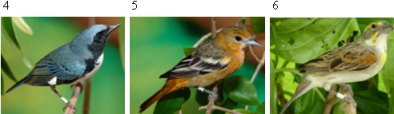
Reinita Cerúlea – Dendroica cerulea (VU) – Migratorio boreal (Foto 2) 
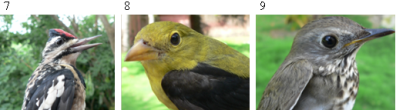
Reinita Alidorada – Vermivora chrysoptera – Migratorio boreal (Foto 3)

Reinita Negriazul – Dendroica caerulescens – Migratorio boreal (Foto 4) 
Oriol de Baltimore – Icterus galbula – Migratorio boreal (Foto 5) 
Arrocero NorteñoSpiza americanaMigratorio boreal (Foto 6)

Carpintero chupasavia – Sphyrapicus varius – Accidental Migratorio boreal (Foto 7) 
Piranga Alinegra – Piranga olivacea – Migratorio boreal (Foto 8) 
Zorzal Buchipecoso – Catharus ustulatus – Migratorio boreal (Foto 9) 


Categorías
Articles

Darién, Chocó


DARIÉN CHOCÓ, ACANDÍ Y UNGÜÍA.

El programa de monitoreo y conservación de aves migratorias, llevó a cabo el monitoreo desde Noviembre del 2003 a Febrero del 2005 en la zona, es una localidad con influencia del Mar Caribe y un punto clave de biodiversidad de la serranía del Darién, siendo una zona estratégica y de paso de aves migratorias. El monitoreo se realizó utilizando Transectos de censos de puntos y capturas, anillamiento y liberación, mediante el uso de redes de niebla.

1. DESCRIPCIÓN GEOGRÁFICA Y HÁBITAT

Estaciones.

Sapzurro – Reserva Agua Viva (Municipio de Acandí, Departamento del Chocó, 190 msnm) En la estribación de la Serranía del Darién cerca de la zona costera en bosque secundario en el Cerro Pérez Prado cerca a zona de cultivo de arroz, en el lugar conocido localmente como la Antena y en el camino que va del corregimiento de Sapzurro a Capurganá en la Reserva Agua Viva, Reserva Punta de las Flores y Reserva La Coquerita de la Red de Reservas de Ungandí y el predio privado de Ciro Arévalo. La vegetación es un bosque secundario de 30 a 40 años aproximadamente, posee en la parte madura árboles de hasta 30m de altura, como el Choíba. Algunas partes de la reserva Agua Viva y la Coquerita están sembradas con Saril.

San Francisco – Reserva Villa María (Municipio de Acandí, Departamento del Chocó, 150 msnm). La loma el cielo, corregimiento Caserío de San Francisco, municipio de Acandí, departamento del Chocó. Pequeño bosque de galería por el río Ciego, donde se ubico el primer transecto de redes y de puntos; predomina un bosque secundario. El primer transecto de redes esta en los predios de la Reserva Villa María que pertenece a la red de Reservas Ungandí. El segundo transecto de redes, está a orillas de la quebrada Manantiales en el predio de Los Caliches y en bosque secundario.

Nuevo Capitán-Reserva Ormúz. (Municipio de Unguia, Departamento del Chocó). En la Serranía de Tripogadí a 500 metros aproximadamente del río Tanela, a la derecha de la vía que conduce al corregimiento de Balboa. Las redes se ubicaron en un bosque en estado de sucesion de 15 años aproximadamente, una parte de las tierras de las reservas esta destinada a cultivos de maíz y plátano y ganadería. Reserva Ormúz, Reserva Paraíso y Reserva Jorge Naranjo, las cuales hacen parte de la Red de reservas de Ungandí. Los puntos de conteo están ubicados a lo largo de la carretera hacia Titumate desde la reserva Paraíso y margen izquierda del río Tanela.

2. EQUIPO Y PERSONAL ASIGNADO

El investigador titular realiza jornadas de educación ambiental con las comunidades adyacentes y los hacen participes activos en su región con la finalidad de divulgar la importancia de la Conservación de las Aves silvestres y migratorias en sus hábitat naturales.

Investigadores titulares:

Carmen Florinda Londoño (Coordinador de campo- Anillador) 
Duvier Yesid Ramírez (Coordinador de campo- Anillador) 
Juan Miguel Ruiz (Coordinador de campo- Anillador)

Asistentes de Campo:

Andres Upegui, Edwin Algarin, Jorge Arredondo, Daniel Carvajal, Bilardo Escobar, Monica Goez, Eder Hernandez, Nelson Idarraga, Arlett Martinez, Elizabeth Noreña, Matilde Palacio, Remberto Toro y Andrés Upegüi.


3. ESPECIES DE INTERES

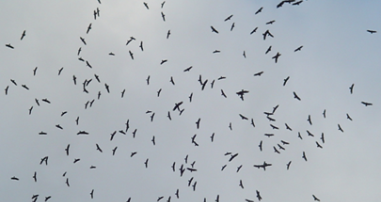
Buteo swansoni – Gavilán de Swainsoni (Migratorio boreal)

Ara ambigua – Guacamaya Verdelimón (VU) 
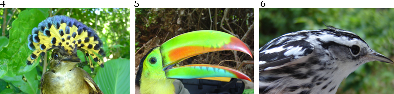
Ramphastos sulfuratus – Tucán Caribeño (Foto 5) 
Phaethornis yaruqui – Ermitaño del Pacífico (Casi – Endémica) 
Baryptengus martii – Barranquero Pechicastaño (Foto 3) 
Icterus galbula – Oriol de Baltimore (Migratorio boreal) 
Dendroica striata – Reinita Rayada (Migratorio boreal) 
Mniotilta varia – Cebrita Trepadora (Migratorio boreal) (Foto 6) 
Protonotaria citrea – Reinita Cabecidorada (Migratorio boreal) (Foto 1) 
Phaenostictus mcleanni – Hormiguero Ocelado (Foto 2) 
Empidonax virescens – Atrapamoscas Verdoso (Migratorio boreal) 
Onychorhynchus coronatus – Atrapamoscas-real Amazónico (Foto 4) 
Piranga olivacea – Piranga Alinegra (Migratorio boreal) 
Vireo olivaceus – Verderón Ojirrojo (Migratorio boreal)

4. ESTADISTICAS DE MONITOREO DE AVIFAUNA EN LA ZONA

Actualización (Agosto – 2006)

Numero de especies registradas por ambas metodologías: 216 
Numero de individuos capturados: 2360 
Número de Individuos anillados: 1704 
Numero de individuos observados: 9565

Migración de Buteo platypterusButeo swansoni durante Octubre del 2004 cerca al municipio de Sapzurro.

Categorías
Articles

Caparú, Vaupés

ESTACIÓN BIOLÓGICA MOSIRO ITÁJURA CAPARÚ, VAUPÉS

El programa de monitoreo y conservación de aves migratorias, lleva a cabo el monitoreo desde Septiembre 2004 en la zona, representa la única estación del programa en la región amazónica en Colombia. El monitoreo se realiza utilizando Transectos de censos de puntos y capturas, anillamiento y liberación.

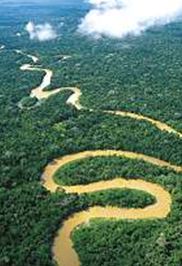
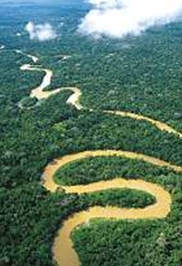
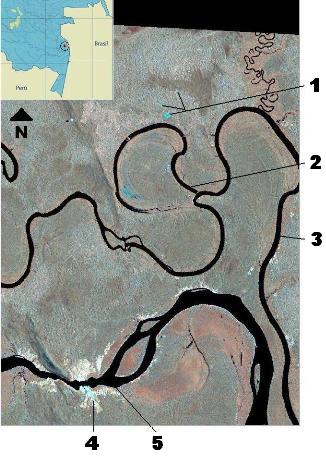
Estación Biológica Caparú, Vaupés. (Municipio de Taraira, Departamento de Vaupés, 200m) Ubicada en una zona de transición a 200m en medio de los centros de endemismos de Imerí y Napo entre las provincias de Guayana y Amazonia. La estación esta rodeada por bosque primario a 24 km a lo largo del lago Taraira el cual es un antiguo meandro del río Apaporis, el mayor en la Amazonia Colombiana.

1. DESCRIPCIÓN GEOGRAFICA Y HABITAT

Las estaciones están ubicadas por tipo de estructura de vegetación de la siguiente manera:

Colina se caracteriza por tener un relieve ondulado, una vegetación muy cerrada y de altura variable (hasta 30m) y se encuentra en el sector suroriental.

Terraza se caracteriza por tener un relieve elevado y plano, una vegetación medianamente abierta y alta (árboles de 30 a 40 m apróx.) ubicada se encuentra en la parte noroccidental.

Transición se caracteriza por tener un relieve ondulado e inclinado hacia el lago, la vegetación no es uniforme, es cerrada con alturas variables (máximo 30 a 40 m apróx.) y se encuentra en la parte suroccidental de Caparú.

1. Estaciones de Monitoreo

2. Lago Taraira

3. Rio Apaporis

4. La Pedrera.

5. Rio Caqueta.

2. EQUIPO Y PERSONAL ASIGNADO

El investigador titular realiza jornadas de educación ambiental con las comunidades adyacentes y los hacen participes activos en su región con la finalidad de divulgar la importancia de la Conservación de las Aves silvestres y sus hábitat naturales

Investigadores titulares:

- Beatriz Ramírez (Coordinador de campo- Anillador)
- Ronald Parra (Coordinador de campo – Anillador)
- Mauricio Gutiérrez (Coordinador de campo Anillador)

Asistentes de Campo:

Ana Palma

Edgar Yacuna

Santiago Macuna

Ivonne Vargas

3. ESPECIES DE INTERESRhegmatorhina cristata – Hormiguerito Colorado (Casi – endemica)

Eubucco richardsoni – Torito Limón

Catharus ustulatus – Zorzal Buchipecoso (Mig – Boreal)

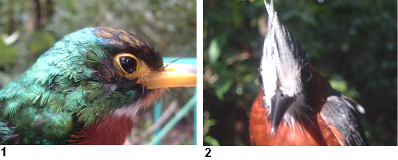
Galbula albirostris – Jacamar Piquidorado (foto 1)

Pithys albifrons – Hormiguero Empenachado (foto 2)

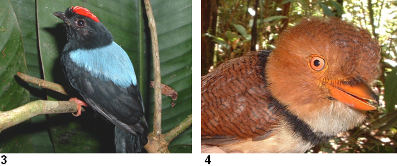
Chiroxiphia lanceolada Saltarín Cola-de-alambre (foto 3)

Bucco capensis – Bobo Collarejo (foto 4)

4. ESTADISTICAS DE MONITOREO DE AVIFAUNA EN LA ZONA

Actualización (Agosto – 2006)


Numero de especies registradas por ambas metodologías: 219

Numero de individuos capturados: 1286

Número de Individuos anillados: 911

Numero de individuos observados: 11910

Categorías
Articles

Suroeste Antioqueño

Suroeste Antioqueño – Bosques Montanos del Sur de Antioquia.

El programa de monitoreo y conservación de aves migratorias, realiza un monitoreo constante desde el año 2003 en la zona, la investigación tiene en cuenta áreas de influencia de tres municipios del suroeste Antioqueño. El monitoreo se realiza utilizando Transectos de censos de puntos y capturas, anillamiento y liberación mediente el uso de redes de niebla.

1. DESCRIPCIÓN GEOGRAFICA Y HABITAT

Estaciones:

Monserrate. (Municipio de Jardín, Departamento de Antioquia, a 1450 msnm, (Diciembre 2003 – Mayo 2006). Zona cafetera con sombrío de Guamos, Laureles, cultivos de plátano y banano asociado con café, a 5 Km. al oeste de Jardín, desde la Fonda Monserrate a orillas del río San Juan y la troncal del café.
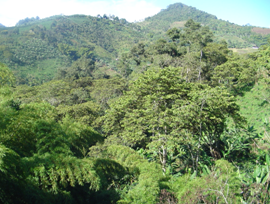
La Mesenia. (Municipio de Jardín, Departamento de Antioquia, a 2400 msnm, (Noviembre 2003 – Febrero 2005) Bosque nublado y poco intervenido en limites con el departamento de Risaralda; en el camino que conduce al corregimiento de San Antonio del Chamí – Risaralda, contiguo al Alto Paramillo en la Cordillera Occidental y nacimientos del río San Juan.

Ventanas. (Municipio de Jardín, Departamento de Antioquia a 2850 msnm (Noviembre 2003 – Junio 2006) Bosque nublado muy intervenido y potreros con rastrojo en limites con el departamento de Caldas, en la parte alta de la vereda Quebrada Bonita; en cercanías de la carretera que conduce de Jardín a Río Sucio en el sitio conocido localmente como Alto de Ventanas.
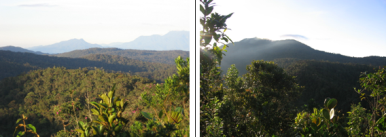
Betuca. (Município de Betania, departamento de Antioquia, 1471-1632 m). Finca con cultivo de café con sombrío extensivo (400 ha aproximadamente) donde predominan los árboles de: Guamo (Inga sp), Nogal cafetero (Cordia alliodora), Vainillo (Cassia spectabilis), Barcino (Cordia eleagnoides) y otros. Además se encuentran potreros con programas silvopastoriles intensivos, con representación de árboles de gran porte en estos potreros. Hay presencia de Guamos, Nogales, Caracolero, Higuerones (Ficus sp), Guayabos (Psidium guajava), Aguacates (Persea americana) y otros.Adicionalmente presenta un bosque en buen estado de conservación de 180 ha. La Finca Betuca está ubicada a 4Km de la cabecera municipal saliendo por la vía que conduce a la troncal del Café.

Cultivares. (Municipio de Jericó, departamento de Antioquia. La zona presenta fragmentos de bosque en buen estado de conservación y cultivos de cardamomo con abundante sombrío donde se encuentran mas de 35 especies de árboles por hectárea y predominan Pisquines (Albizzia lebeck), Nogales (Cordia alliodora) y Guamo (Inga sp). El area de presenta además una pequeña quebrada, vegetación de rastrojo bajo con algunos árboles con copas dominantes, entre ellos Guayabos (Psidium guajava), Vainillo (Cassia spectabilis). La Finca la Suiza forma parte de la asociación Cultivares, en donde esta cultivando Cardamomo con sombrío pero se está planeando el reemplazo de estos cultivos y por ganadería. El área total de Cultivares es de aproximadamente 1500ha, pero solo se trabajo en las inmediaciones de la Finca La Suiza. Ubicado en la Vereda la cascada, en la Finca la suiza a 5kms al Norte de la cabecera municipal por la vía que conduce a la variante de Cauca viejo.

EQUIPO Y PERSONAL ASIGNADO

Gustavo Suárez – Coordinador de campo

Luz Marina Uribe – Asistente de campo

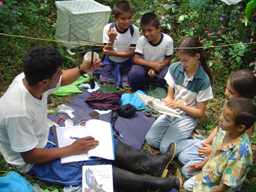
El investigador titular y su asistente realizan jornadas de educación ambiental con las comunidades adyacentes y los hacen participes activos en su region con la finalidad de divulgar la importancia de la Conservación de las Aves silvestres y sus hábitat naturales
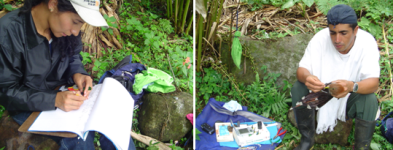
Voluntarios e investigadores participantes en jornadas de monitoreo

Patricia Agudelo,Maria Patricia Arenas,Leandro Marin, Sebastián Marin, Fabio Suarez, Mario Suarez, Johanna Agudelo, Daniela Agudelo, Jose Fernando Castaño,Hector Fernando Gaviria, Kellyn Patiño, Marcela Vargas, Jorge Velasquez, Andrea Pizarro, Maria Agudelo,Alexander Cortes y Victor Quiroz
ESPECIES DE INTERES.

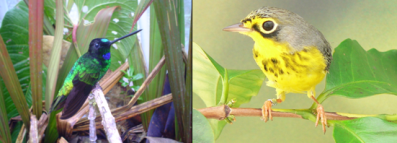
Dendroica cerulea-Reinita Cerúlea (VU)-Mig. Boreal

Diglossa gloriosissima-Picaflor Pechirrufo (EN)

Iridosornis porphyrocephala-Musguerito Gargantilla (NT)

Margarornis stellatus-Corretroncos Barbiblanco(NT)

Odontophorus hyperythrus-Perdiz Colorada(NT)

Eriocnemis derbyi-Calzoncitos Piernioscuro(NT)

Coeligena orina-Inca Oscuro(Endemica)

Wilsonia canadensis-Reinita de Canadá – Mig. Boreal

Hypopyrrhus pyrohypogaster-Cacique Candela(Endemica)

Ognorhynchus icterotis-Loro Orejiamarillo (CR)
ESTADISTICAS DE MONITOREO DE AVIFAUNA EN LA ZONA

ACTUALIZACIÓN (Agosto – 2006)


Numero de especies registradas por ambas metodologías: 429

Numero de individuos capturados: 8404

Número de Individuos anillados: 5813

Numero de individuos observados: 80795

Agradecimientos

El programa de monitoreo de aves migratorias que dirige la fundación ProAves, expresa sus agradecimientos a las personas de la vereda monserrate y muy especialmente a los señores Mario Pelaez y Juan Crisostomo Osorio por haber permitido que en sus fincas se realizaran los monitoreos con redes de niebla. De igual forma agradecemos a los colegios de la región por haber abierto un espacio en sus actividades y permitir que jovenes de los grados superiores se vincularan a las actividades que realiza la fundación ProAves en la región del suroeste de Antioquia.

Categorías
Articles

Educational Material

mateedu

The environmental education program ProAves Foundation has developed a series of educational and informative material, which aims to promote knowledge and conservation of threatened bird species in the country.

These subsidies have been elaborardo to support and strengthen the changes in attitude towards the conservation of natural resources in areas where bird populations are still in critical danger of extinction, so that in this way local communities know and keep wealth their natural territory.

This educational material is part of the second objective of the National Strategy for the Conservation of Birds in generating environmental education activities to increase public awareness.

Categorías
Articles

Mission and Vision

Mission:Mision_y_Vision

To protect wild birds and their habitats in Colombia through investigation, directed conservation actions and community approach.

Vision:

Fundación ProAves will become established as a leading organization in the protection of birds and their habitat, contributing to the prevention of species extinction and the protection of key areas of Colombia, in partnership with institutions, communities, leaders and general citizens oriented towards the goal of human development in harmony with nature.

Categorías
Articles

Grupo Ecológico

Última actualización : Miércoles 17 de mayo de 2006

GRUPO ECOLÓGICO AMIGOS DE LAS AVES

1. ¿Quienes somos?

Somos grupos ecológicos creados y apoyados por la Fundación ProAves e integrados por niños, niñas y jóvenes entre los 6 y 17 años de edad de diferentes regiones del país, en especial donde la fundación desarrolla sus acciones. Dedicamos nuestro tiempo libre a apoyar y desarrollar iniciativas para la conservación de la naturaleza y en especial de las aves y sus habitats.

Queremos asumir un compromiso desde niños con el cuidado y protección del medio ambiente que nos permita vivir en armonía con la naturaleza y contribuir a la conservación de los recursos naturales.

2. Nuestra misión

Liderar y desarrollar acciones para el conocimiento y conservación de las aves silvestres y los recursos naturales en las diferentes regiones del país a través del desarrollo de iniciativas locales que promueven la adopción de criterios y prácticas para su conservación.
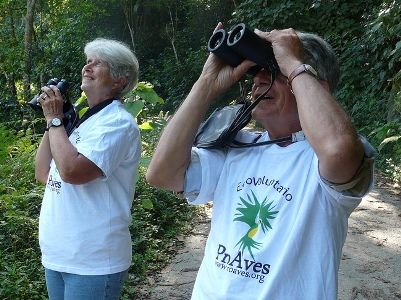
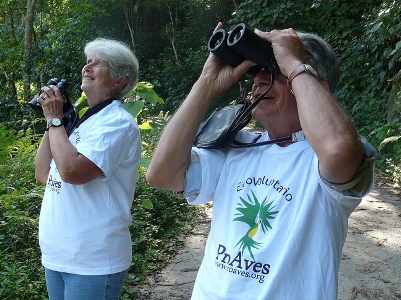
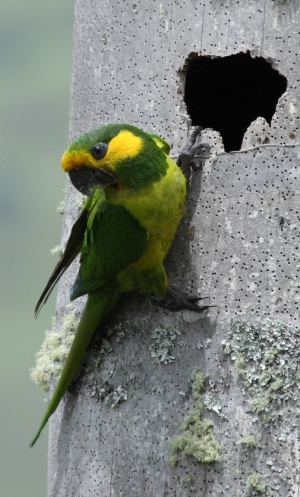
3. Con nuestras acciones buscamos…

- Crear una conciencia ecológica en los miembros de los grupos que contribuya a la protección y conservación de los recursos naturales en las diferentes regiones del país.

- Desarrollar en la comunidad infantil la capacidad de analizar su entorno ambiental, de tal forma que les permita elaborar sus propios proyectos de acuerdo a sus necesidades de conservación.

- Promover el conocimiento y conservación de las especies de aves amenazadas en las diferentes regiones del país.

- Contribuir a la formación de carácter y liderazgo de los miembros del los grupos fomentando los valores de colaboración, disciplina, respeto y responsabilidad.

- Crear fuertes lazos de hermandad entre los miembros de los diferentes grupos “Amigos de las Aves”.

- Brindar un espacio para el aprovechamiento del tiempo libre.

- Ayudar a que la comunidad y los visitantes conozcan las especies que se encuentran en las diferentes áreas donde la Fundación desarrolla sus proyectos y la importancia de estas.

4. Nuestras actividades:

- Participación en eventos ambientales (Festivales, Campañas, Actividades masivas).

- Desarrollo de actividades para el buen uso del tiempo libre (Cine Club, Centros de Documentación).

- Programas al Aire Libre. (salidas de observación de aves, reforestación y jornadas complementarias).

- Charlas sobre temas ecológicos de relevancia.

- Observar especies silvestres en sus hábitat naturales.

- Formación de líderes y guías ambientales.

- Participación en las políticas ambientales locales.(PRAES, mesas municipales ambientales).

- Apoyo en las actividades de las líneas de trabajo de la fundación Investigación, conservación y educación ambiental.

5. ¿Como puedes hacer parte de los Grupos Amigos de las Aves?

Es muy fácil, debes llenar el FORMATO DE INSCRIPCION DEL GRUPO ECOLÓGICO AMIGOS DE LAS AVES, con tus datos completos. Una vez se formalice tu inscripción tendrás a vuelta de correo el carnet que te acredita como miembro activo del “Grupo Amigos de las Aves” de tu Región.

Actualmente el programa cuenta con más de 200 niños(as) y jóvenes reunidos en grupos locales “Amigos de las Aves” de los municipios de Jardín-Antioquia, Génova-Quindío, Roncesvalles-Tolima.

Categorías
Articles

Online Data Base

The Migratory Bird Program developed a system of online reporting and analysis that allows the retrieval of information.

To make information accessible and interactive to the public, the program builds a database online that allows every researcher attached report view and / or change its draft monitoring including information on catches and / or comments.

Also this tool allows users to sign up for free to see basic information on the recording of species and in the case of belonging to a project, data input capture, banding and observations. On this page you should report banded birds that people report in the field or occasionally caught.

The home page displays the general statistics of banding data and observations of the various projects under the system entered into the system.

This database was established as a valuable and effective search tool for decisions makers, researchers and the general public.

Categorías
Articles

National Census

observacion2

Although Colombia is the largest number of bird species in the world (about 1879), counts of birds are a relatively new activity. For this reason in 2001 the regional ornithological associations Colombia, the National Birding and Alexander von Humboldt Institute, established the National Census of Birds to increase interest, knowledge and conservation of birds in our country. Currently there are two annual national surveys: the Christmas Bird Counts and Waterfowl Census.

What are Christmas Bird Counts?

Christmas Bird Counts is an initiative that seeks to generate information to determine the current status, changes may have on bird populations over time in specific locations in addition to strengthening the knowledge and the generation of appropriate tools for management and conservation birdlife.

How and where are born the Christmas Bird Counts?

Just over 100 years in the U.S. was a tradition during the Christmas season that was to hunt as many birds as possible. Concerned about the disappearance and conservation of many of these species, in 1900 the ornithologist Frank Chapman suggested going out to count birds rather than hunt them. From this year, these counts have been conducted continuously in this region of the world and spread to Central and South America having already more than 60 000 participants annually observers.

Christmas in Colombia Counts

For several years in Colombia these counts were conducted by regional organizations like the Association ornithological Ornithological Bogota Ornithological Foundation and the Atlantic. Currently, these counts are included in the annual national census of birds, which has enabled its establishment over 10 sampling points throughout the country, from the island of San Andrés to the department of Nariño.

When do these counts?

The counts are traditionally held every year during the last days of December and early January. In Colombia the dates for the completion of this count is between 14 December and 5 January.

How are the Christmas Bird Counts?

The methodology is quite simple in that each association, organization or person wishing to make a count shall:

• Choose your region in a circle of 25 km in diameter with the center of it properly georeferenced (geographical coordinates).

• Include in the circle several natural and man-made habitats that are easily accessible (ie forests, wetlands, bamboo forest, urban and suburban areas, etc.).

• Form groups of no more than five people to visit at least one of the proposed habitat within the circle and having a focal point to gather information.

• Perform the count at a period not exceeding 24 hours.

• Identify and count all birds seen and heard, and the number of individuals observed.

• Note the number of hours of counting, ie the start and end of activity, distance and means of transport.

• Take note of the prevailing climatic conditions during the count: wind, temperature, cloudiness, precipitation, etc.

• Meet at the end of the day with different teams, compiling all the information collected and turned in to the circle so that he in turn sent it to the national coordinator.

• You can include night-time observations or troughs in the final list of species, but the treatment of number of individuals and other data should be performed separately.

Who can participate in the Christmas Bird Count?

Are invited to attend as observers, bird lovers in the country (associations, organizations, regional ornithological groups, civil society) and generally anyone who is interested in the study and conservation of the environment in Colombia.

How can you participate in the Christmas Bird Count?

Going to the nearest bird association or by directly contacting the event coordinators to address censosnacionales@rnoa.org who will be willing to answer questions and facilitate their participation in the event. This year censuses are conducted by the National Birding and ProAves.

Categorías
Articles

History

Afiche

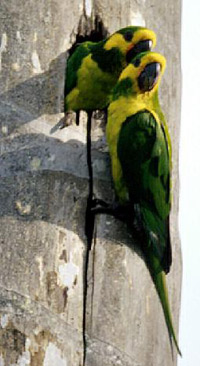
At the beginning of the XXth century this magnificent species with a long greenish-yellow tail was found in great herds in the High Colombian Andes and in the north of Ecuador. However, in 1980 the number of these birds experienced a sharp drop and by the beginning of the 90’s the big herds began to disappear at an alarming speed. In the middle of the 90’s this species disappeared mysteriously and only 50 surviving individuals were left.

As a response to the increasing gravity of the situation of this species, Niels Krabbe launched a preservation project in 1996 for the last remaining herd that at that time was found in Ecuador. The project was a very successful one and it managed to locate the herd in the northeast part of Ecuador. An action plan with many activities was carried out.

In October 1997 Doctor Paul Salaman observed a herd of 24 individuals in the central mountain range of Colombia. At the beginning of 1998 Salaman and Krabbe started the Ognorhynchus Project with the support of numerous organizations. This project was an emergency answer to study and to protect this species in Colombia. The fieldwork started in June 1998 with the aim of locating the species so as to be able to identify the threats and the strategy of preservation to follow in this case.

The team searched and used posters to focus in the geographical historic area were the species had been traditionally found: the central Andean mountain range. This search was done in collaboration with government environmental agencies and also with the local community asking the latter to report to the researchers whenever they saw any member of the species. It took more than 3500 hours of field work extended over the period of 11 months to find the remaining members of the species. The species had abandoned its historical area and its survival seemed threatened.

The search was about to be finalized when a Colombian reported the presence of the species in the countryside. The field researcher investigated this report that was coming from a distant valley in central Colombia. The afternoon of the 18th of April 1999 the researcher heard the weak but distinctive cry of the Yellow-eared parrots. There were two herds of Yellow-eared parrots flying towards the pasture, 61 individuals in total.

Two weeks after an additional herd was found in an adjacent valley. The three herds, 81 individuals in total, used to meet to socialize before resting at night. The following months, researchers collected an enormous amount of data regarding the Yellow-eared parrot ecology and natural history. There was radio transmitters put up to some individuals so that they would give extensive information regarding their location and routes over long periods of time.

Regarding the implementation of the project, there is an additional field study programmed, preservation efforts and environmental education addressed at the local communities. The project Ognorhynchus will benefit another threatened bird species such as the Golden-plumed Parakeet (Leptosittaca branickii), the Rufous-fronted Parakeet (Bolborhynchus ferruginefrons) and the Fuerte’s Parrot (Hapalopsittaca fuertesi). Researchers will also observe and collect data regarding these species while they study the Yellow-eared parrot (Ognorhynchus icterotis).

Categorías
Articles

Habitat

yellow-eared-parrot-duoColombia is a biologically rich and diverse country. There are 1889 bird species, 358 types of mammals and more than 45000 types of plants. However, the rich Andean ecosystem is in danger because of deforestation. During the last 150 years, 80% of the grassland areas have been devastated by intensive farming and cattle, consequently the survival of 80% of native Colombian bird species has been endangered. Today it only remains a 5% of the Yellow-eared Parrot (Ognorhynchus icterotis) habitat.

The Wax Palm (Ceroxylum quindiuense) is the nacional tree of Colombia and it is also endangered. The population of Wax Palms is aged and it is not being replaced by young individuals. Cattle feed on the grasslands, thus eating the Wax Palm seeds and preventing the tree species from reproducing at a natural speed. Permanent Wax tree deforestation and the fragmentation of the habitat are endangering the tree species survival. There is a critical and immediate need to preserve the Wax Palm.

Categorías
Articles

Conservation

Ognorhynchus_icterotis-RoncesvallesProAves is a purely conservationist NGO, which for more than 10 years has been implementing and developing tools and conservation activities, in order to mitigate the impact caused by the man on the habitats of endangered species.

The ProAves conservation area works to contribute to maintaining the quality and availability of habitat for conservation of priority bird species through the establishment and management of nature reserves in civil society and to develop other forms of protection supported by a concept of self-sustainability and community integration, influencing local, regional and national environmental protection.

Its objectives are:

  • To establish, expand and manage comprehensively the protected areas of the Foundation, ensuring compliance of the function in perpetuity.
  • To implement, evaluate and strengthen programs and tools for conservation in nature reserves and areas of influence.
  • To promote and develop self-sustaining actions to ensure the perpetuity of the reserves.
  • To participate in and influence the formulation, management and implementation of conservation policies.

We have thus managed to retain under our Natural Bird Reserves 30,503 hectares of various kinds of ecosystems, and restore and reforest 1,200 hectares and establish 3,600 hectares under figures of Payments for Environmental Services.


Related news


Inicio_ecoguas

A new generation of Eco-Guides in Colombia
Thursday 2 August 2012.

The 3rd Eco-guide Training Course was undertaken by professional guides from 13-21 June in the Las Tangaras Bird Reserve with rural community citizens and Reserve Rangers. A new generation of highly trained guides in birding and nature guiding will provide outstanding services.


Nota_Johanna_2

Biodiversity of Antioquia presented in Jardín
Friday 27 July 2012.

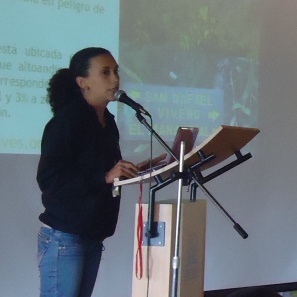
At the Regional Meeting “Southwestern Antioquia: the Biodiversity Jardín” with around 200 participants took place in May in Jardín, where ProAves presented “Bird Reserves: a strategy for the conservation of biodiversity in southwestern Antioquia”.


Grallaria

Conservation Success for three Endemic and Threatened Colombian Birds
Tuesday 3 July 2012.

The recent change in the threat category for three Colombian endemic bird species – now no longer in imminent danger of extinction – is in large part thanks to the conservation and research efforts of ProAves, particularly with its strategic network of 21 Bird Reserves across Colombia.


sloth_realease_el_pangan

Sloth rescue in Colombia’s threatened forest
Wednesday 14 December 2011.

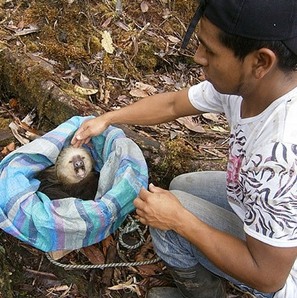
Generous donations to rangers help protect the forest home of the Two-toed sloth and a multitude of other threatened species.


Colombia reaffirmed as #1 nation for birds
Wednesday 19 October 2011.

ProAves published the 15th issue of its journal Conservación Colombiana, which includes five articles related to new bird records for Colombia plus the annual review of the national list of birds. To date, we confirm a total of 1,889 bird species occurring in Colombia to reaffirm that Colombia is the #1 nation of birds on earth.


Roncesvalles

Roncesvalles, pioneer town for the signing of Reciprocal Water Agreements
Thursday 29 September 2011.

In September, ProAves assisted two property owners in Roncesvalles, Tolima, to commit to preserving the majority of their land that is within the town’s watershed. As agreed, for at least ten years, the total of 3,200 acres will be saved and restored for natural habitat conservation.


inicioRonces

ProAves establishes Colombia’s first joint Municipality Environmental service agreement
Thursday 4 August 2011.

The Municipality Council of Roncesvalles approved ProAves Environmental Service Agreement to create the first joint program, funded by water users, to protect watersheds and endangered species.


Inicio_1

The wetlands of Bogotá – critical habitat for birds
Monday 1 August 2011.

At the invitation of the Association EcoVida, our collaborator Monica Parada gave a Talk: “The wetlands of Bogotá and Cundinamarca, an important habitat for waterfowl in Colombia”, in the Wetlands Course with the lakeside community of Santa Maria del Lago.


inicio-4

ProAves at the IUCN Regional Forum
Thursday 21 July 2011.

ProAves Executive Director, Lina Daza, attended the first South American Forum of Members of the International Union for Conservation of Nature (IUCN) in Lima, Peru, from 13-15 June.


Inicio-9

Fifth protected areas management course
Wednesday 29 June 2011.

The 5th meeting of protected area managers from 15 protected areas from across Colombia was held from 3-11 June, 2011 in El Paujil Bird Reserve thanks to NMBCA. Training included monitoring biodiversity, camera trapping, management planning, mapping and constructing platforms.


Heidy

ProAves presents to the GEF Council in Washington DC
Wednesday 15 June 2011.

ProAves presented its progress on establishing some of Colombia’s first environmental service agreements in Tolima to the Global Environment Facility (GEF) Council between 23 to 26 May 2011 in Washington DC.


gente

ProAves helps protect Paramo del Sol in Antioquia
Tuesday 4 January 2011.

To socialize the actions and strategies undertaken at local level aimed at the protection and management of the Páramo del Sol, on 9th December ProAves held a workshop on “Management, Conservation and Protected Areas of the Páramo del Sol”. ProAves is working to protect this highly vulnerable AZE site.


inicio-3

Life Distinction Award for Fundación ProAves
Monday 25 October 2010.

The Corporación Autónoma Regional CorAntioquia, celebrated its 15 years of work with a ceremony in which it acknowledged ProAves with a Life Distinction, the highest award given to organizations who have worked diligently and consistently for the preservation of natural resources in Antioquia.


inicio-29

Pride Campaign in Roncesvalles, Tolima
Monday 2 August 2010.

Under an agreement established with the Conservation Organization RARE and through Pride Campaign, ProAves is promoting actions aimed at the conservation of ecosystems that offer environmental goods and services to generate environmental awareness in communities.

Categorías
Articles

The Advisory Council

The Council of Directors is an external and independent of the Foundation and the Board of Directors, made up of individuals, conservationists – whose sole purpose is to serve as a watchdog of the actions and procedures carried out within each of the lines of work of the Foundation. Council members are:

Consejo2

  • Alex Cortes
  • Pablo Florez
  • Robert Giles
  • Ignacio Góngora
  • Sara Inés Lara
  • Juan Carlos Luna
  • Dr. Robert Ridgely
  • Juan Lázaro Toro
  • Dr. Juan Carlos Verhelst
  • Ana Celmira Gomez
  • Luis Alfonso Ortega