Fundación ProAves – por la conservación en el país de las aves

Categorías
News

ProAves and EcoTurs representing Colombia at the 2011 British Birdfair

Thursday 1 September 2011.

ProAves and EcoTurs are proud to announce that we again represented Colombia at the world’s largest international bird watching event! This is the 5th year that we have been at the Birdfair promoting the conservation work of ProAves and incredible birding opportunities EcoTurs offers in Colombia.

This is an excellent opportunity for us to directly reach a wide audience of birdwatchers and let them know how birding with EcoTurs directly supports the conservation of Colombia’s most imperiled species.

[slickr-flickr search=”sets” set=”72157627564263534″ items=”20″ type=”gallery”]

This year we featured the upgraded infrastructure at five of our flagship bird reserves, the Women for Conservation Project and our recently released Field Guide to the Birds of Colombia.

About 600 people visited the stand and the Women for Conservation Project more than doubled last year’s sales! We plan to continue our presence at the Birdfair next year to continue strengthening old contacts and making new ones.

A very special thanks to ProExport Colombia and everybody who helped make this event such a great success!

With support of:

Proexport ecoturs proaves
Categorías
News

Colombia reaffirmed as #1 nation for birds

Published edition Conservación Colombiana No. 15. The PDF is available here.

Fundación ProAves has publishes selected papers from the 15th volume of its scientific journal Conservación Colombiana, The print edition will be available on 31 October 2011. This edition includes no less than five scientific papers discussing records of new bird species for Colombia, plus its now annual paper on revisions to Checklist of the Birds of Colombia. Together, these publications document that a total of 1,889 bird species occur in Colombia.

The “Checklist of the birds of Colombia” has been annually maintained by ProAves since 2007 and with the same lead author since its first publication in 2001. The number of bird species recorded in Colombia has climbed from 1,869 species in 2007 to 1871 species in 2009, 1,879 in 2010, and now 1889 in October 2011. This increase is despite the removal of several species based on dubious old or unsupported records and taxonomic reviews resulting in the ‘lumping’ of various species during this period. The recent glut of newly recorded species for the country has resulted from greater birdwatching and ornithological activity in Colombia following the return of security to many regions, resulting in new records and findings relevant to taxonomy. It seems likely, at this rate, that Colombia will become the first country in the world to break through the 1,900 bird species barrier within the next two years. ProAves is announcing a prize for the person that confirms the 1,900th bird species for Colombia!

Colombia officially remains the most diverse country for birds on the planet, with second and third placed countries Peru and Brazil considered to hold 1,834 and 1,785 bird species each, respectively.

The checklist revision paper in Conservación Colombiana provides a comprehensive peer-reviewed update on the birdlife of Colombia. Five new species recorded in Colombia include the Yellow-bellied Sapsucker (Sphyrapicus varius) and Scissor-tailed Flycatcher (Tyrannus forficatus) – both new records for South America of nearctic migrants, while Rufous-breasted Wood-Quail (Odontophorus speciosus), White-bellied Parrot (Pionites leucogaster) and Masked Water-tyrant Fluvicola nengeta are new confirmed records for Colombia of species previously known to occur in northern Ecuador. A review of the Thrush-like Manakins or Schiffornis is presented, which concludes that at least five species should be recognised in this group, three of which occur in Colombia. Other new records and splits published in the literature are also discussed.

The 15th volume of Conservación Colombiana also contains a paper on the rediscovery of the Santa Marta Tree-Rat or Toro (Santamartamys rufodorsalis) after 113 years in ProAves’ El Dorado Nature Reserve, following-up on the news flash of the rediscovery in May 2011. A study of the population of Brown-throated Parakeet (Aratinga pertinax) on San Andrés island concludes that subspecies aeruginosa of northern Colombia has been introduced to the Caribbean region for the first time.

Fundación ProAves has also published detailed information on the conservation status of 16 bird species found in Colombia based on research by its staff and researchers mostly in the ProAves reserve network. This data was previously presented to BirdLife International and the IUCN for purposes of their threatened species status review process in 2010-2011. ProAves recommended upgrading the status of two endemics of Sierra Nevada de Santa Marta (Black-backed Thornbill Ramphomicron dorsale [LC] and Santa Marta Wren Troglodytes monticola [VU]) whose precarious status had previously been overlooked. Critically Endangered status was recommended for two species largely only known from ProAves’ Colibri del Sol Bird Reserve in western Antioquia Dept (Fenwick’s Antpitta Grallaria fenwickorum and Paramillo Tapaculo Scytalopus canus). Recently, IUCN red list coordinator for birds, BirdLife International, concurred with the majority of our assessments and upgraded both the Santa Marta Wren and Fenwick’s Antpitta to Critically Endangered redlist status and Paramillo Tapaculo and Black-backed Thornbill to Endangered status – all of which were either major changes or new for the IUCN redlist. Sadly, there are now 95 Globally Threatened bird species occurring in Colombia (up from 78 in 2001) and 63 Near-threatened species (up from 43 in 2001).

If you would like to contribute data for the checklist for next year’s review or have other new records on Colombian birds, please email  fundacion@proaves.org

You can buy the 2010 checklist online here . An updated Excel version of the checklist will also shortly be available online for researchers and birders.

Conservación Colombiana is published with the support of:

lpf abc iucn
proaves worldlandtrust
Categorías
News

Tragic demise of the Magdalena Spider Monkey

The Magdalena Spider Monkey is about to disappear!

Make a donation and help save it! We need YOUR support to stop deforestation in the Magdalena valley and educate local people to stop killing mothers with infants. There is so much to be done and so little time remaining.

Tragically, the wonderful Spider monkey is targeted by hunters, who frequently shoot and kill mothers with infants. The infants cling in desperation and shock to their dead mothers as they fall from the canopy and lie on the ground… the hunters then walk over and grab the helpless infants from their dead or dieing mothers. Infant Magdalena Spider monkeys are sold as pets for around US$50.

“True benevolence or compassion, extends through all existence and understands the suffering of any creature capable of feeling.” Joseph Addison. At the bottom, you can find where your donation goes, and how it supports this wonderful cause.

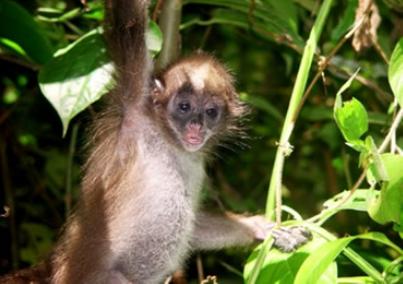
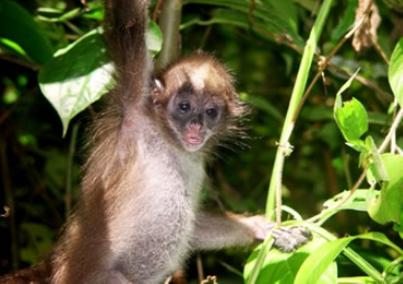
The Magdalena Spider Monkey (Ateles hybridus), one of the largest primates in the America’s, needs your help. It has lost 98% of its habitat and considered the primate at great risk of extinction in the America’s. Its sole secure protected area in Colombia is ProAves’ 7,000 acre El Paujil Bird Reserve in Boyaca and Santander departments.

Mono_araa

Locally known as “Choibo” or “Mono Araña”, the Magdalena Spider Monkey is Critically Endangered and endemic to Colombia and western Venezuela. It lives in the tropical forests of the Magdalena Valley, where the species has lost 98% of its habitat due to deforestation and habitat fragmentation, while facing daily threats from hunting that endanger their survival. Their vulnerability is further exposed due to the low density of its population and slow reproduction (8 month pregnancy and one young every 3 years).

The project and the people.

One of the most important aspects of our project is to involve local people. It is critical that we involve and train local people as they hold a major key to finding the solution and saving the spider monkey. Developing community outreach, education, participation and training is vital. We also hope to form leaders in the field of biology and conservation, by supported Colombian students to participate in this project.

Gente

Where does my donation go?

We urgently need support to train and educate poor rural communities whose actions directly impact on the Spider Monkey around the El Paujil Bird Reserve and across the Magdalena valley. Our dedicated team of conservationists urgent needs funds for education materials and local transport costs. Through environmental outreach materials, workshops and alternative income opportunities we can make a real impact at helping save this special species for their future, and for our future.

With your help, you will make a real difference to saving the Magdalena Spider Monkey.

To make your donation click aquí

For more information contact Nate Skinner, Director of Development.

E-mail: nskinner@proaves.org

{youtube}bM4AZFQa1pg|425|344|1{/youtube}

The Magdalena Spider Monkey Ateles hybridus in his natural habitat – El Paujil Bird Reserve.

Categorías
News

ProAves accepted as new IUCN member

Friday 5 December 2008.

ProAves is pleased to announce that it has been admitted as a formal member of IUCN – the International Union for Conservation of Nature following approval during the 70th meeting of the IUCN Council, and announced at the World Conservation Congress, held October 5-14 in Barcelona, Spain.

ProAves is proud to join IUCN, the world’s oldest and largest environmental network and comprises more than 1,000 government and non-governmental organisations and more than 11,000 volunteers in over 160 countries.

IUCN helps find practical solutions to our most pressing environmental and development challenges. It supports scientific research, manages field projects around the world and helps governments, NGOs, UN agencies, companies and local communities developing and implementing policies, laws and best practices.

It is a leading global authority on environmental issues and sustainable development; as such, it produces the Red List of Endangered Species, which is a major focus of the work ProAves undertakes. IUCN is governed by a board elected every four years by its member organizations during the World Conservation Congress of IUCN and is based in Gland, Switzerland.

Categorías
News

ProAves Council assists 5-year planning

Monday 16 February 2009.

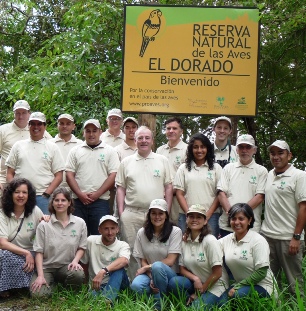
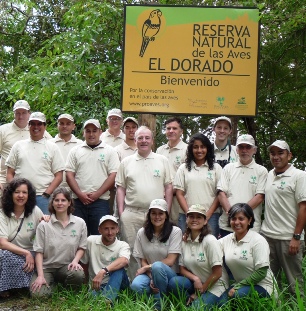
On January 3-7, 2009, the ProAves Council met with senior ProAves staff in Reserva Natural de las Aves El Dorado,  to plan the future five years of the Foundation with a five year strategic plan, 2009-2013. The draft plan was designed in a previous meeting of ProAves staff and refined over the three day meeting.

The ProAves Advisory Council is composed of 15 members with diverse experience and from various organizations and companies, and is elected by ProAves assemble members. Council members present included Robert Giles (President of the Council), Juan Lázaro Toro, Dr Nigel Collar, Ignacio Góngora, Dr Paul Salaman, Fabio Arjona, Thomas Donegan, Rita Fenwick, and Byron Swift (on behalf of Dr Robert Ridgely).

The meeting consisted in an overview of ProAves by staff directors of the organizational, conservation, research, environmental education and communications areas, and discussed the vision and priorities for ProAves. Sessions continued with a two-day review of the 5-year ProAves strategy plan.

Evening presentations included themes of finance, funding and opportunities by the Executive Director, Sara Inés Lara and a presentation about ecotourism by EcoTurs. Council members also met to define its future directions and establish its rules and regulations.

This planning is extremely important as ProAves completes ten year of conservation and looks ahead to another decade. The immediate future will be critical for conservation as Colombia’s rapidly changing social and economic situation may accelerate the loss of the most important remnants of natural habitat in the Andes and Chocó regions. However, we were humbled looking back at the past five year plan (2003-2008) as our conservation achievements exceeded our greatest expectations.

ProAves staff in the meeting included Sara Inés Lara (Executive Director), Alonso Quevedo (Development Director), David Caro (Operations Director), Heidy Valle (Conservation Director), Andrés Páez (Investigation Director), Luz Dary Barrera (Environmental Education Director), and Diana Balcázar (Communications Director), and Christian Olaciregui (Caribbean Director).

The meeting in the El Dorado reserve was followed by a tour to some ProAves reserves by Council members.

NMBCA usfish abc
Categorías
News

Miniature, the art of Nature in miniature

Friday 31 July 2009.

As part of the Colombian Independence celebration, ProAves and artists Fernando Laverde and Paula Andrea Romero, with the support of the Special Administrative Unit for Natural National Parks in Colombia, are organizing the exposition ‘Miniature, the art of Nature in miniature’ at the Centro Andino, Bogota, open until August 6 2009.

These images are part of the exposition and will also be put up on sale:

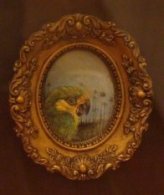
Yellow-eared parrot Miniature (Ognorhynchus icterotis)

American Kestrel (Falco sparverius), Black Backed Grosbeak) (Pheucticus aureoventris), Rufous-collared Sparrow (Zonotrichia capensis) and Green wing Macaw (Ara chloroptera).

The exposition presents 62 painting miniatures portraying Colombian animals (mainly birds), plants and landscapes. The main piece is a painting of the Yellow-eared parrot (Ognorhyncus icterotis), ProAves’ emblem. 30% of the funds recovered from the sales will be donated to ProAves, and are destined to support conservation in Colombia,

For more information, please visit:

http://fernandolaverdebypaularomeroa.blogspot.com/

Categorías
News

Invitation to “NATURE”: paintings of nature for conservation

Wednesday 28 October 2009.

You are cordially invited to the “Natura” exhibition to appreciate the beauty of Colombian fauna and flora, created in small and large format paintings. 30% of the sales from this exposition will be donated to ProAves for conservation projects for the bird life of Colombia.

The inauguration will be on Thursday 29th October at 7:30 pm and the exhibition will last until the 4th December 2009.

Please come and visit at: Centro Cultural Skandia Av. 19 # 109 A – 30 For more information call: 3123456747 – 3114554571

 http://fernandolaverdebypaularomeroa.blogspot.com/


Categorías
News

New Colombian stamps promote Endangered birds

Thursday 8 April 2010.

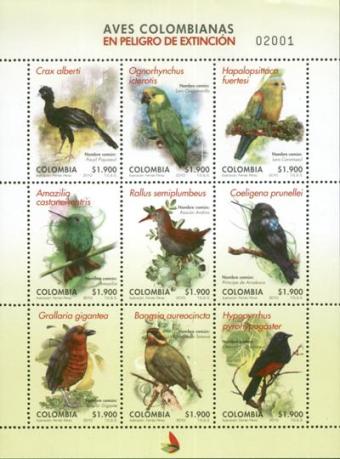
288,000 stamps with the official value of $ 1,900 pesos (US$1) each will start circulation in Colombia and the world.

Nine of the most beautiful images that highlight Endangered species will be posted throughout Colombia and the world to raise environmental awareness and promote respect for birds. With the stamp issue “Endangered Colombian Birds” the Ministry of Information Technologies and Communications and the official postal operator, 4-72, seek to draw attention to the conservation of Colombian birds and our natural heritage.

Philatelic sheet of this issue

It is worth noting that although the issue described nine species of birds, four of them are Critical Endangered with extinction, while more than 100 species of birds in Colombia are in imminent danger. These species demand emergency measures for the conservation and preservation of their ecosystems.

Fundación ProAves has worked for 10 years for the protection of birds in Colombia, with our projects directly protecting 57% of listed species at risk in the 18 Nature Bird Reserves established in Colombia.

Among the most important projects by ProAves, whose species are found in this stamp issue, we have the Yellow-eared Parrot, the Blue-billed Curassow and Fuertes’ Parrot, among others; with these projects having major outreach both nationally and internationally. ProAves is working hard on implementing strategies and action plans that promote the conservation of species and their habitat.

288,000 stamps were printed in size 30 x 40 mm, which will have an official value of $ 1,900 pesos (US$1) each for the postage on mail pieces, letters and parcels nationally and internationally.

Categorías
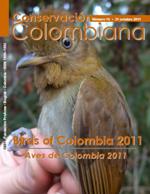
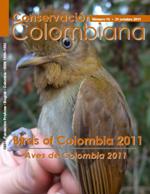
Colombian Conservation Journal News

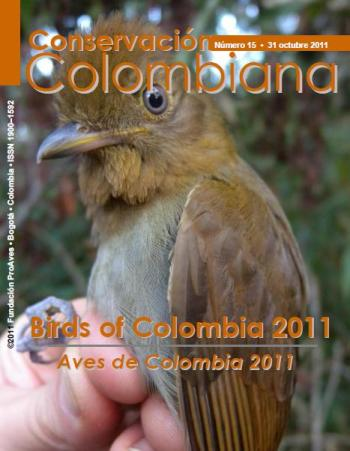
Nº 15 Aves de Colombia 2011

Portada_Conservacin_15

Fundación ProAves has publishes selected papers from the 15th volume of its scientific journal Conservación Colombiana, The print edition will be available on 31 October 2011. This edition includes no less than five scientific papers discussing records of new bird species for Colombia, plus its now annual paper on revisions to Checklist of the Birds of Colombia. Together, these publications document that a total of 1,889 bird species occur in Colombia.

Content:

Revision of the status of bird species occurring or reported in Colombia 2011. Conservación Colombiana 15: 4-21. Download here.

First confirmed records of Yellow-bellied Sapsucker (Sphyrapicus varius) in Colombia and South America. Conservación Colombiana 15: 29-30. Download here.

First records of Rufous-breasted Wood-Quail (Odontophorus speciosus) for Colombia. Conservación Colombiana 15: 31-33. Download here.

First records of White-bellied Parrot (Pionites leucogaster) for Colombia. Conservación Colombiana 15: 34. Download here.

The subspecies of Brown-throated Parakeet (Aratinga pertinax) on San Andres island. Conservación Colombiana 15: 35-37. Download here.

First records of the Masked Water-tyrant (Fluvicola nengeta) for Colombia. Conservación Colombiana 15: 38-39. Download here.

Rediscovery of the Santa Marta Toro (Santamartamys rufodorsalis) (Rodentia: Echimyiadae), after 113 years, with notes on all three known records and the species’ conservation needs in the Sierra Nevada de Santa Marta. Download here.

First published record of Scissor-tailed Flycatcher (Tyrannus forficatus) for Colombia and South America. Download here.

The nomenclatural availability of and priority between two recently described names for the same new antpitta species from Colombia. Conservación Colombiana 15: 45-55 Download here.

Other articles available in the print edition only.

Categorías
News

EcoTurs and ProAves were present in III Colombia Show

On 28th September in the framework of this event, Angela Gomez, Manager of EcoTurs, explained everything about the joint work carried out by EcoTurs and ProAves to promote ecotourism in Colombia. One of the key points of the exposition was to instill in participants the importance of ecotourism for the protection of the environment, besides which it is an essential alternative for conservation in perpetuity of the Bird Reserves of the Fundación.

It’s worth noting the importance of participating in this event since it is one of the most important of the Colombian tourist sector, where the country has a space to show their diversity and offer as a region. ProAves and EcoTurs had their stand in the Caribbean region as it promoted the El Dorado Bird Reserve located in the Sierra Nevada de Santa Marta, being one of the most fragile and important sites in Colombia where a large number of animal species and unique plant exist.

[slickr-flickr search=”sets” set=”72157627787879202″ items=”20″ type=”gallery”]

For the third consecutive year the Colombian Show of ANATO showed the strength of domestic destinations, and thanks to this, EcoTurs and ProAves with their information and promotional material, spread among visitors the privilege to visit 7 of 18 Natural Reserves ProAves has for ecotourism.

This great event will continue its journey through the country on October 5th in Medellin, ending in Cali on October 12th.

With the support of:

ecoturs

Categorías
News

Launch of the Spanish “Guide to the Birds of Colombia”

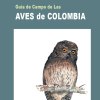
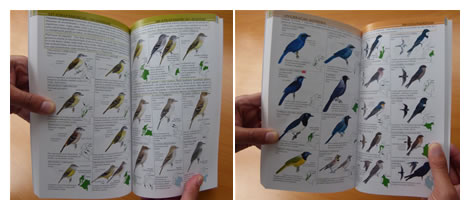
This past 11th of October, the successful launch of the Field Guide to the Birds of Colombia in Spanish took place in Bogotá. The new book contains illustrations all 1889 species found in Colombia, including 20 new illustrations of recently described birds not included in the previous English version. The book contains 200 distribution maps, high-quality paper, and new text describing key points for field identifications.

ProAves published the field guide to the birds of Colombia in Spanish with all 1889 species illustrated, in the hope that it will inspire a new generation of Colombians interested in studying and protecting their birds.

Coinciding with the International Month of Birds and after the success of the highly acclaimed Field Guide to the Birds of Colombia in English in 2010, ProAves is proud to publish the new Field Guide to the Birds of Colombia in Spanish.

The objective of this book is to promote an interest in birds and their conservation to all Colombians.

You can buy the book online here.

[slickr-flickr search=”sets” set=”72157627703103821″ items=”20″ type=”gallery”]

This is the first Spanish language field guide that illustrates all 1,889 Colombian bird species, plus is practical to use being “pocket” sized. The Field Guide to the Birds of Colombia is the collaboration between the bird illustrator Miles McMullan, Alonso Quevedo and Thomas M. Donegan, based on bird research conducted by the authors throughout Colombia. It contains illustrations of 20 new species not included in the 2010 English guide, plus more than 200 updated distribution maps, and many new notes on plumage and voice highlighting the key features for identifying birds in the field.

The field guide is just $50.000 pesos (US$29.95) with a 10% discount for ProAves members, plus a further 10% discount when acquired at the ProAves office in Bogotá (Cra 20 #36-61).

All profits from the sale of this publication will be donated to ProAves, so those who buy the book directly contribute to research, conservation and education in Colombia!

Categorías
News

Conservation, tradition, culture and environmental awareness Threatened Parrots and Migratory Birds Festival.

For 2013, we celebrate the Ninth Fuertes’s Parrot Festival, the Eighth Yellow-eared Parrot Festival, the very first Festival of the Santa Marta Parakeet and the Tenth Migratory Birds Festival in the cities of Genova, Quindio; Roncesvalles, Tolima; Jardín, Antioquia; Minca, Magdalena and San Vicente de Chucurí, Santander.

Categorías
News

Launch Field Guide to the Birds of Colombia in Spanish

This is the first Field Guide to Birds of Colombia in Spanish with illustrations of all species of birds of Colombia. It is practical to use and is the only guide “pocket” for bird world’s richest country. The book includes updated distribution maps, notes on plumage and voice, and a concise format that is based on modern taxonomy.

The Field Guide to the Birds of Colombia is the result of collaboration between the illustrator of birds and Miles McMullan and the Fundacion ProAves, based on research conducted by the authors on birds throughout the country. Contains illustrations of 20 new species not included in the previous version, upgrading of more than 200 distribution maps, several sheets improved, new texts, field notes and memos about the status of threatened and endemic species, highlighting the most important for identification in the field. The body of the publication consists of 226 pages and its size is only 12.5 x 22 cm.

InternasEspaol

This book is the first field guide to birds of Colombia’s main objective is the promotion of birding not only within the academic community but for all Colombians. The book will be available only for an initial period and, at the headquarters Fundacion ProAves in Bogota, but then will be sold by other means and organizations. Thus, the publication of the Field Guide is a great moment for Colombia and a big step to promote interest in the birds of our country and thus help preserve them.

We are confident that this book will inspire a new generation of Colombians interested in studying and protecting their birds.

All proceeds from the sale of this publication will be donated to ProAves, so those who buy the book will contribute directly to research, conservation and environmental education in Colombia!

The launch of the Field Guide to Birds in Spanish, will be held on October 11 at the headquarters of the Fundacion ProAves (Cra.20 No. 36-61) at 5:00 p.m.

Authors: Miles McMullan; Alonso Quevedo & Thomas Donegan

ISBN: 978-0982761526

Size: 12.5 x 21 cm.

Pages: 226

Price: $ 50,000 (US$29.95)

Categorías
News

Monitoring wildlife with camera traps

The camera traps have become an important tool since their development in early 1980s to monitor cryptic species with low densities which are naturally difficult to observe. In addition, this technique allows us to cover a wide range of environments that other methodologies do not permit.

Camera traps serve multiple purposes such as identifying individual species to the assessment of population size and information about various aspects of a species ecology and behavior. The use of camera traps is one of the most important and versatile methodologies for conservation biology and wildlife studies.

With this tool you can identify and confirm the presence of species that are difficult to recognize by their tracks or other evidence and allow for studies of behavior, activity patterns, population estimates, among others.

[slickr-flickr search=”sets” set=”72157627196550944″ items=”20″ type=”gallery”]

The uses of camera traps are:

• To record medium and large animals which are naturally shy and difficult to observe, to estimate the number of individuals within an area using the photo capture-recapture of individuals and It is also useful to determine patterns of temporal and spatial movement.

• Photos with time/date to measure days or blocks of days as sampling events.

• Presence of species difficult to observe via nocturnal and elusive behavior.

• Allow to evaluate the quality of the ecosystem with the identification of certain apex species.

• Habitat preference data, forming groups, identification of land, identification of individuals.

• Surveillance of the roads and trails located within the Reserves.

ProAves has been implementing this tool in studies to monitor populations of Ateles hybridus and Crax alberti and to verify the presence of other species of mammals and birds in protected areas located in some of the most threatened ecosystems in our country.

Likewise, camera traps have allowed us to monitor the reserves to combat illegal hunting.

Thanks to the implementation of this methodology, we have obtained records of at least 40 different species of rare birds and mammals, many of which are endemic and of special interest for conservation efforts.

Fundación ProAves hopes to continue using this method in studies of biological diversity, abundance and population monitoring, all of which are relevant to the conservation and protection efforts for several species of fauna and flora within Colombia.

lpf abc ecoturs Nature
Categorías
News

Roncesvalles, pioneer town for the signing of Reciprocal Water Agreements

Developed with RARE, the project “Pride campaign for El Espinal and Roncesvalles” established Reciprocal Water Agreements as a tool for protection and conservation of watersheds and endangered species in the municipality. On September 13th the signing of the two agreements took place with the goal of incentivizing local farmers to preserve natural habitats and forests thus ensuring abundant and safe water resources for future generations.

FOTOS_edit

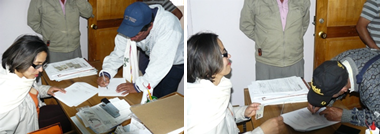
Signing of Reciprocal Water Agreements. From left to right: Aleyda Oviedo (Secretary of the Court), Antonio Rivas (Committee Chairman), Alexander Bermúdez (Committee Secretary), Leidy Alarcón (outreach specialist) and Yesid Ocampo (property owner of Las Brisas.

The signing ceremony was held at the Municipal Court and was attended by Juan Antonio Rivas, the Chairman of the Committee for the protection and conservation of watersheds and endangered species, Secretary Alexander Bermúdez, ProAves local education coordinator Leidy Alarcon, Gonzalo Cardona, the committee member representing ProAves, Hernan Ocampo and Eduardo Ocampo, both local property owners.

Mr. Eduardo Ocampo (left), owner of the “Amberés” property located in the Cucuanita village, committed to conserve 2,718 acres hectares out of his 2,965 acres; and Mr. Hernán Ocampo (right) owner of the “Las Brisas” property contributed to the conservation 481 acres out of 583 acres of his property. Thus, property owners committed to preserving remnants of forest and paramo in exchange for incentives for their farms, not only benefit the property owners, but also the municipalities of Roncesvalles and El Espinal via the securing of water from the Cucuana river and its tributaries. The El Espinal community is dependent upon the Cucuana river for growing rice; and this new agreements promotes conservation of biodiversity and enhances the quality of life among its inhabitants.

It is a considerable effort to protect and conserve the environment, and the strong commitment and interest of property owners, along with the hard work of environmentalists, communities and ProAves supported by Foundación Loro Parque over 13 years, have contributed immensely to the success of the “Pride Roncesvalles” campaign. The implementation of Reciprocal Water Agreements, and the active participation of stakeholders involved in this process have contributed to the success of this new initiative: Antonio Rivas (City Council representative and chairman of the Committee), Alexander Bermúdez (Rep. of downstream users and secretary of the Committee), Norberto Rodríguez (rep of Water Company ESPRON), Maria del Rosario Peña (Mayor’s rep) and Gonzalo Cardona (rep. of environmental NGO).

At the conclusion of this historic event, the committee chairman invited the property owners and integral people to the “Signing of the Reciprocal Water Agreements as a means to promote pride and commitment to our natural resources” and said that these two agreements are just the beginning.

Thanks to the commitment each of these actors have shown, today Reciprocal Water Agreements are a reality in Roncesvalles, a pioneer town in the department of Tolima which has established long-term effective tools to encourage the protection and conservation of their natural resources.

Supported by:


Usocoello

roncesvalles

Roncesvalles (Tolima)

logo_campaa_del_orgullo_FINAL
rare lpf


Categorías
News

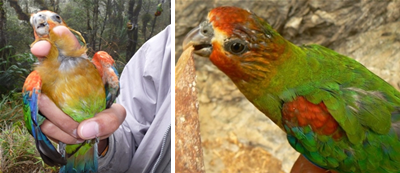
First telemetry study of the Rusty-faced Parrot

During the first telemetry study conducted in the Natural Bird Reserve Colibrí del Sol, with the discovery of the Rusty-faced Parrot (Hapalopsittaca amazonina) population in the Cordillera Occidental, the journey of two individuals: Inty and Chia, were tracked recording their locations to identify possible changes in their movements and the use that this species makes of the habitat, in this case the Colibrí del Sol Reserve.

We found that the H. amazonina group studied uses an area of 2686 acres which comprises three major habitat types: the first is a primary forest where they are assumed to have carried out fruit consumption activities. The second is an oak forest, in which it seems they develop eating and perching activities, and sites mainly used for roosting. And finally the moorland, less frequently visited but where they did salt consumption and grooming activities.

Rusty-faced Parrot (Hapalopsittaca amazonina).

Also it was determined that the group of these individuals broke up into small and medium-sized subgroups during their daily activities inhabiting other parts of the sector where the reserve is located.

Through this study data were obtained on habitat selection by the Rusty-faced Parrot population in the Cordillera Occidental, their movements and how they form their groups to perform daily activities, likewise, the importance of conservation of this area has been confirmed through the establishment of Colibrí del Sol Bird Reserve along with the Páramo de Frontino are part of the habitat for this species in this area of the country.

This research was conducted with support from:

zgap SPS
Categorías
News

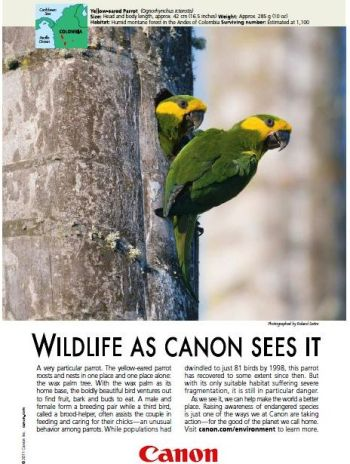
The Yellow-eared parrot in National Geographic

The article was published thanks to information provided by the ProAves and the accompaniment we provided to renowned nature photographer Roland Seitre during his tour of the ProAves Reserve Loros Andinos.

Article on the Yellow-eared Parrot published by National Geographic.

Roland Seitre’s photographs during his tour of the Fundación ProAves reserves:

[slickr-flickr search=”sets” set=”72157624100417717″ items=”20″ type=”gallery”]

In 1998, ProAves, with the support of the Fundación Loro Parque and American Bird Conservancy , initiated the Yellow-eared Parrot Project with the main objective of ensuring the survival of the species and habitat protection in the Colombian Andes.

Almost twelve years later, its population has grown from 81 individuals to over 1000; which is why the International Union for Conservation of Nature IUCN, in 2010, dropped its threat category from Critically Endangered to Endangered.

ProAves has developed several initiatives to save the Yellow-eared Parrot, in 2009 it established the Andean Parrot Bird Reserve; in order to protect the Yellow-eared Parrot, the strategic acquisition of over 4,000 ha of critical habitat and significant efforts in reforestation was added in the department of Tolima.

The artificial nests program is one of the more effective conservation tools, this program was created and implemented in 2003 and since then has provided new nesting sites that reflect, directly, the increase in population.

{youtube}e1a4WuxvIRU|425|344|1{/youtube}

Video: Yellow-eared Parrot Project.

Another important effort is the preservation of the Wax Palm, Colombia’s national tree, which is also endangered because the Palm is the unique habitat of the Yellow-eared Parrot, the campaign Reconcile with Nature was institutionalized, which, with the support of the Catholic Church has been able to discourage, in large proportion, the use of the Wax Palm in celebrations of Palm Sunday.

The effort of conservation of the Yellow-eared parrot advances day by day thanks to the support of local authorities and the commitment of rural communities and environmental education projects.

With the support of:

lpf abc
Categorías
News

Amparo Crafts has received a Fair Trade certificate in the UK

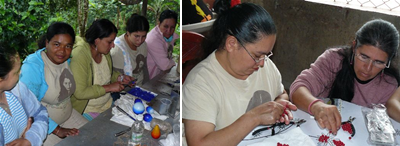
Amparo Crafts, marketing the product page of Women for Conservation, has received a BAFTS (British Association of Fair Trade Shops) certificate, this certification tells our customers that the way we do business primarily benefits artisans, and the work of Women for Conservation adheres completely or is working towards full compliance with the 10 regulations WFTO (World Fair Trade Organization), these include: fair payment for the hand made products, contribute to the conservation of the environment, not to employ children in the making of products, having a good democratic relationship with the artisans where women’s work is properly valued and rewarded, among others.

Members of the program making jewelry.

Fair trade is based on cooperation between producers and consumers. The producers have fairer and more profitable commercial terms, this allows them to improve their living conditions and make future plans. For consumers, fair trade is an effective way to reduce poverty through their everyday purchases, source (Fairtrade International).

In this sense, the ProAves project, Women for Conservation, through Amparo Crafts, has trained women in four rural populations of Colombia in the use of natural resources for making crafts, and offers them business opportunities to help relieve pressure on natural resources in protected reserves.

With the support of:

BAFTS abc
Categorías
News

The wetlands of Bogotá – habitat for birds of Colombia

The activity was held on May 28th in the community room of St. Mary of the Lake, district of Bogotá, thanks to the Association EcoVida course developed for the community, with the attendance of 40 people interested in learning about the importance of conserving wetlands and wildlife associated with these ecosystems.

Attendees at the presentation.

The presentation was based on the characteristics of a wetland and its importance, on the other hand the most representative species of wetlands in Bogotá and Cundinamarca were selected, classifying them in local species, endemic species (endangered) and migratory species, she also spoke about the bird species associated with wetlands that have not had any new records and finally she explained the 4 important aspects to help shape an environmental group in a community: 1) Conservation and Recovery, 2) Environmental education and Recovery, 3) Planning and Environmental Management and 4) Environmental Management.

ProAves is grateful to Mr. Juan Jose Senior from the Association EcoVida for the invitation to the Wetlands Course and also the participation and support of the Foundation Natural Planet.

With the support of:

Natural_Planet EcoVida
Categorías
News

Recreational holiday in Génova, Quindío

The meeting provided a forum for good clean fun creating identity and consciousness for the conservation of natural resources. As part of the holiday different recreational activities were carried out to publicize the threat categories of Rusty-faced Parrot (Hapalopsittaca amazonina), which, according to the IUCN (International Union for Conservation of Nature) is Endangered (EN).

These activities created in the children and young people of the town, a sense of belonging and regional identity around the recognition of this endangered species and the specific characteristics of its ecosystem.

During the activities environmental workshops were also held with chicks from the Hogar Infantil La Isla, a radio program with Friends of the Birds girls and the Youth Social Service involving an average of 98 children per day.

With the support of:

proaves genova
Génova (Quindío)
Categorías
News

ProAves at the Regional Forum of IUCN members

The first South American Forum of Members developed a three-day agenda of work, a methodology that sought to combine presentations by keynote sessions and group work techniques to provide feedback and prepare proposals, focusing on the following themes:

1. Update technical issues related to conservation and management of nature through parallel sessions with the invitation of specialists and experts.

2. Review and input to the initiative of One Program and the Global Program.

3. Review of progress of the 2009-2012 regional program and steps for a new regional program.

4. Preparation of recommendations and actions to be considered on the thematic lines with the collection of contributions and observations to the proposed 2013-2016 and review of the responsibilities and scope of the constituents. Establishment of a drafting group of the regional program.

5. Review of key governance issues on the agenda of the Council of IUCN.

6. Getting to know the World Nature Conservation Congress and mechanisms for participation of members.

7. Process of filing motions.

8. Information on the definition of candidates for Directors and formation of a monitoring group for the election process after the Forum.

For more information go to:Foro de miembros UICN 2011.

Colombian participants:

From left to right: Lina Daza, ProAves, Brigitte L.G. Baptiste, Institute Alexander von Humboldt, Sonia Peña Moreno, IUCN Switzerland, Andres Guhl, Quinaxi; Joao De Queiroz, South office IUCN, Julia Miranda Parques Naturales Nacionales and Elizabeth Taylor, CORALINA Corporation .

“Participation in this event was very important for strengthening relationships with leading conservation organizations in South America, likewise, the policies that frame the operation of the IUCN were made known, the situation and needs at regional level were identified and information was collected on the World Nature Conservation Congress, at which stage the participation of ProAves of Colombia in 2012 is essential.” said Lina Daza, Executive Director of ProAves.

Elizabeth Taylor, CORALINA Corporation; Lina Daza, ProAves; Inseob Lee, Director of the IUCN World Congress in Jeyu.

Baptiste LG Brigitte, Alexander von Humboldt Institute; Bernardo Ortiz, Traffic South America; Lina Daza, ProAves.

iucn
Categorías
News

Recreational holiday in Génova, Quindío

The meeting provided a forum for good clean fun creating identity and consciousness for the conservation of natural resources. As part of the holiday different recreational activities were carried out to publicize the threat categories of Rusty-faced Parrot (Hapalopsittaca amazonina), which, according to the IUCN (International Union for Conservation of Nature) is Endangered (EN).

These activities created in the children and young people of the town, a sense of belonging and regional identity around the recognition of this endangered species and the specific characteristics of its ecosystem.

During the activities environmental workshops were also held with chicks from the Hogar Infantil La Isla, a radio program with Friends of the Birds girls and the Youth Social Service involving an average of 98 children per day.

With the support of:

proaves genova
Génova (Quindío)
Categorías
News

Protection of watersheds and endangered species

The draft agreement for the creation of the protection and conservation of watersheds and endangered species is formulated by the Municipal Government of Roncesvalles, the public utility services of Roncesvalles (ESPRON) and ProAves under the project of the Pride Campaign and Reciprocal Water Agreements and funded by RARE Conservation.

This is the first municipal agreement in Roncesvalles that has been created for the conservation of watersheds and micro watersheds that supply the town and several villages. Through this agreement, the benefit of users are thought about as well as flat areas of the department’s plan, as is the case of El Espinal, direct beneficiaries of water services from the Cucuana River to irrigate rice, cotton and sorghum the which are the productive base of the town.

With the creation of this agreement, the municipality now has a committee and a water fund which will support the establishment of Reciprocal Water Agreements (ARBs), or any other agreement or maintenance contract involving the owners of the forests and moors of the municipality.

Pictured: Edwin Guayara, Mayor of Roncesvalles (Tolima), members of City Council and the ProAves team.

Similarly, it was possible to create a voluntary fee which will be charged on the water bill from July, in order to link users with a contribution to the protection of these areas. The municipality also joined to contribute to the fund and so a group of actors have decided to support its establishment which will be conducted by a committee integrated by the community of Roncesvalles, which will allow long-term incentives for landowners to preserve the moors, forests and endangered species found in the area which, for our case, is the Yellow-eared Parrot.

Coming soon will be a committee which will administer the donated resources and sign contracts with the owners, defining and approving the incentives which will be given, thus, the first signatories of the Reciprocal Water Agreements (ARBs) will be available for early August this year. We thank all the people and institutions who have joined actively in the conservation of natural resources and environmental services.

With the support of:

Base

roncesvalles

Roncesvalles (Tolima)

logo_campaa_del_orgullo_FINAL Rare_Spanish_Blue
Categorías
News

Fifth meeting of protected areas

The meeting also had the presence of regional deputies of the different protected areas, also of the Executive Director Lina Daza and the General Director of ProAves Alonso Quevedo and representatives of the administration and EcoTurs.

Lina

Executive Director Lina Daza & ProAves reserves’ rangers.

This event was the perfect platform for the exchange of experiences among the various rangers of the Foundation reserves and from the conservation, administrative and directive areas. In this regard, Lina Daza, ProAves Executive Director stated: “It is gratifying to realize such courses which provided training in different subjects for the workers of the Foundation, all of which bearing in mind that the rangers and other team members are the mainstay of conservation guidelines and processes developed by ProAves”.

The opportunity served the rangers to receive training in different fields associated with the management of protected areas such as demarcation of boundaries, building cairns, outdoor signage, management of camera traps, GPS management, legalization and implementation of budgets, reforestation and management of drinking fountains and feeding troughs for wildlife, building and guidance of bird watching.

[slickr-flickr search=”sets” set=”72157626832194751″ items=”20″ type=”gallery”]

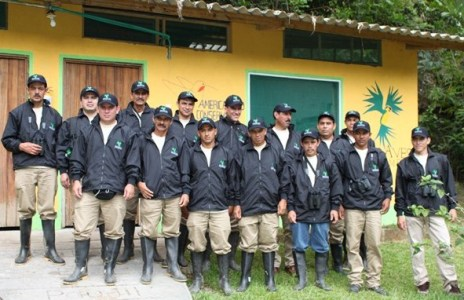
ProAves also gave the Rangers waterproof jackets, denim trousers, shirts, hats, raincoats and boots. Similarly, the reserve deputies were endowed with a waterproof jacket, hat, shirt and boots.

Articulo_4

Endowment to the Rangers provided by the Foundation.

Thus ProAves continues its efforts to conserve the habitats of Colombian birds by training their protected areas team in order to ensure proper handling of its reserves.

With the support of:

abc proaves ecoturs
Categorías
News

ProAves present in the GEF Council Meeting

The purpose of the meeting was to commemorate the 20th anniversary of the Global Environment Facility (GEF), a cocktail was also held at the Smithsonian National Museum of the American Indian in Washington, DC, where participants, including ProAves, honored countless generations who have shown us how to provide responsible stewardship of the land, water and sky.

In the event, Heidy Valle, Deputy Director of Restoration and Conservation of the ProAves Foundation, explained the objective of the campaign “For the pride of Roncesvalles – El Espinal and the Reciprocal Water Agreements” which from 2010, thanks to the support of RARE Conservation, decided to prepare for this project with a social marketing campaign to refine conservation strategies and thus achieve a behavioral change in the community, in this case the Reciprocal Water Agreements. The campaign is currently underway in the towns of Roncesvalles and El Espinal (Tolima).

{youtube}bfh4VVNYm7g|425|344|1{/youtube} 

Campaign “For the pride of Roncesvalles – Espinal and Reciprocal Water Agreements”.

Because of the importance of the project, The Fund for Global Environment Conservation invited RARE as a partner and they invited ProAves to the meeting, being a high value achievement for the Foundation, as the GEF is the largest financer of projects to improve the global environment. Also, through its Small Grants Program (SGP), GEF has made more than 12,000 small grants directly to NGOs and the community in general.

The Global Environment Facility (GEF) unites 182 member governments in collaboration with international institutions, NGOs and the private sector to address global environmental issues.

With the support of:

rare FMAM


Categorías
News

ProAves bird database exceeds 270,000 records

Monday 30 November 2009.

ProAves wanted to leave a historic legacy of research conducted in Colombia, we have documented and maintained a database so that information recorded is used by the entire scientific community to benefit the conservation of birds in Colombia.

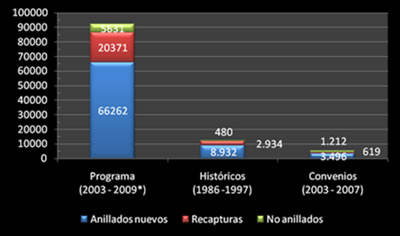
Currently ProAves has a database that contains 270.425 entries, of which 109.937 are collected records distributed in the following way: 92.264 for the program; 12.346 historical records; 5.327 that belong to agreements and 160.488 records of specific observations. This information has been obtained through the research undertaken through projects, agreements and explorations throughout Colombia.

Esfuerzo de muestreo de capturas 2003-2009 y número de individuos de especies por categorías registrados por años.

Catch Effort sampling 2003-2009 and number of individuals of species recorded by category for years.

The program has registered 1035 species of birds; representing 56% of birds, 115 species of birds have been reported only in conventions, historical data or other projects. For a total of 1191 representing 63% of the birds.

The effort to conserve birds throughout the national territory is a major concern for ProAves who took charge of implementing the monitoring program of 116 stations in 16 locations throughout Colombia. Seven years of monitoring over the Andes Mountain Range, the massif of the Sierra Nevada de Santa Marta, the Chocó, the San Andres islands in the Colombian Caribbean and Malpelo in the Pacific Ocean as part of a strategic network for knowledge and conservation of birds, a work that has a mayor importance, now that the foundation acquired natural reserves for the conservation of the birds, focusing in them, and their influence in their areas.

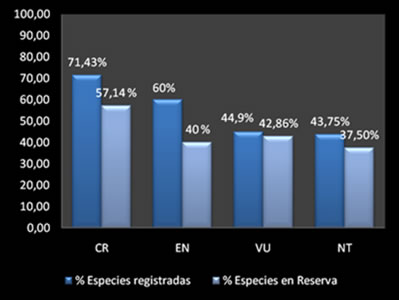
Of the 88 globally threatened species by IUCN in 2004 found in Colombia, 50 species were recorded, corresponding to 57% of those listed as threatened.

For the conservation of these endangered species ProAves has been developing some projects for the conservation of these birds:

• Saving the Blue-billed Curassow (Crax alberti)
• Chicamocha Project for Preserving of nicefori Wren (Thryothorus nicefori) and Chestnut-bellied hummingbird (Amazilia castaneiventris)
• Corredor Norandino Project for this species: (Odonthophorus stropium, Hapalopssitaca amazonina, Coeligena prunellei, Macroagelaius subalaris) • Loros Amenazados Project divided into three subprojects: Cordillera Central (Bolborhynchus ferrugineifrons, Hapalopssitaca fuertesi and Leptosittaca branickii); Pyrrhura (Pyrrhura viridicata), Proyecto loro Orejiamarillo (Ognorhynchus icterotis)
• Migratory Bird Project, two subprojects: Golden-winged Walbler (Vermivora chrysoptera) and Cerulean Group (Dendroica cerulea).

With the support of:

usfish lpf abc


Documentos:

image1
Results of the threatened species present in Data Base
PDF
 

Categorías
News

La Brea Poison Frog rediscovered, but in critical condition

Monday 27 September 2010.

In the Colombian Pacific coast, about 45 miles within the jungles of Cauca, some examples of the La Brea Poison Frog (Oophaga occultator), first described in 1976 by Myers and Daly were found. Despite having been described so many years ago, many details about its behavior, reproduction and habitat status for reasons of public order were unknown. The significance of the finding is due to the collection of data on the species and its distribution, in addition to warning about the state of deforestation of their habitat with a view to conservation.

La Brea poison frog (Oophaga Occultator) – Environment deforested. Around about the occultator sang all morning.

The name of this species (occultator) was given because of its “hidden” conduct in the middle of the jungle. The first few times it was seen in the wild (1975) it was found that preferred the upper parts of trees and branches, where it mimicked the environment of the forest. It was said that it sang at heights over 1.50 cm and their song is rarely heard. However, during this visit they could be seen singing up to 10 cm off the ground, in severely deforested areas and in different locations to La Brea. Although some scientists have been able to enter the area in years past (in the 90s and early 2000), nobody has seen any more pictures of this magnificent and little known species in its natural environment: the jungles of Colombia.

{youtube}vY3yjcPEVy8|425|344|1{/youtube}

Among some risks to the extinction of Oophaga occultator are:

Illicit crops: Even before the drug bonanza of the 90s, even to this day, this area of Cauca hundreds of hectares of forest have been cleared to plant coca indiscriminately. Fueled by easy money and anxiety and by violence that seems not to be letting up, the people (indigenous and Afro-Colombians) for several years saw their primary method of support in this lucrative business. The crops became so great that the state sent planes with glyphosate to destroy the crops (and incidentally killing off surrounding fauna and flora).

Coca cultivation (left) expanding into the jungles of the river Guanguí (right).

Backhoe for mining in the river Saija

Mining: 25 backhoes and dredges arrived at Timbiquí to tear up the edges of the river in search of gold in early June. Thanks to the efforts and protests of the civilian population of Timbiquí, the dredges were expelled from the village, avoiding the destruction of the area near the village. However, these dredges only changed direction and began to climb the Saija River in search of gold on the slopes of river. Mining activities destroy the environment with their irresponsible and devastating activities.

Trafficking of species: During the 80s and 90s this frog was trafficked to countries in Europe and North America, to be bred in captivity and be marketed in the world of collectors. A cargo was taken to the United States in 1997, along with other species of frog in the area such as Phyllobates terribilis and Phyllobate saurotaenia, but the chances of breeding and reproduction in captivity are very rare, making it a target for traffickers who come to Colombia to take them away illegally.

Fortunately for the frogs, the Saija River area is not safe now for dealers (nor for researchers), because 3 illegal armed groups, including FARC, the ELN and Los Rastrojos (paramilitary group) are vying for control of this strategic corridor for drug trafficking.

Singing male – Belly of occultator.

The villagers are indigenous Emberá, who have been in travel status for 2 years, living in cramped conditions in a large communal house with more than 600 indigenous people, victims of the violence and the constant threats from insurgents. This is a community that originally used the frogs (Phyllobates terribilis) to poison darts and for hunting, but this activity has been discontinued by the villagers today. We hope that the life and culture of these indigenous peoples as well as the great diversity of the Saija area can be preserved over time and that we will not have to remember them only through books and old photographs.

With the support of:

Global_wildlife abc conservacioninternacionalcolombia
Mohamed_Bin_Zayed


Categorías
News

Search for the Lost Amphibians of Colombia

Friday 8 October 2010.

During a herpetological exploration in the Colombian Chocó and framed within the international project Lost Frogs supported by USFWS (Wildlife without borders), the expedition team composed by Alonso Quevedo, Felipe Barrera, Uberney Garcia, Juan Carlos Luna, Luis Rubelio Garcia (Fundación ProAves), Robin Moore (Conservation International), Don Church, Wes Sechrest, Nikki Roach (Global Wildlife Conservation) and Lucy Cooke (journalist) found 3 species new to science, 3 very rare and endemic species of the Chocó.

The species found have become a large and significant contribution to the biodiversity of Colombia and the planet at a time when, unfortunately, many species of amphibians are on the verge of extinction due to factors such as climate change, accelerated deforestation and the fungus Batrachochytrium dendrobatidis, a fungus that threatens the world’s amphibians.

Atelopus sp. nov. (cf) Rhinella sp. nov (cf)

Silverstonea sp. nov (cf)

[slickr-flickr search=”sets” set=”72157624943951547″ items=”20″ type=”gallery”]

Amphibians are considered the best bio-indicators of ecosystem status and within the group of vertebrates they are also more susceptible to disappear before any changes resulting from human actions on ecosystems. Colombia is considered the richest country in the world in amphibian species, but, paradoxically, this special category holds no escaping the unfortunate and sad process of extinction.

Additionally, the expedition found other species of conservation concern including the poison dart frog (Oophaga histrionic).

Oophaga histriónica

Expeditionary Team to the Chocó.

Concern for biodiversity loss and forming part of its institutional mission has led the Fundación ProAves to worry about the conservation of amphibians in Colombia, which has enjoyed the support of all interested international organizations the conservation of biodiversity in Colombia.

We appreciate the resources to support field work donated by USFWS – Wildlife without Borders, Conservation International, Global Wildlife Conservation, American Bird Conservancy and field equipment donated by WLT-US and Columbia Sportswear.

usfish wildlife_without_borders Global_wildlife abc
worldlandtrust conservacioninternacionalcolombia Columbia dendro


Categorías
News

NUEVO REGISTRO DE Polylepis

Encontrada una población de {Polylepis} {quadrijuga }en el Páramo Frontino es la única representación del genero {Polylepis} en la Cordillera Occidental, y su presencia en la Cordillera Occidental representa una extensión de rango de 300 km. Además, cabe resaltar que la población que sobrevive en Frontino se encuentra en estado fragmentado en menos de 100 ha en total.


Recientemente, el Director de la {{[Reserva Natural de las Aves El Colibrí del Sol->https://www.proaves.org/rubrique.php?id_rubrique=76] – }}Diego Andrés Caranton, fotografío la especie del genero {{ {Polylepis} }} presente en el Páramo de Frontino en la Cordillera Occidental. Botánicos de la Universidad Nacional y Universidad de Antioquia confirmaron recientemente que la especie presente en esta zona no se trataba de la especie {{ {Polylepis} }}{{ { sericea} }}, como se creía inicialmente, distribuida en toda la Cordillera Central de Colombia y hasta el Perú, si no {{ {Polylepis} }}{{ {quadrijuga} }}, que es una especie endémica de la Cordillera Oriental de Colombia y en grave estado de peligro de extinción.

La población de {Polylepis} {quadrijuga }en el Páramo Frontino es la única representación del genero {Polylepis} en la Cordillera Occidental, y su presencia en la Cordillera Occidental representa una extensión de rango de 300 km. Además, cabe resaltar que la población que sobrevive en Frontino se encuentra en estado fragmentado en menos de 100 ha en total. Notablemente, una gran parte de esta población se encuentra en la {{[Reserva Natural de las Aves El Colibrí del Sol ->https://www.proaves.org/rubrique.php?id_rubrique=76]}}de la Fundación ProAves.

De esta forma Juan Carlos Verhelst representante por la Fundación ProAves presentó el pasado mayo su ponencia {{“El Estado de Conservación de los bosques de {Polylepis} en Colombia”}} junto al Profesor Orlando Rangel del Instituto de Ciencias Naturales de la Universidad Nacional, dentro del marco del “{{II Congreso Internacional de Ecología y Conservación de {Polylepis}”}} en Cusco, Perú.

Categorías
News

Resultados Taller Polylepis – Colombia

Con gran éxito y gracias al apoyo de American Bird Conservancy y la Comunidad Andina, ProAves llevó a cabo el pasado 31 de mayo el taller {Futuro para los Bosques de Polylepis}, al cual asistieron representantes de 16 instituciones.


Con el apoyo de {{[American Bird Conservancy->http://www.abcbirds.org/]}} y la {{[Comunidad Andina->http://www.comunidadandina.org/],}} el pasado 31 de mayo ProAves llevó a cabo en sus instalaciones en Bogotá el taller {Futuro para los bosques de Polylepis}, al cual asistieron representantes de 16 organizaciones gubernamentales y no gubernamentales.

Durante las discusiones se hizo evidente que existe un desconocimiento casi total sobre la existencia de estos bosques en Colombia y el riesgo de destrucción a corto plazo que afrontan; por esta razón, el taller fue un espacio apropiado para el intercambio de conocimiento sobre su estado actual y sus potenciales amenazas.

En los análisis realizados se detectaron nueve áreas preliminares de importancia para la conservación de {Polylepis:} Complejo Páramo de la Rusia, Serranía del Cocuy, Parque Nacional Natural Chingaza, Parque Nacional Natural Sumapaz, Volcán Cumbal y Chiles, Macizo Colombiano – Puracé, Páramo de las Hermosas, Parque Nacional Natural Los Nevados y Páramo de Frontino. A estas áreas les fueron realizados diagnósticos de situación actual y detección de amenazas.

Uno de los puntos satisfactorios del taller fue llegar a la conclusión de que en los planes de manejo de las Corporaciones Autónomas Regionales y municipios se deben tomar en consideración los bosques de {Polylepis} con fines de conservación. Igualmente, se recomendó proponer que las especies de {Polylepis} en Colombia sean clasificadas bajo un criterio de amenaza así como continuar con la identificación de su fauna y flora asociadas y llevar a cabo una estrategia de divulgación para mostrar su importancia a nivel nacional.

También se advirtió que, de no tomar medidas inmediatas, los pocos fragmentos de bosques de {Polylepis sericea} y {Polylepis quadrijuga} desaparecerán. En ese sentido, la creación de la Reserva Natural de las Aves Colibrí del Sol, de ProAves, es una iniciativa que protege un gran segmento de estos bosques en la Cordillera Occidental.

La gran conclusión del taller es la urgencia de priorizar la conservación de estos bosques.

Para más información consultar el archivo adjunto al final de esta nota.

Con el apoyo de:

Instituciones asistentes al taller:

Categorías
News

Premio de bronce a Proyecto Chicamocha


Colombia – Premio de Bronce (BP Conservation Programme)
AVIFAUNA AMENAZADA DEL VALLE DE BOSQUE SECO DE CHICAMOCHA (proyecto chicamocha)

El cucarachero de Nicéforo y el colibrí ventricastaño, endémicas de los valles secos de la Cordillera Oriental olombiana, son especies críticamente amenazadas. Aunque de poco conocimiento, sus distribuciones actuales son altamente restringidas y su hábitat en los bosques remanentes, están bajo una intensa presión antropogénica.

En orden de desarrollar una estrategia de conservación necesitada de emergencia para estas dos especies, esta iniciativa estudiantil apunta a establecer el estatus actual de las dos especies a través de: determinación precisa de su distribución, identificación de sus principales hábitat y requerimientos de recursos, delineamientos claros de las amenazas actuales y la recolección de información relevante para esclarecer el estatus taxonómico de ambas especies.

Los datos serán recolectados por medio de entrevistas informales, encuestas cuantitativas (transects de línea, redes de niebla, tramas de rejilla) y estudios ecológicos detallados.

Este proyecto producirá información vital en el estatus de la población y la distribución de estas especies, así como las actividades de conservación y educación ambiental enfocadas a despertar la conciencia ecológica en la comunidad local.

Mayor Información:

Jorge Parra: jparra@proaves.org,
Nicolás Dávila: ndavila@proaves.org
Oswaldo Cortés:ocortes@proaves.org

Categorías
News

Objetivos del proyecto


{{Investigación}}

-Valorar y priorizar las amenazas que afectan las poblaciones de {Crax alberti}
-Determinar la distribución actual de {Crax alberti} y ubicar sitios prioritarios de conservación en los Departamentos de Boyacá, Santander, Córdoba, Antioquia y Magdalena
-Realizar censos para estimar y monitorear los tamaños poblacionales
-Adelantar trabajos de campo intensivos para determinar los requerimiento ecológicos de la especie
-Evaluar la preferencia de hábitat y la determinación de la disponibilidad actual de hábitat para la especie
-Realizar investigaciones enfocadas en la biología reproductiva de la especie

{{Conservación}}

-Zonificar las áreas de estudio importantes para la conservación de {Crax alberti} en los departamentos de distribución.
-Construir acuerdos y establecer responsabilidades específicas para la investigación, capacitación, uso, manejo y conservación de los recursos a los diferentes actores (comunidad, organizaciones gubernamentales y no gubernamentales, instituciones educativas, etc.)
-Gestionar administrativamente áreas protegidas con el apoyo de las alcaldías municipales, corporaciones regionales, ONG`s y demás entidades interesadas en la conservación.
-Identificar alternativas de desarrollo sostenible que incentiven el interés de la comunidad en la conservación y apropiación de los recursos naturales que les provee el ecosistema.
-Elaborar un vivero para la reforestación con especies maderables y que son consumidas por {Crax alberti} y otras especies amenazadas en zonas alteradas o de alta intervención.
-Dar continuación y ampliar la cobertura de los Planes de Acción propuestos para {Crax alberti} a nivel nacional.

{{Educación ambiental}}

-Constituir grupos ecológicos con la comunidad infantil y adolescente en los corregimientos y veredas implícitas dentro del proyecto.
-Realizar charlas y talleres medioambientales y de conservación en las escuelas.
-Elaborar murales y carteles alusivos a la conservación de {Crax alberti}, su hábitat y las demás especies amenazadas dentro de la zona de estudio.
-Promover la participación activa del grupo ecológico y de los miembros del proyecto en los eventos sociales de las veredas de trabajo enfatizados en la conservación de {Crax alberti} y su hábitat.
-Realizar un programa de sensibilización con los habitantes locales de las zonas de influencia del proyecto.
-Diseño y elaboración de material divulgativo y promocional de los proyectos.

Categorías
News

Hábitat, distribución geográfica y aspectos comportamentales

El Paujíl de Pico Azul se distribuía originalmente en los bosques tropicales de zonas bajas desde el piedemonte noroccidental de la Sierra Nevada de Santa Marta hacia el sur hasta los valles de los ríos Sinú y San Jorge


El Paujíl de Pico Azul se distribuía originalmente en los bosques tropicales de zonas bajas desde el piedemonte noroccidental de la Sierra Nevada de Santa Marta hacia el sur hasta los valles de los ríos Sinú y San Jorge, la región del Bajo Cauca y Nordeste de Antioquia, la Serranía de San Lucas, la Serranía de San Jacinto y el Valle Medio del río Magdalena hasta Honda (Hilty y Brown 1986, Cuervo et al 1999). La distribución histórica de la especie también incluyo en el Valle de Cauca y Valle Alto del Magdalena (Cuervo et al. 1999). En la actualidad se estima que esta especie ha perdido cerca del 88% del hábitat en el área de distribución original (Renjifo et al. 2002).

Las últimas poblaciones relictuales conocidas del Paujil de Pico Azul se encuentran en Antioquia y en los Parques Nacionales Naturales Tayrona y Sierra Nevada de Santa Marta. En el departamento de Antioquia se encuentra en los de bosques húmedos y muy húmedos tropicales de las regiones del nordeste y Bajo Cauca, ecosistemas en la actualidad sometidos a procesos fuertes de deterioro por la extracción de madera, por la minería o por la destrucción para establecimiento de cultivos o potreros (Melo y Ochoa 2004).

El Paujil de Pico Azul habita bosques húmedos de tierras bajas y de piedemonte hasta los 1200 m, pero es más frecuente por debajo de 800 m. Se ha registrado en el interior de bosques maduros poco intervenidos, sujetos a tal selectiva y muy ocasionalmente en bosques muy intervenidos o en bosques secundarios o en bordes de bosque (Cuervo et al. 1999, Ochoa et al. 2002).

De esta especie se ha empezado a recopilar información de manera continuada desde 1998 cuando el Grupo de Estudio de Aves de la Universidad de Antioquia empezó un proceso de investigación sobre la especie en el nororiente de Antioquia, de este proceso se generaron dos publicaciones sobre aspectos de historia natural (Cuervo et al. 1999, Cuervo et al. 1999), posteriormente se ejecuto una búsqueda de poblaciones (GEA U. de A. 2000), un proyecto de utilización del bosque (Ochoa et al. 2002), y por último una evaluación de amenazas en el nororiente de Antioquia (Melo y Ochoa 2004) y una estimación de densidades poblacionales en la misma zona (JD González Com. Per). Sin embargo debido a las fuertes amenazas que presenta la especie se deben seguir coordinando esfuerzos para lograr la conservación de esta especie por tal motivo se genero la estrategia nacional para la conservación del Paujil de Pico Azul, mediante el proyecto “Salvando al Paujil de Pico Azul” el cual tiene como prioridad rescatar y proteger las poblaciones existentes de este Cracido, en el Magdalena Medio (Boyacá – Santander), Antioquia, Santa Marta y Córdoba en el Valle del Rió Sinú, que genero en el año 2004 grandes avances en cuanto al conocimiento específicos de la biología y la conservación de la especie en aspectos como la evaluación y prioización de amenazas (por Eliana Machado), densidad y estructura poblacional (por Hernán Arias ) y el Uso del hábitat y aspectos comportamentales (por Eduardo Urueña ), además de una fuerte campaña de educación ambiental y la creación de una Reserva Natural Privada denomina “El Paujil” que comprende mas de 2000 Ha destinadas a la conservación con ello se consiguió el apoyo de mas de 5 entidades internacionales y 3 nacionales para el seguimiento de esta estrategia.

Categorías
News

Sitios de exploración, comunidad y avances

Serranía de las Quinchas – Reserva Natural El Paujil – Departamentos de Boyacá y Santander Cañón del Rió Alicante – Departamento de Antioquia Valle del Rió Sinú – Municipio de Tierra Alta – Departamento de Córdoba – Parque Nacional Natural Paramillo.


{{Sitios de Exploración}}

Serranía de las Quinchas – Reserva Natural El Paujil – Departamentos de Boyacá y Santander Cañón del Rió Alicante – Departamento de Antioquia Valle del Rió Sinú – Municipio de Tierra Alta – Departamento de Córdoba – Parque Nacional Natural Paramillo.

{{Trabajo con la Comunidad}}

El proyecto “Salvando al Paujil de Pico azul” dedicado a la investigación y conservación de {Crax alberti} en Magdalena Medio y otras localidades del país, ha enfatizado gran parte de su trabajo en campañas de educación medioambientales, dirigidas a las comunidades aledañas a las zonas en donde se encuentran poblaciones de esta especie, especialmente a niños, campesinos, cazadores y aserradores de estos lugares.

La educación ambiental involucrada en la investigación ofrece un conocimiento integral del medio ambiente, no sólo encontrándose un componente natural como los suelos, los bosques, el agua, la fauna, sino también un componente social y cultural en la medida en que el hombre influya sobre la naturaleza.

La falta de conocimiento por parte de la comunidad acerca de la importancia y manejo de los recursos naturales convierten la educación ambiental en una urgente prioridad en los procesos de conservación ya que estos son los que permiten a largo plazo la protección de las especies y sus habitas debido al apropiamiento de los recursos naturales por parte del hombre del campo.

Los objetivos de estas actividades, se basan en la relación campesino – campo, campesino – educador, en donde el campesino juega el papel mas importante, pues este tiene contacto directo con el ambiente a conservar todos los días de su vida; entre las actividades que se han realizado se destacan: Grupo Ecológico Amigos del Paujil, Talleres y mesas de conversación, Talleres sobre manejo de Viveros, Mesas de Diagnostico Comunitario, Talleres medio ambientales y de conservación, Elaboración de Murales, Eventos en las festividades de la comunidad, Primer Festival del Paujil, entre otras.

{{Avances}}

El proyecto ha sido ganador por segunda vez consecutiva del premio mundial de conservación “Follow Up” otorgado por el Bp Conservation Programme (Conservation International, Wildlife Conservation Society, BirdLife International, BP, y Fauna & Flora Internacional) el cual premia a proyectos elaborados por estudiantes de todo el mundo y reconoce el alcance de jóvenes conservacionistas a través de capacitación y apoyo; este permitió para el año 2005 fortalecer las estrategias de conservación y ampliar el rango de acción a mas zonas del país.

Categorías
News

Scytalopus rodriguezi del valle del alto Magdalena

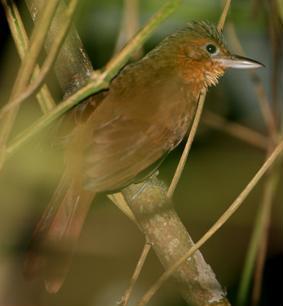
Bogotá, 16 de junio de 2005. Descubierto en el 2003 en la Reserva Natural de Meremberg, municipio de San Agustín, departamento del Huila, Cordillera Central de Colombia por los especialistas Niels Krabbe, Paul Salaman, Alex Cortés, Alonso Quevedo, Luis Alfonso Ortega y Carlos Daniel Cadena; investigadores de las Universidades de Copenhague y Missouri, Conservación Internacional y Fundación ProAves


Bogotá, 16 de junio de 2005. Descubierto en el 2003 en la Reserva Natural de Meremberg, municipio de San Agustín, departamento del Huila, Cordillera Central de Colombia por los especialistas Niels Krabbe, Paul Salaman, Alex Cortés, Alonso Quevedo, Luis Alfonso Ortega y Carlos Daniel Cadena; investigadores de las Universidades de Copenhague y Missouri, Conservación Internacional y Fundación ProAves; fue oficialmente reconocida por la revista científica británica Bulletin of the Ornithological Club en el número 2 de su volumen 125, en abril del 2005.

Los individuos de esta especie pesan entre 21 y 23 gramos y no superan en tamaño de un copetón de la sabana. El descubrimiento se hizo en la Reserva Natural Meremberg, Municipio de San Agustín, Departamento del Huila, Cordillera Central de Colombia, el 24 de febrero de 2003, a 2.200 m.s.n.m. Esta especie es muy parecida a otra recientemente descubierta ({Scytalopus stilesi}), sin embargo la diferencia radica en su canto.

La especie fue nombrada en honor a Jose Vicente Rodríguez, un conservacionista colombiano que ha liderado procesos de evaluación de la fauna silvestre en varias regiones del país, promovido el desarrollo de los mecanismos de aprovechamiento sostenible del recurso faunístico a través de su manejo en condiciones controladas. Igualmente ha abanderado varios programas de investigación y conservación de especies amenazadas como el programa de reintroducción del Cóndor Andino.

Actualmente es el Director de la Unidad de Conservación de Especies del Centro de Biodiversidad de los Andes de Conservación Internacional desde donde promueve una serie de actividades tendientes a la protección y conservación de especies, dando especial énfasis a las endémicas y amenazadas.

Según José Vicente Rodríguez: “Este hallazgo muestra que a pesar de que se considera que ya este todo conocido para Colombia en el campo de las aves, la verdad es que todavía hay mucho por descubrir. Desafortunadamente esta especie “nace” ya con una presión sobre su conservación, pues los autores recomendaron que sea incluida en la lista roja de la UICN en el estatus de Amenazada debido a que el área ocupada es de 170 kilómetros cuadrados y la cantidad de individuos de la población es menor a 5000”.

El reconocimiento lo hizo el director de la Fundación ProAves, el Doctor Paul Salaman, quien ha sido destacado en el ámbito internacional por sus publicaciones y los proyectos que con ProAves está desarrollando en Colombia a favor de la avifauna amenazada.

Además se realizó la inauguración de la Biblioteca Nacional de Ornitología ubicada en la sede de ProAves, que posee publicaciones especializadas para biólogos, ornitólogos y comunidad científica en general, así como para el público en general; se aprovechó también para lanzar la segunda etapa del Programa de Aves Migratorias que desde hace dos años viene desarrollándose en el territorio colombiano.

links: [El Tiempo.com->http://eltiempo.terra.com.co/naci/tolima/2005-07-26/ARTICULO-WEB-_NOTA_INTERIOR-2163372.html]
Fuente: ProAves Colombia – Conservación Internacional Colombia
Categorías
News

Un canto bien particular

Tras el reciente descubrimiento del {Scytalopus rodriguezi}, no se tenía información exacta sobre el canto de esta ave endémica que ya es considerada en vía de extinción por la UICN.


Tras el reciente descubrimiento del {Scytalopus rodriguezi}, no se tenía información exacta sobre el canto de esta ave endémica que ya es considerada en vía de extinción por la UICN. Para los que están interesados en oir cómo es la “voz” de esta ave, haga click [aquí->https://www.proaves.org/Aleteos/Documentos/ScyrodQ4.mp3]

Categorías
News

Vence plazo para II Simposio de Aves Amenazadas

El 12 de junio se vence el plazo de envío de resúmenes de ponencias para el simposio {Avances en el conocimiento y conservación de las aves amenazadas en Colombia}, que ProAves estará coordinando dentro del próximo II Congreso de Ornitología Colombiana.


En el marco del II Congreso de Ornitología Colombiana que tendrá lugar los días 8, 9 y 10 de agosto de 2007 en Bogotá y que es organizado por la Asociación Colombiana de Ornitología – ACO, ProAves llevará a cabo el simposio {Avances en el conocimiento y conservación de las aves amenazadas en Colombia}.

El propósito de este simposio es establecer cómo ha avanzado el estado de conocimiento de las especies amenazadas en Colombia en los últimos años; qué tipo de herramientas de conservación han sido implementadas; identificar los vacíos de información y/o grupos que requieren mayor atención en el futuro cercano y elaborar una base de datos de las organizaciones e individuos que estén realizando o hayan realizado proyectos en torno a esta temática en particular.

Este simposio es el segundo que ProAves organiza sobre el tema; el primero tuvo lugar durante el Primer Congreso de Ornitología Colombiana, celebrado en el 2004.

Las personas interesadas en participar con ponencias deberán enviar antes del 12 de junio un resumen de 300 palabras siguiendo las [{{pautas para autores}}->http://www.ornitologiacolombiana.org/instrucciones.htm]de la revista {Ornitología Colombiana}, a {{[María Isabel Moreno->mailto:mmoreno@proaves.org]}} indicando las especies involucradas y cómo se desea participar (ponencia, afiche y/o memorias).

Para mayor información sobre el simposio descargue el documento adjunto y consulte la{{ [información para ponentes->http://www.ornitologiacolombiana.org/congreso/infoponentes.htm]}} que aparece en la página Web de la ACO.

Categorías
News

Endangered Baudo Oropendola discovered in Antioquia

A ProAves expedition in the Chocó of the Western Cordillera has discovered two colonies of Baudo Oropendola Psarocolius cassini with a total population of 70-80 individuals. This new location represents a crucial 120 km range extension for the IUCN Endangered species from the currently known location in Utria National Park on the Pacific coast of Colombia in Chocó Department. It also significantly expands the known population of the species from less than a dozen individuals have been documented from Utria National Park.

[slickr-flickr search=”sets” set=”72157624909924430″ items=”20″ type=”gallery”]

“American Bird Conservancy is thrilled to have helped fund this research expedition that led to the discovery of these two new colonies of this very rare bird. We now look forward to working with ProAves on measures to conserve and protect them. Their work with us on this and many other projects has advanced the cause of bird conservation enormously,” said ABC President George Fenwick.

During an ornithological exploration of western Antioquia by ProAves team Alonso Quevedo and Trevor Ellery, a number of rare Chocó endemics were discovered including two colonies of Baudo Oropendola Psarocolius cassini in the foothills of the Western Cordillera. The species was tape-recorded and photographed showing the extensive pink cheek patch on all individuals that differentiated it from Black Oropendola P. guatimozinus that should occur in this area.

Unfortunately, the area of the two colonies is privately owned and completely unprotected. More alarming is deforestation in this area is accelerating fast as security has recently been restored to the area and local people are returning to clear forest for pasturelands.

ProAves is conducting further surveys at the site with a view to establish conservation actions. Given the locations close proximity and good accessibly to Medellin, we are requesting birders to allow a 12-month period be given to establish conservation measures with local land owners before visiting the site. Thereafter we will disclose the specific location.

ABC, working in cooperation with a variety of local partners, has established or expanded 43 bird reserves in Central and South America, and the Caribbean. Many of these reserves are featured on a new website: www.conservationbirding.org. The site encourages the birding community worldwide, to visit these reserves to see the spectacular variety of birds the reserves help protect. Such visits help provide funding that will ensure the long term viability of these world class birding destinations.

Many thanks to USFWS, American Bird Conservancy, and EcoTurs for sponsoring fieldwork.

abc ecoturs
Categorías
News

Redescubrimiento de anfibios perdidos

El proyecto Evaluación de Anfibios Amenazados en sitios {{[AZE ->http://www.zeroextinction.org/]}} ha logrado reportar tres especies de anfibios en Peligro Crítico de extinción.


Luego de la primera etapa de campo del proyecto {{Evaluación de Anfibios Amenazados en sitios [AZE ->http://www.zeroextinction.org/]}}en Colombia por ProAves y financiado por {{Conservation Leadership Programme}}, se ha logrado reportar tres especies de anfibios en Peligro Crítico de extinción, incluyendo la Salamadra de Frontino ({Bolitoglossa hypacra}), en la Reserva Natural Colibrí del Sol{.}
El objetivo del proyecto es reencontrar y evaluar el estado poblacional de algunas de las especies de anfibios que poseen mayor vulnerabilidad y riesgo de extinción en Colombia. El equipo lo conforman los biólogos Víctor Luna, Manuel Guayara, Ricardo Medina y Oscar Gallego, quienes se encuentran desde hace más de un mes en campo explorando cuatro de las áreas de mayor importancia para la biodiversidad en las Cordillera Occidental, Cordillera Central y Sierra Nevada de Santa Marta. Esta iniciativa es acompañada por acciones de educación ambiental con las comunidades.

Categorías
News

A new endemic bird species for the Sierra Nevada

Tuesday 23 December 2008.

ProAves supported eminent Andean ornithologist, Dr Niels Krabbe to study the birds in the Reserva El Dorado in 2007. His research has revealed new insights into the birds of the Sierra Nevada de Santa Marta, including the discovery of one new species for science (Santa Marta Screech-owl Megascops gilesi) and production of the CD of bird songs “Birds of the Sierra Nevada de Santa Marta” available from ProAves.

Automolus rufipectus.

In a scientific paper published this month in the Bulletin of the British Ornithologists’ Club, Niels justified the species status of a thitherto overlooked subspecies of Ruddy Foliage-gleaner Automolus rubiginosus rufipectus that is endemic to the Sierra Nevada de Santa Marta. Not only is this taxa distinctive, but it may even be more closely related to a genus Hylocryptus composed of two species in southern Ecuador and Peru and Brazil.

The species, named the Santa Marta Foliage-gleaner Automolus rufipectus was only found in the El Dorado Bird Reserve and is restricted to closed canopy primary subtropical forest, which is extremely fragmented and predominately cleared for agriculture. While know to occur in other sites in the Sierra Nevada, the species highly restricted range and sensitivity of habitat suggest the species be considered as Vulnerable to extinction.

The Sierra Nevada has no fewer than 70 endemic bird taxa (species and subspecies), and is perhaps the most diverse smaller centre of terrestrial endemism in the world. Seventeen are presently ranked as species by ProAves checklist to the birds of Colombia.

Preliminary analyses of vocalisations from El Dorado suggest that species rank is likely to be appropriate for five other taxa, including the Masked Trogon (Trogon personatus sanctaemartae), Montane Woodcreeper (Lepidocolaptes lacrymiger sanctaemartae), Rufous Antpitta (Grallaria rufula spatiator),Gray-breasted Wood-wren (Henicorhina leucophrys anachoreta), and Stripe-headed Brush-finch (Arremon torquatus basilicas), and possibly others.