

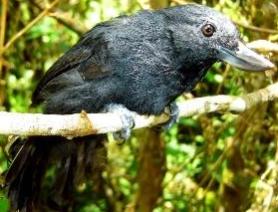
(Clytoctantes alixii) |

Establishment:
The Recurve-billed Bushbird Bird Reserve was established on October 3, 2006 to preserve habitat in perpetuity Recurve-billed Bushbird (Clytoctante salixii), a species listed as endangered and that was rediscovered in the year 2006 in Venezuela and Colombia, after 40 years without any data on it.
Location and Area:
The reserve has an area of 86 acres and is located in the Village of Agua de la Virgen Township of the same name, in the municipality of Ocaña, Northern Santander department, Colombia. Located in a small patch of preserved forest in the region, which the species inhabits, between 800m and 900m.
Biological Importance and Protection:
The reserve protects one of the last relic forests in the municipality of Ocaña and the region, which in addition to the natural value is an important cultural value. Populations of threatened species such as Recurve-billed Bushbird and Black-fronted Wood-Quail (Odontophorus atrifons), among others have been found.
The presence of key bird species promoted the site’s designation as an Important Area for Bird Conservation, Agua de la Virgen (AICA CO072), which is protected by the Reserve, the Santuario Nuestra Señora de Torcoroma and a local association promoting the protection of the Quebrada de La Virgen (USUAIN).
These forests are located within an Endemic Bird Area: Eastern Andes of Colombia (EBA 038) where it is thought there are a significant number of species of restricted distribution. This region is part of the South Perijá District in biogeographic province of Norandina and part of the Hot Spot Tropical Andes which is the most diverse Priority Terrestrial Ecoregion of the planet.
Physical Aspects and Ecosystem:
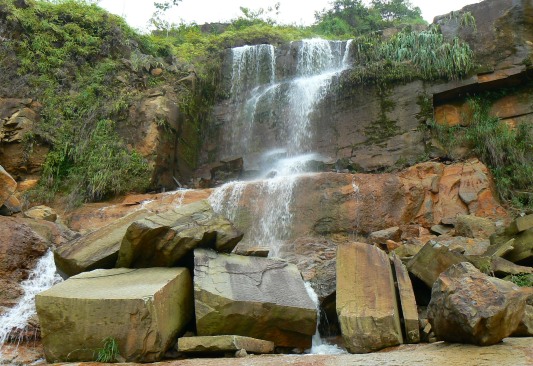
Hydrography: Regionally, Ocaña is supplied by two major rivers: The Tejo and the Algodonal or Catatumbo. The Reserve is part of the buffer zone of the Tagus River basin and at the lower end of the protected area there are permanent pipes that drain into the river.
Climate: The average annual temperature in Ocaña is 22 ° C, with a temperature not lower than 17 degrees Celsius and prone to cold and heat in its upper and lower limits. The climate is wet and dry tropical and well-defined drought areas and rainfall between 1,000 and 2,000 millimeters per year. The rains during the first six months are rare, occurring between the months of August to November.
Ecosystem:
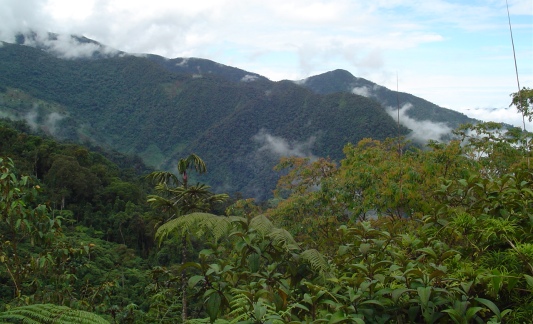
Natural forests in the area of Agua de la Virgen are described as sub-Andean rain forests or equivalent subhigrofíticos and Tropical Rainforest montane and submontane to the classification of UNESCO (1973) and rainforests, pluvial and rain forests of the montane and floor lower montane Holdridge (1967). Correspond to pre-montane cloud forests, primary and secondary, where the frequency of fog tends to raise the humidity and evapotranspiration decreases.
Vegetation:
The reserve consists of secondary forests preserved and in advanced stages of growth with a canopy that reaches 15 m high and some trees exceptionally reaching 20 m, as is the case barbatuscos (Erythrina sp.) Guam (Inga sp.) and Sloanea sp. In general the forests are dominated by a bamboo locally called reed (Rhipidocladum racemiflorum),which is the preferred feeding site for the Recurve-billed Bushbird. The families most observed in the understory are rubiaceae and bromeliaceae.
Biophysical characteristics:
It is located in a dry valley on the western slopes of the Cordillera Oriental.
Biodiversity:
Among the most important on the bird reserve are the Recurve-billed Bushbird (Clytoctante salixii) The Black-fronted Wood-quail (Odontophorus atrifrons), Grey-throated Warbler (Basileuterus cinereicollis),the Moustached Brush-finch (Atlapetes albofrenatus) and the Golden-breasted Fruiteater (Pipreola aureopectus).Mammals are also characteristic as the Paca (Agouti paca), Brown-throated sloth (Bradypus variegatus), The Brown-eared Woolly Opossum (Caluromys lanatus) and The kinkajou (Potos flavus), among others.
Conservation:
Tourism:
Facilities: There is no accommodation for visitors.
Attractions: The reserve has a circuit of trails where you can observe the birds and in general the fauna and flora of the reserve, in addition to a kiosk and a viewpoint from where you can see the city of Ocaña.
General Recommendations:
- Respect the natural values of the reserve, the plants and animals.
- Collection of biological material is prohibited.
- Follow the directions of reserve staff and travel on the established paths.
- You must wear coats for the cold, Pantanal boots and waterproofs.
- Disinfect shoes with bleach or clorox to prevent the spread of the chytrid fungus (one of the leading causes of death of amphibians in the world).
Admission and tours:
visit@conservation.co and fundacion@proaves.org
 |
Related news
First published photos of the Recurve-billed Bushbird
Wednesday 27 June 2007.
Wildlife researchers have photographed two rare bird species, the Recurve-billed Bushbird and the Perija Parakeet and published it for the first time.
First published photos of two rare species
Thursday 10 May 2007.
This male Recurve-billed Bushbird (Clytoctantes alixii) was photographed by ProAves staff, Adriana Tovar and Luis Eduardo Uruena. The publication of these photos represents the first time this globally Endangered species have been captured on camera.