Fundación ProAves – por la conservación en el país de las aves

Categorías
News

New species of “moustached” butterfly

Monday 9 March 2009.

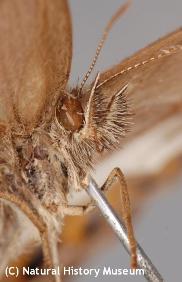
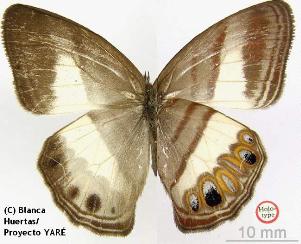
The new species was discovered on Proyecto YARE, a research and conservation initiative by Fundación ProAves in Serrania de los Yariguies, Santander and funded by the BP Conservation Leadership Programme. During fieldwork in this previously unstudied region, Blanca Huertas and Cristobal Rios found a butterfly species that they could not identify. Among the distinguishing features are its unusually hairy mouthparts, reminiscent of a moustache! Further studies and comparisons with texts and in museums led Huertas to conclude that the species was previously undiscovered: and new to science. It was described and named as Splendeuptychia ackeryi and is now being referred to as the “Magdalena Valley Ringlet”. The description was published in a recent issue of leading scientific journal, Zootaxa.

(c) Natural History Museum

On returning to the Natural History Museum, where she is the curator in charge of the butterfly collection, Huertas found further specimens of the Magdalena Valley Ringlet, among the three million butterfly specimens there. These specimens had laid without identification for 90 years.

(c) Blanca Huertas/Proyecto YARÉ

The Magdalena Valley Ringlet has a highly localized range: known from Andean slopes bordering the Magdalena valley, including from near two ProAves reserves: the Cerulean Warbler Bird Reserve in Santander and the Chestnut-capped Piha Reserve in Antioquia.

As a result of discoveries such as this on Proyecto YARE and other fieldwork initiatives supported by ProAves, Serrania de los Yariguies was declared a National Park in 2005 and ProAves has established two nature reserves in the region.

conservationleadership Yar EBA_Colombia Natural_History_Museum


Categorías
News

ProAves expedition solves Tapaculo mystery

Wednesday 10 February 2010.

ProAves expedition solves Tapaculo mystery

The Tapaculos (genus Scytalopus) are one of the most complicated groups of birds to identify largely as they look strikingly similar, but their voice is one of the key ways to distinguish between different taxa. In recent decades, the surge of bird recordings by ornithologists from across the Andes has revealed the tremendous diversity of Tapaculo species with the number of recognized species having risen from ten to nearly forty. For example, in 2008, another ProAves project resulted in the discovery of a new subspecies Scytalopus griseicollis gilesi and alerted ornithologists to a further four undescribed populations in Colombia and Venezuela. There are several species complexes that remain unresolved and new species and subspecies pending to be described.

The Paramo Tapaculo (Scytalopus canus) is common in the timberline and paramo areas of the Northern Andes of Colombia, Ecuador, and northern Peru. It was described 95 years ago by Frank Chapman on the basis of ten specimens collected at 3,810 meters elevation on Páramo de Paramillo in the Western Cordillera of Antioquia, Colombia. This site has been inaccessible for decades so further information on this species was not possible.

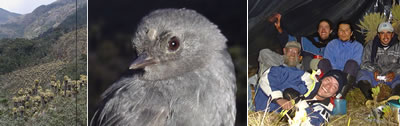
In August 2004, a ProAves expedition led by our Council member Dr Niels Krabbe, undertook the first bird survey of the highest massif in the Western Cordillera after over 50 years, in the Páramo del Sol (also known as Páramo Frontino), in the municipality of Urrao, Antioquia – 70 km SSW of Páramo de Paramillo. The results of that expedition have been tremendous, including the rediscovery of the Critically Endangered Dusky Starfrontlet and the establishment of the Colibri del Sol Bird Reserve by ProAves that protects a critical tract of montane forest and páramo in the Paramo del Sol.

During this expedition, Niels Krabbe (one of the leading experts on the Scytalopus genus) made tape recordings and collected one Paramo Tapaculo in the now Colibrí del Sol Bird Reserve, which formed the basis to permit a major revision of the species across its entire range. Working in collaboration with Dr Daniel Cadena of Los Andes University in Bogota (Laboratorio de Biología Evolutiva de Vertebrados), they examined the phylogenetic relationships and patterns of genetic variation (together with vocalizations) within the entire complex and other Tapaculo species using DNA sequences.

On 9 February, Dr Niels Krabbe and Dr Daniel Cadena published in Zootaxa, a revision to the Paramo Tapaculo which is now composed of multiple taxa (three differentiated lineages), including a new subspecies – Scytalopus opacus androstictus from southern Ecuador and northernmost Peru. The original “Paramo Tapaculo” has changed its name to “Paramillo Tapaculo” (Scytalopus canus) and now only known from a highly restricted area of timberline vegetation on Paramo de Paramillo and Paramo del Sol. The subspecies Scytalopus canus opacus has been given species ranking and given the name Paramo Tapaculo (Scytalopus opacus) which occurs across the Northern Andes of Colombia (except the Western Cordillera), Ecuador and northernmost Peru.

The highly range restricted Paramillo Tapaculo is know from a narrow swath of treeline vegetation (scrub, stunted trees and polylepis woodland) situated between montane forest and páramo grasslands that is often just hundreds of meters wide on both Paramo del Sol and Paramo de Paramillo. While locally common, the estimated area of suitable habitat in both areas for the species is 3 km squared. Only 0.1 km2 is effectively protected by the Colibri del Sol Bird Reserve. Presently, both Paramo del Sol and Paramo de Paramillo are suffering from a severe drought with at least one fire accidentally started by hikers in late January that destroyed a large area of habitat on Paramo del Sol. Extreme droughts related to El Niño, plus the future impacts of climate change, present serious risks for the species and its fragile habitat.

Given the Paramillo Tapaculo’s estimated extent of occurrence and observed decline in the extent and quality of habitat, ProAves considers that the Paramillo Tapaculo probably warrants IUCN Critically Endangered status with immediate efforts to assess its population and implement actions to assist its survival.

To see the first and only photos of Paramillo Tapaculo alive and view the sole location to see the species (in ProAves reserve) see Flickr.

Categorías
News

New Mountain-Tanager discovered in Colombia

Thursday 18 March 2010.

A brightly colored, new subspecies of Mountain-Tanager has been discovered in Colombia. It was first found in the Serranía de los Yariguíes mountains, near ProAves’ Cerulean Warbler Bird Reserve in 2005.

However, it was not until this week that the scientific paper formally describing the new subspecies was published. The new tanager is a subspecies of the Lachrymose Mountain-Tanager, and has been given the scientific name Anisognathus lacrymosus yariguierum. It was discovered and described by ProAves Council member Thomas Donegan and Jorge Enrique Avendaño, who found it during biological explorations of the Yariguíes mountains supported by ProAves. The description was formally published last week in the scientific journal Bulletin of the British Ornithologists’ Club

Photo: Lachrymose Mountain Tanager Anisognathus lacrymosus yariguierum: a new subspecies discovered in Colombia. © B. Huertas / Proyecto EBA.

The new subspecies is a handsome bird, with bright yellow underparts, bluish wings and ’tears’ below its eye. It differs strikingly from other populations in Colombia’s East Andes in its darker upperparts and crown. The name yariguierum refers to the Yariguies mountain range where the species is found, which is itself named for an indigenous group who perished during the Spanish colonial period.

The discovery of any new bird taxon is exciting for ornithologists, but the discovery of a new tanager is of special significance. Tanagers are among the most brightly colored, beautiful, conspicuous and popular groups of birds in the world. As a result, they were frequently a target of bird collectors in the 1800s and most of them were described and discovered over a century ago. New bird species and subspecies in cryptic families like tapaculos and antpittas are still found today, but it is surprising that ornithologists might find a new tanager in the year 2010.

This particular population had gone unnoticed as it is restricted to isolated and virtually inaccessible paramos in the Yariguies range, above 2900 m elevation, and stunted vegetation along steep slopes above 2450 m. It was first found on the ridge of the Yariguies range in an area only accessible by helicopter. The last time that a new tanager subspecies was described was over 15 years ago in 1994, when Aveledo and Perez published details of a population of the Beryl-spangled Tanager from the coastal mountains of Venezuela as Tangara nigroviridis lozanoana. However, there has not been a fieldwork-based discovery in this group since the 1980s.

This is the fifth new bird subspecies described from expeditions in the Yariguies mountains. Also, in butterflies, two new species have been described by Blanca Huertas and colleagues. A large number of endangered bird species are also found in the Yariguíes mountains, including Gorgeted Wood-Quail and Mountain Grackle. As a result of the expeditions and fieldwork supported by ProAves, the Yariguíes mountains were declared a 78,837 ha National Park in 2005 and ProAves established two private nature reserves totalling 2081 ha adjacent to the National Park to protect these and other species.

Thomas Donegan is a member of Fundación ProAves Council and Jorge Enrique Avendaño was formerly an undergraduate student at Universidad Industrial de Santander and is presently studying in the Universidad de Los Andes in Bogota supported by a Giles Scholarship from Fundación ProAves.

Notes

Anisognathus lacrymosus yarigiuerum was discovered on the Fundación ProAves “EBA Project” and “YARÉ Project” expeditions to Serranía de los Yariguíes. These initiatives were supported by Royal Geographical Society, BP Conservation Programme (BirdLife International, Conservation International, Flora Fauna International, Wildlife Conservation Society), Duke of Edinburgh, Fondo para Acción Ambiental, Conservation International Colombia (Becas Iniciativa de Especies Amenazadas-Jorge Ignacio “El Mono” Hernández-Camacho), the Percy Sladen Memorial Fund (Linnean Society), Tropical Andean Butterfly Diversity Project, Game Conservancy Trust, World Pheasant Association, Corporación Autónoma Regional de Santander, Mayoralties of San Vicente de Chucurí, Galan and El Carmen, Universidad Industrial de Santander, Universidad de Caldas, Universidad de Tolima and Gobernación de Santander. Other expedition participants included: Colombian and British biologists and students Blanca Huertas, Elkin Briceño, John Jairo Arias, Cristóbal Ríos, Laura Rosado, Diana Villanueva, Diana Montealegre, Clare Turner, Martin Donegan and local guide José Pinto. Later expeditions to Yariguíes were supported by the Robert Giles Scholarship of Fundación ProAves, The Explores Club, Fundación Alejandro Ángel Escobar and the Faculty of Sciences of Universidad de los Andes.

Contact details for further information:

Thomas Donegan tdonegan@proaves.org

Jorge Avendaño jorgeavec@gmail.com

Links:

EBA Project report for Serranía de los Yariguíes PDF

 Article: Description of Yariguíes Brush-Finch Atlapetes latinuchus yariguierum

Article: Description of butterfly Idioneurula donegani

Article: Description of Scytalopus griseicollis gilesi

Article: Description of Grallaricula nana hallsi


Categorías
News

First ever photo of Endangered Santa Marta Sabrewing

Wednesday 31 March 2010.

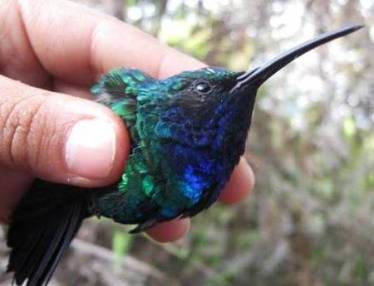
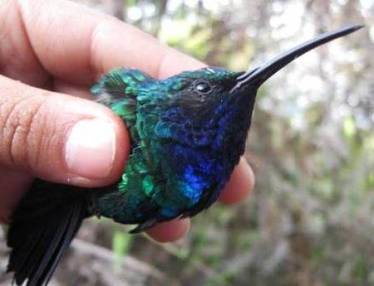
The first ever photo of a living Santa Marta Sabrewing (Campylopterus phainopeplus) was taken on 24 March by Laura Cardenas beside the new “Condor Observation Tower” ay 1,900 meters (6,200 feet) elevation in the El Dorado Nature Reserve in the Sierra Nevada de Santa Marta. Laura was monitoring migratory birds in the reserve as part of the project: Crossing the Caribbean: identification of critical sites for migratory birds in northern Colombia. This photograph is the first confirmation of this spectacular hummingbird after over 60 years when the species was collected by ornithologists working in the Sierra Nevada de Santa Marta at the end of the second world war (in 1946).

Photo: Santa Marta Sabrewing (Campylopterus phainopeplus) by Laura Cárdenas.

The Santa Marta Sabrewing, classified by IUCN as Endangered and endemic to the Sierra Nevada de Santa Marta, is at high risk of extinction. Historical specimens come from the southern slope of the Sierra Nevada where birds would be feeding at high elevation (up to snow line at 4,800 meters) in low vegetation during the warmer wet season (June to September), so more easily seen and collected. During the dry season (February to May), the species is reported to descend to lower elevations (1200-1800 meters) probably because there was a more diverse source of nectar resources. This record at lower elevations during the dry season is consistent with this assumption.

Apart from a single sighting of the species above Valledupar, Cesar Dept in 1990 by Mark Pearman, ProAves and visiting birders have several sightings since 2000 in and below the El Dorado reserve to the town of Minca, typically single birds feeding in the canopy. However, the widespread and relatively common Lazuline Sabrewing (Campylopterus falcatus) is more common in the same area. The real difference is the tail coloration, which fortunately is easy to see.

Surveys by ProAves on the southern slope of the Sierra Nevada de Santa Marta (considered the species core population area) witnessed extremely poor quality of páramo vegetation and lack of native forest – which highlights the species delicate plight. Recent records of the Santa Marta Sabrewing in and around El Dorado and Minca are probably related to the fact that this area remains some of the last remnants of native subtropical forest. This confirmation of the Santa Marta Sabrewing further emphasizes the national and global importance of the El Dorado Nature Reserve for endemic birds and wildlife.

Categorías
News

Rediscovered Sabrewing highlights the Sierra Nevada

Tuesday 11 May 2010.

The first clear evidence of the species survival was presented in early April and has aroused considerable attention. It has also highlighted the importance of conservation and urgent needs for the many threatened and endemic species found in the Sierra Nevada de Santa Marta.

The record generated interest for ornithologists within Colombia that reported a capture and photo of the Sabrewing just months before, but unfortunately the record was not published nor made public. Nevertheless, there have been several observations each year by researchers and visitors since 1999 in the area of the reserve down to the town of Minca, but unfortunately firm evidence has never been obtained.

Santa Marta Sabrewing (Campylopterus phainopeplus) by Laura Cárdenas on 27th March 2010. On the 27th April 2010, ProAves celebrated an agreement with the new NGO called SELVA that now manages the Cruzando el Caribe project within the El Dorado Reserve. The photo is thanks to the Cruzando el Caribe Project and SELVA.

Even sound recordings of Sabrewing vocalizations, possibly of Campylopterus phainopeplus, were recorded by Niels Krabbe board member working for ProAves in Feb 2007. The exact comments on the recordings were “Three or four birds appearing to be Campylopterus phainopeplus were observed and tape-recorded as they fed from a flowering Inga tree at 1150 m on 24 February 2007.” However, as noted by Niels Krabbe, Campylopterus falcatus was not confirmed, but known to be in the same area.

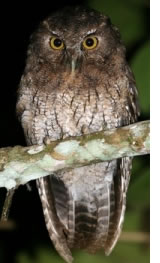
Magascops gilesi

Magascops gilesi.

So despite some discussion, it remains clear that the first published photos Read article is the first clear evidence of the Santa Marta Sabrewing existence in over 60 years.

Some errors were published in a press release issued by American Bird Conservancy, however ProAves and their research has made much progress in ornithology in the area, including a new species of Megascops Screech-owl.

The identification of a distinct species as the Ruddy Foliage-gleaner (Automolus rubiginosus rufipectus) (read more) that is endemic to the Sierra Nevada de Santa Marta, the first investigation and recording was done by Dr Niels Krabbe within the Natural Reserve El Dorado (11° 5’28 .78 “N, 74 ° 4’26 .27” W). Not only is this taxa distinctive, but it may even be more closely related to a genus Hylocryptus composed of two species in southern Ecuador and Peru and Brazil.

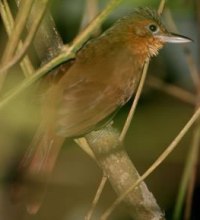
Automolus rufipectus

Automolus rufipectus.

The species, named the Santa Marta Foliage-gleaner Automolus rufipectus was studied by Niels Krabbe inside El Dorado Bird Reserve and is restricted to closed canopy primary subtropical forest, which is extremely fragmented and predominately cleared for agriculture. While know to occur in other sites in the Sierra Nevada, the species highly restricted range and sensitivity of habitat suggest the species be considered Vulnerable to extinction.

Preliminary analysis of vocalizations from El Dorado by Dr Niels Krabbe and are now on sale while species rank is likely to be appropriate for five other taxa, including the Masked Trogon (Trogon personatus sanctaemartae), Montane Woodcreeper (Lepidocolaptes lacrymiger sanctaemartae), Rufous Antpitta (Grallaria rufula spatiator),Gray-breasted Wood-wren (Henicorhina leucophrys anachoreta), and Stripe-headed Brush-finch (Arremon torquatus basilicas), and possibly others.

We thank the media for its interest in showing the importance to science and conservation of the Sierra Nevada de Santa Marta, now we must push actions for its conservation.

Categorías
News

$4.3 Million for Neotropical Migratory Birds and Habitat Conservation

Wednesday 11 May 2011.

Matched by more than $15.1 million in additional funds from partners, the projects will support habitat restoration, environmental education, population monitoring, and other priority activities within the ranges of neotropical migratory birds in the United States, Canada, Mexico and 13 Latin American and Caribbean countries.

The grants are funded under the Neotropical Migratory Bird Conservation Act, which supports public-private partnerships carrying out projects in the United States, Canada, Latin America and the Caribbean that promote the long-term conservation of neotropical migratory birds and their habitats. Neotropical migratory birds breed in Canada and the United States during summer and spend the winter in Mexico, Central America, South America or the Caribbean islands.

“The Neotropical Migratory Bird Conservation Act is a catalyst for bird conservation projects, and the grants made under the Act allow bird habitat conservation to take place where it otherwise might not happen,” said Acting Service Director Rowan Gould. “These grants bring together partners to achieve conservation on a far greater scale than would otherwise be possible.”

The more than 340 species of neotropical migratory birds include plovers, terns, hawks, cranes, warblers, and sparrows. The populations of many of these birds are presently in decline, and several species are currently protected as threatened or endangered under the Endangered Species Act.

The Neotropical Migratory Bird Conservation Act of 2000 established a matching grants program to fund projects promoting the conservation of neotropical migratory birds in the United States, Canada, Latin America, and the Caribbean. Funds may be used to protect, research, monitor, and manage bird populations and habitat as well as to conduct law enforcement and community outreach and education. By law, at least 75 percent of the money goes to projects in Latin America, the Caribbean and Canada, while the remaining 25 percent will go to projects in the United States.

Examples of projects receiving grants include: U.S.-Mexico Grassland Bird Conservation, Phase IX (Mexico, United States) Grantee: Rocky Mountain Bird Observatory This project will continue work funded through the Act since 2002 to conserve grassland bird species of western North America. Partners will conduct grassland bird research and monitoring in Mexico to provide quality data to inform conservation and management of high priority wintering grassland bird species.

They also will conduct training in Mexico to build local capacity for grassland bird conservation and in Colorado to educate students and teachers about grassland birds and habitat.

Conservation Action for Bicknell’s Thrush Across its Range in Canada Grantee: Bird Studies Canada. Project partners will work together across the Bicknell thrush’s breeding range in Canada to mitigate threats and set the stage for long-term species recovery. Primary objectives are to partner with forestry companies and relevant agencies to develop and implement best management practices on industrial forest land and to develop specific habitat and population targets for individual management jurisdictions. Regional and range-wide monitoring programs will evaluate the success of these conservation actions.

More information about all projects awarded grants is on the Web at:  www.fws.gov

usfish


Categorías
News

Spectacular Mammal Rediscovered after 113 Years!

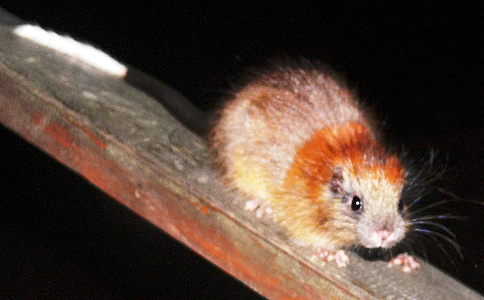
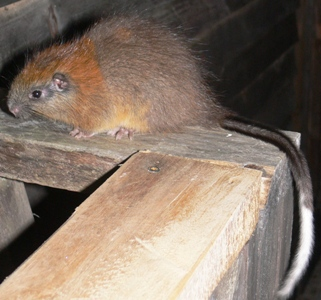
The magnificent Santa Marta Toro (Santamartamys rufodorsalis), stayed for almost two hours while two ProAves volunteers took the first photos ever of a creature the world thought would never be seen again.

The charming nocturnal rodent made his re-debut to the world at 9:30PM on May 4, 2011 at the Reserva Natural El Dorado, in the Sierra Nevada. The reserve was established in 2005 by Fundación ProAves – Colombia’s foremost bird conservation organization – with support from Rainforest Trust, ABC, and Fundación Loro Parque.

The animal was rediscovered by Lizzie Noble and Simon McKeown – two volunteers with ProAves monitoring endangered amphibians. It posed for photographs – including close-ups -before calmly proceeding back to the forest, but they were unaware of the significance of the sighting until they showed Rainforest Trust CEO, Dr Paul Salaman, who immediately identified the species as the long-lost Santa Marta Toro also known as the Red-crested Tree Rat.

“He just shuffled up the handrail near where we were sitting and seemed totally unperturbed by all the excitement he was causing. We are absolutely delighted to have rediscovered such a wonderful creature after just a month of volunteering with ProAves. Clearly the El Dorado Reserve has many more exciting discoveries waiting,” said Lizzie Noble from Godalming, England.


Red-crested Tree Rat (Santamartamys rufodorsalis).


“We are so proud that our El Dorado Nature Reserve has provided a safe haven for this enigmatic little guy to survive. The discovery exemplifies why we buy forested properties known to be important for endangered wildlife yet at imminent risk of being destroyed. We are also proud that our volunteers made the discovery of the decade, and hope future eco-tourists will see the mammal at the reserve,” said Lina Daza, Executive Director of ProAves.

“The El Dorado Nature Reserve represents the ultimate Noah’s Ark, protecting the last populations of many critically endangered and endemic flora and fauna; a living treasure trove like no other on earth,” said Dr. Paul Salaman, the CEO from Rainforest Trust who confirmed the identity of the species.

The Red-crested Tree Rat will now likely be designated as Critically Endangered under the International Union for Conservation of Nature (IUCN)’s Red List of Threatened Species criteria. What is most concerning, however, is that much of the tree rat’s potential remaining range is inundated with introduced feral cats that prey on native fauna.


To download the pictures click here.


The 2,000-acre El Dorado reserve is named after the legendary lost city of gold, and is internationally known as a unique destination for eco-tourists. It is situated in cloud forests at 5,900 feet, just two hours’ drive from the popular coastal tourist city of Santa Marta. The reserve and adjacent lands host the highest concentration of continental, range-restricted bird species found anywhere in the world, including the endangered Santa Marta Parakeet, Santa Marta Bush-Tyrant, and Santa Marta Sabrewing, all of which have their entire or major stronghold populations there. It also holds one of the highest concentrations of endemic and threatened amphibian species in the world. The reserve is among the world’s highest priorities for conservation, yet remarkably little is known about the area.

This discovery marks the beginning of a major effort by ProAves and Rainforest Trust to save the Santa Marta Toro.

El Dorado Bird Reserve

[slickr-flickr search=”sets” set=”72157616919731317″ items=”20″ type=”gallery”]

With the support of:


Categorías
News

Restoration in Sierra Nevada de Santa Marta

Monday 16 February 2009.

The eradication of non-native and invasive pines in and around the Reserva El Dorado is critical for saving endangered fauna of the Sierra Nevada de Santa Marta, especially two species of Critically Endangered Harlequin frogs and the Endangered Santa Marta Parakeet.

Unfortunately, a large area of native vegetation on the Cuchilla de San Lorenzo ridge was cleared in the 1970’s and reforested by the National Parks authority by non-native pines. Unfortunately, the pines have matured and killed the majority of native flora. Furthermore they have seeded and expanding down the slope across 1-2 km of the ridge into areas of native forest.

Since establishing the El Dorado Bird Reserve on Cuchilla de San Lorenzo, ProAves has felled many thousands of pine seedlings that have invaded native forest. Also we are working with CorpoMag to clear mature pines on the Cuchilla de San Lorenzo ridge within and beside the El Dorado reserve.

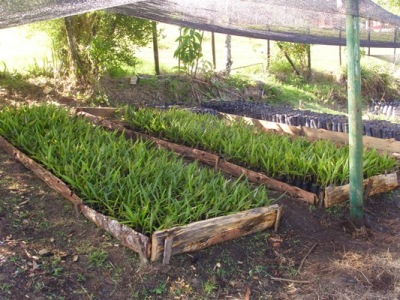
Simultaneously ProAves is reforesting cleared pine plantation areas with thousands of seedlings of 14 native species important to the avifauna of the site. Restoring the native flora of the area is a key part of conservation initiatives to save the many endemic species to the Sierra Nevada de Santa Marta.

It is estimated that less than 19% of the original vegetation of the Sierra Nevada de Santa Marta still remains, due large in part to deforestation for crops and livestock, setting fires and non-native plantings. For this reason, ProAves conducts conservation efforts to restore habitats for native species of fauna and flora through the production of local native species and eradication of introduced pine trees and cypresses, and restoring native species.

This year 2009 ProAves will continue the intensive process of eradication of non-native and invasive pines, with the aim of complete the elimination of these plantations in the short term to benefit the endemic and native biodiversity of the Sierra Nevada de Santa Marta.

If you want to contribute to forests conservation in the Sierra Nevada de Santa Marta and its biodiversity, please support us with a secure donation online or VOLUNTEER to cut down pines! Write to fundacion@proaves.org

With the support of:

abc blue_moon ecoturs


Categorías
News

Kids restore the forest in Sierra Nevada

Friday 31 July 2009.

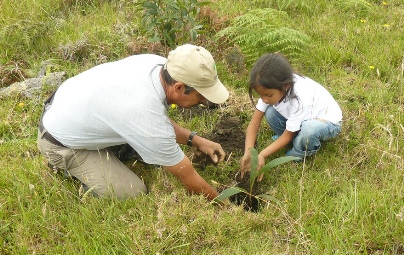
On May 9, 2009, 9 kids living close to El Dorado Bird Natural Reserve were part of a full day of reforestation within the area of the reserve. This activity was created to show the importance of restoring native habitats of Sierra Nevada de Santa Marta, benefiting one endemic and endangered species of this habitat, the Little-Parrot of Santa Maria (Pyrrhura viridicata).

This beautiful bird has been suffering since many of the native trees were replaced by exotic pinecone trees in some areas and total deforestation in others.

0,18 hectares were designated to be reforested. 181 trees of four endemic species were planted, such as the Ramo Palm (Ceroxylum ceriferum), use by the Little-Parrot of Santa Maria’s main site of nesting, and the Sangro (Croton sp), which it’s the birds main source of food. The four varieties of trees were grown within the botanic nursery of the reserve.

Besides the kids, other people participated in this activity: the teacher in charge of the school group, her assistant, two people for the construction of the fence surrounding the terrain and the reserve’s team. The aim is to continue with restoring habitats in the reserve and in its muffling zone, all with the support of the community and the kids.

More Pictures on Flickr.

Categorías
News

ProAves and the municipality of Jardín join forces

Friday 31 July 2009.

On 15 April 2009, ProAves and the mayoralty of Jardin, Antioquia, signed an institutional cooperation agreement in the framework of Ognorhynchus Project of ProAves in this municipality. This activity is carried out mainly via the establishment, management and joint production of the municipal botanic nursery that includes indigenous species used by avifauna.

Municipal botanic nursery of Jardín, Antioquia, with Wax Palm trees donated by Corantioquia.

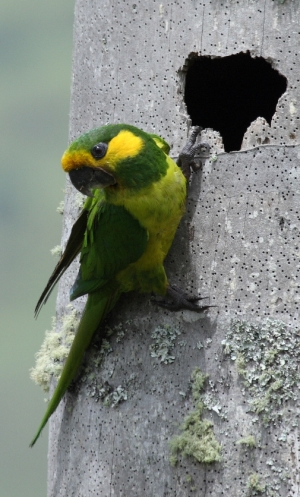
With the plants produced, ProAves will carry out ecological restoration activities at the Yellow-eared Parrot Nature Reserve, both in cushioning and forage areas of this bird as part of its reforestation programme.

Luis Felipe Barrera, ProAves Sub-Director of Protected Areas – Central Regional said: “With the signature of this agreement, we are demonstrating that it is perfectly possible to integrate a private initiative with a municipal initiative, pro conservation of the yellow eared parrot habitat”, who also indicated that this agreement is being fully and successfully applied.

Moreover, Corantioquia donated 2,000 Quindío Wax Palm trees (Ceroxylon quindiuense) to be sprinkle at the Yellow-eared parrot Reserve and in other ecological sites established by the Foundation in cooperation with the community.

proaves Jardin corantioquia
Jardín (Antioquia)


Categorías
News

Restoring Native Habitat for Migratory Birds

Thursday 10 December 2009.

For almost two years and thanks to the support of ABC, Usfws y NMBCA we have in the Corridor Reinita Cerúlea and in the Amphibian Nature Reserve of Ranita Dorada 3 temporary nurseries with a total capacity of 90.000 seedlings. The production is based on the selection of seedlings that provide resources for wildlife, humans and agroforestry systems. 

So far a total of 165.114 seedlings of 56 native species have been produced including species of flora that are under some degree of threat such as: Sweitenia macrophylla (Mahogany), Cariniana pyriformis (Abarco) and Quercus humboldtii (Oak).

In this way 30 hectares have been reforested in silvopastoral systems, 60 hectares of coffee in the shade and 12 hectares of cocoa in open zones (pasture recovery) for a total of 102 hectares.

This process has been joined by 8 community action groups for the paths through which the Corridor passes and in the area of Frías in Falán and more than 50 families not only with reforestation but also with training in reforestation and management of the same delivering educational material which also serves to support those skills.  

Categorías
News

Programa de Servidumbres Ecológicas

En el segundo semestre de 2007 ProAves inició el programa de servidumbres ecológicas en Colombia, con la firma del segundo acuerdo de este tipo, conformado entre su {{[Reserva Natural de las Aves Loro Orejiamarillo->https://www.proaves.org/rubrique.php?id_rubrique=281]}} y el predio La Meseta, en Jardín, Antioquia.


En el segundo semestre de 2007 la Fundación ProAves dio inicio al programa de servidumbres ecológicas en varias localidades de Colombia, con la firma del segundo acuerdo de este tipo, conformado entre su {{[Reserva Natural de las Aves Loro Orejiamarillo->https://www.proaves.org/rubrique.php?id_rubrique=281]}} y el predio La Meseta, del señor Mario Peláez, en Jardín, Antioquia.

La primera servidumbre se había conformado tres años antes, también en el municipio de Jardín, Antioquia, gracias al esfuerzo de organizaciones como [{{Resnatur}}->https://www.proaves.org/article.php?id_article=150], {{[The Nature Conservancy->http://www.nature.org/]}} (TNC) y {{ProAves}}, contando con el acompañamiento de ProAves desde entonces.

Las servidumbres ecológicas son un mecanismo legal de acuerdo voluntario entre dos partes para la conservación, en el que la sociedad civil se encarga de proteger la biodiversidad y los recursos naturales de un área. El programa de ProAves se lleva a cabo a través de sus Reservas Naturales de las Aves y predios particulares, y está dirigido a incrementar y mejorar las áreas destinadas para la conservación de especies de aves tanto residentes como migratorias en todo el territorio nacional.

Están en proceso otras servidumbres como la de la [{{Reserva Natural El}}{{ Paujil}} ->https://www.proaves.org/rubrique.php?id_rubrique=40]y un predio privado de 180 hectáreas en el municipio de Puerto Boyacá, Boyacá; la {{[Reserva Reinita Cielo Azul->https://www.proaves.org/rubrique.php?id_rubrique=78]}} y el Colegio Colnupaz, de San Vicente de Chucurí, Santander; la reserva Loro Orejiamarillo y el predio Fátima-La Cordillera de Támesis, Antioquia, y la reserva Loro Coroniazul y el predio Guayabal de Génova-Quindío.

Con el apoyo de:

Categorías
News

New permanent ecological easements

Tuesday 24 March 2009.

With the support of Fundación Loro Parque and American Bird Conservancy, ProAves has established a second permanent ecological easement in Colombia, benefiting the Critically Endangered Yellow-eared Parrot. The easement was created beside the Yellow-eared Parrot Bird Reserve. The farm is called La Antioqueña, in Riosucio, department of Caldas.

The Antioqueña is a 1038 acres farm situated at 2600-2850 meters elevation and located in the humid montane forest lifezone. It includes 692 acres of forest and 346 acres of pasturelands for cattle. This area represents a critical site for the Yellow-eared Parrot for reproduction and feeding due to the presence of the Wax Palm and key foraging trees such as Cytharexilum subflavescens, Croton magdalenensis and Sapium utyle.

Panorámica de la finca La Antioqueña y de la Reserva Natural Loro Orejiamarillo

Panoramical of Farm La Antioqueña and Yellow-eared Parrot Bird Reserve.

The farm owners are Julia Amparo Velásquez Mejía and Gildardo Alzate Gómez, a couple of veterinary doctors devoted to conservation since they bought this land twenty years ago with the aim of having a place to teach and share their love for nature with their children. With their help, ProAves will implement direct conservation actions including silvopasture, forest fragment protection and Wax Palm reforestation.

Protecting the area is vital to counteract the many threatens presented in the municipality of Riosucio due to the lack of adequate conservation programs, land use and pressures from illegal logging and charcoal production. 

If you want to contribute maintaining our conservation activities on Yellow-eared Parrot Bird Reserve or helping directly the conservation of this parrot species, please support us with a secure donation online, join our Adopt a nest box, or write to fundacion@proaves.org

abc lpf


Categorías
News

Eight New Ecological Easements

Wednesday 23 September 2009.

The program was created two years ago, and already thirteen ecological easements have been established in the country. Eleven were set up this year, and three of those were in San Vicente de Chucuri, Santander, within the Cerulean Warbler corridor. The easements protect strips of forest that are on coffee and cacao farms. The trees provide native shade for the crops and a place for migratory birds like the Dendroica cerulea (Cerulean Warbler) to arrive.

Recently eight easements were approved in the town of Jardin, Antioquia for the conservation of the Yellow-eared Parrot. They are ecological easements because they protect and conserve the culture of Jardin’s threatened flora and fauna. With the easements in place, the local government becomes connected to conservation efforts, whose aim is to conserve these areas forever. That is why ProAves conserves 458 hectares of land that protect the habitats of threatened species.

Five other easements are currently in process that will further strengthen habitat conservation for many species within the Cerulean Warbler corridor in San Vicente de Chucuri.

We would like to thank all of the government and non-government institutions that develop and approve conservation initiatives and that provide support for their establishment and implementation. Our thanks also go to the local governments in Jardín, Antioquia and San Vicente de Chucuri, Santander to Corantioquia to American Bird Conservancy, Loro Parque Fundación and to all of the community members who have been part of this process.

abc lpf corantioquia
Jardin San_Vicente_Chucur Yar
Jardín (Antioquia) San Vicente de Chucurí (Santander)


Categorías
News

Photo gallery, handcrafts made by Women for Conservation

Wednesday 15 April 2009.

These products are made by the group Women for Conservation. These products are a sample of the collection and each design uses different colors and materials. To obtain more information and purchase these products please contact agomez@ecoturs.org


Product:Necklece
Material:Nickel-plated metal rings, hand made with Bombona seed in read color and nickel metal chain
Size:44 cm

Product: Necklece
Material:Hand made with oval mustard tagua seed, mustard tagua diente de leon, nickel-plated metal rings and chain.
Size:37 cm

Product:Necklece
Material:Hand made with bombona and asai seed color light blue.
Size:34 cm
Product:Necklece
Material:Hand made with earthglase brown beeds, square metal bronze rings and chain
Size:30 cm
Product:Necklece
Materiales:Hand made with dark green tagua seed and nickel-plated metal rings
Size:42 cm
Producto: Bracelet
Material:
Size:
Product:Necklece
Material:Hand made with ceramic beeds in brown color and bronze metal chain and rings
Size:40 cm
Product:belt and bracelet
Material:
Size:
Product:Bracelet
Material:Hand made with camajuro light blue seeds and bronze rings
Size:7 cm diameter (elastic)
Categorías
News

Medical checkup for Women for Conservation

Tuesday 2 June 2009.

With support from American Bird Conservancy, on April 25, 2009 ProAves and its program Women for Conservation conducted a medical checkup and health workshop for the women who are part of the group in El Paujil Natural Bird Reserve and their families.

The day was held in the reserve between 9:00 AM and 4:30 PM and was attended by 28 children and 26 adults. The population of the area surrounding the reserve is extremely poor and several hours from the nearest health services. For almost all participants this was their first ever health and dental checkup and clearly important as not only has immediate benefits but long-term effects by educating them on basic health issues. The joy and gratitude of the recipients were evident, which gave great satisfaction to the team that performed the work, directed by the program coordinator, Andrea Linares.

The children were also given a talk on oral hygiene and a recreation activity led by Parrot Bus team.

ProAves also delivered these materials to women and their children:

- 1 gas stove and 13 gas cylinders in order not to use firewood for cooking.
- 15 bags of Women for Conservation, each with a personal hygiene kit, donated by a woman friend of the program to contribute to it.
- 14 suitcases for children between 6 and 16 years old, each with a school kit.
- 10 suitcases for children between 8 months and 6 years old, each with an underwear and outerwear.
- 22 boxes with an oral hygiene kit.

ProAves thanks all the medical, reserve and logistics staff, as well to many other people who contribute to the activity, for their support.

Witness this wonderful activity clicking in this video.

abc


Categorías
News

Women for Conservation collecting palm seeds

Tuesday 3 November 2009.

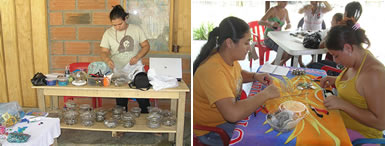
The “Women for Conservation” program by ProAves has trained 44 women around four reserves on the sustainable use of natural resources. These resources are used for handmade jewelry such as necklaces and bracelets, hand-painted objects, embroidered bracelets, and book markers.

ProAves sells the final products in gift shops located at the reserves, at special events, ornithological gatherings, and exhibitions throughout the world. The proceeds go directly to the community, where they provide income and encourage a positive attitude towards the reserves by local populations.

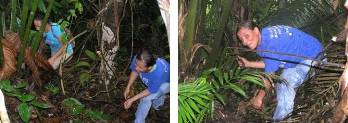
Tagua, also known as marfil nut or vegetable ivory, is the seed of the Tagua palm tree Phytelephas macrocarpa. It grows in humid tropical woods commonly found in Panama, Colombia and Ecuador. (Wikipedia)

We would like to invite you to learn more about how Tagua seed is collected:

Izq. Hábitat natural de la tagua. Bosque primario. Der. palma de tagua

Left. Primary woods, the natural habitat of Tagua. Right. This is the Tagua palm.

La tagua crece en medio del bosque rodeada de distintas especies vegetales, en zonas bajas y húmedas.

The Tagua palm grows in the center of the woods, and is surrounded by distinct species of flora. It prefers low and humid areas.

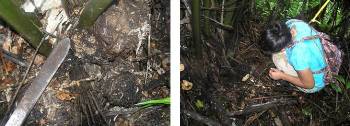
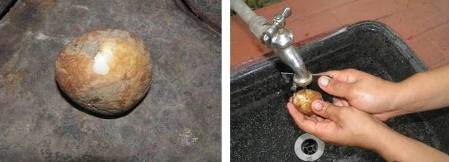
The seeds grow at the base of the palm, inside a shell or a “morula”, that is quite hard. Every morula holds approximately twenty (20) Taguas. It is difficult to calculate how many morulas there are per a palm tree, but there may be as many as ten (10) morulas in different stages of maturation.

The seed must be completely hard (gecha in the local dialect) before it can be extracted from the palm.

Morulas en la base de la palma

Morulas at the base of the palm tree.

Se  hace un pequeño y duro corte sobre la morula para saber si esta lista para extraer.

One must make a small, deep cut on the morula to know if it is ready for extraction.

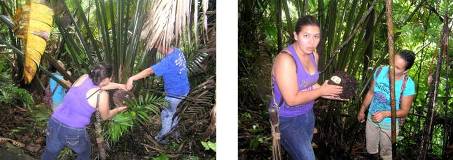
After the test incision, the morula is separated from the base of the palm tree. Once several morula have been collected, the next step is to extract the seeds from the morula. A hammer must be used to open the morula due to the shell’s hardness.

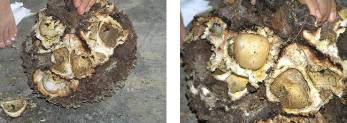
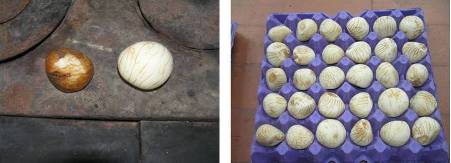
Las taguas de esta forma salen casi limpias, es suficiente lijarlas un poco y lavarlas para iniciar el proceso de corte y tintura.

The Taguas of this type come out nearly clean. It is sufficient to sand and wash the Tagua at the beginning of the cutting and tinting process.

There are other forms of collecting Tagua, such as gathering them from the forest floor. One can find some Tagua that animals dropped or left behind in their feeding process. Tagua found by these methods are slightly older and harder to process. A Tagua found on the ground is protected in a hard shell that is quite difficult to remove. The process of shell removal in these cases requires an additional step, and lowers the commercial value of the seeds.

Below is a sample of the artesian crafts made from Tagua:

Bracelette with Tagua and acrylic and Triangular Tagua.

Sliced Tagua and metal and Flat Tagua and leather.

With the support of American Bird Conservancy and Audubon Naturalist Society, ProAves is expanding its successful program Women for Conservation, in order to protect four of its natural reserves. This will be carried out as a way of promoting business opportunities for the rural women who live in communities neighboring reserves.

In many ways the local communities can pose a challenge to the management of the reserves, because they tend to cut down woods to clear land for cultivation or to sell the wood, and often they must resort to hunting the local wildlife or to chopping down the trees for fuel as firewood.

ProAves also employees people from the community as park rangers, guides and camp assistants to help with reforestation activities. All of these activities help the people of the communities in the end. ProAves also designs environmental education programs for the children of the communities, so that they too can become integrated with conservation efforts.

With the help of ABC and the Audubon Naturalist Society, ProAves is now expanding the program to other communities, thus helping to alleviate the pressures on the protected natural wildlife resources in our reserves.

abc audubon


Categorías
News

Supporting women for conservation

Wednesday 11 August 2010.

The successful Women for Conservation, led by fundación ProAves with support from the American Bird Conservancy, has trained women in four rural Colombian villages in the use of natural resources for the production of handicrafts and offered them business opportunities to help relieve pressure on natural resources protected on the reserves.

Products made by members of the group

www.amparocrafts.com

The website www.amparocrafts.com supports the Women for Conservation program through the sale and promotion of products, the goal is to provide a fair return that is above the national average and better quality of life for those who have no alternative to the exploitation of natural resources to support their families.

Visit www.amparocrafts.com and find a detailed catalog of these significant handcrafted pieces and profiles and the life stories of the women working in the project.

Sales are available online in the United Kingdom.

Learn more about the Women for Conservation project in the following video:

{youtube}y3SodabAqT0|425|344|1{/youtube}

amparo abc proaves
Categorías
News

Comunidad lidera VI Festival del Paujil de Pico Azul

Miércoles 1 de diciembre de 2010. 

“Cuidemos el hábitat del paujil de pico azul”

ProAves realiza cada año el VI Festival del Paujil con el objetivo de enseñar a los niños, jóvenes y adultos sobre el paujil de pico azul (Crax alberti) ave endémica de Colombia y críticamente amenazada de extinción.

Este festival es un evento dinámico y educativo donde se desarrollan diferentes actividades dirigidas a la comunidad, en especial a los niños, niñas y jóvenes que se encuentran más cercanos al área de influencia de la Reserva Natural de las Aves el Paujil, lugar en el que la Fundación concentra sus esfuerzos en la conservación de esta ave.

[slickr-flickr search=”sets” set=”72157625342154381″ items=”20″ type=”gallery”]

Durante el Festival se realizaron diferentes actividades como talleres y charlas sobre el paujil, en la Institución Educativa Puerto Pinzón se pintó el mural del VI Festival del Paujil, con los estudiantes del grado noveno y el acompañamiento de personal docente y de ProAves.


Con la participación de más de 180 niños, jóvenes y adultos de la misma Institución Educativa se realizó un desfile, bajo el lema “Cuidemos el hábitat del paujil de pico azul”; éste se desarrolló por las calles de Puerto Pinzón llevando un mensaje a la comunidad de conservación y cuidado del paujil de pico azul (Crax alberti) y su hábitat. Así mismo, con la asistencia de más de 400 personas, se realizó el desfile de comparsas donde la Fundación ProAves participó con la comparsa mitos, leyendas, el paujil y las migratorias; donde los niños caminaron por las calles del municipio disfrazados de paujil, de aves migratorias y de personajes de distintos mitos y leyendas propias de la región como la llorona, la madre monte, el duende, el diablo, el mohán y el barbudo.

La carrera de observación se constituyó en una actividad lúdica y educativa, donde participaron 66 personas en su mayoría jóvenes y niños, a cada equipo se le asignaron nombres de aves y de especies amenazadas de la región, así, participaron en pruebas tales como twister de aves, pintura, pasar por el pantano, armar el paujil y las aves migratorias, entre otras.

Estas muestras culturales se establecen en una fuente educativa y de reconocimiento ambiental y cultural. El día 26 de octubre, como un acto simbólico se realizó el desfile de faroles por las principales calles de Puerto Pinzón, donde participaron más de 300 personas entre niños, jóvenes y adultos, estos faroles fueron realizados por los niños con distintos motivos, entre ellos el paujil y las aves migratorias.

AfichePaujil

Afiche que hace parte de la divulgación, es una obra de arte que realizaron los artistas e ilustradores plásticos Paula Romero y Fernando Laverde de la Fundación Arte y Conservación.

Gracias a las siguientes organizaciones por su apoyo en la realización del Festival.

Logos

Categorías
News

¡En venta Café Reinita Cielo Azul!


Ya está a la venta en los Estados Unidos el Café de Conservación Reinita Cielo Azul gracias al apoyo de ProAves

Se trata de un café de calidad premium que se produce en los cafetales con sombrío del departamento de Antioquia, en Colombia, que gracias al apoyo de la Cooperativa de Caficultores de Andes (COOPERAN) ha sido posible contar con una certificacion de la excelencia del cafe. Estos cafetales se constituyen en hábitat para la Reinita Cielo Azul o Reinita Cerúlea {(Dendroica cerulea) }cuando llega en su migración invernal desde el norte del continente a los bosques de las montañas del centro del país.

Apoyar la producción de un {{[café amigo de las aves->https://www.proaves.org/rubrique.php?id_rubrique=184]}} es uno de los puntos fundamentales del programa de conservación de la biodiversidad que desarrolla ProAves. Al comprar este producto, los consumidores norteamericanos están contribuyendo a estos esfuerzos, a la conservación de este tipo de cafetales y a la preservación no sólo de la Reinita Cielo Azul sino de otras aves como el Pibí Boreal {(Contopus cooperi)} y la Reinita de Canadá {(Wilsonia canadensis), }también migratorias,{ }que utilizan su mismo hábitat.

La comercialización se hace a través de firma Thanksgiving Company que destina parte de sus ingresos a esta causa. Para más información marque {{[aquí->http://www.abcbirds.org/]}}.

Categorías
News

New Video: Shade grown coffee – its for the birds!

Monday 14 February 2011.

Ever wonder where does your coffee come from?

Trust for Wildlife with Fundación ProAves presents a short film “Shade-grown coffee and saving migratory birds of North and Latin America” that is produced by Samuel Orr, Marshal T. Case, and Elisabeth N. Radow. Much of the tropical film footage is taken in the Cerulean Warbler Bird Reserve and local community of San Vicente de Chucuri in Santander Department.

Tropical forests support some of the greatest diversities of life on earth, but the same areas also produce one of the most valuable commodities on earth – COFFEE. Traditionally grown in the shade of forest trees, people drink nearly one billion cups of coffee each day. But over the past 30 years more than a half of the coffee-growing farms have eliminated their forests and beautiful shade trees that tropical wildlife depend on, the farms that produce coffee grown under the sun are relatively sterile and can support only 10% of its diversity as compared to shade coffee.

Decades of rainforest removal for sun grown coffee has contributed to climate change, extreme weather patterns and dramatic loss of essential animals who call the rainforest home. This includes an alarming loss of Neotropical migratory birds that winter in our coffee and migrate to the United States and Canada to nest and raise their young in our forests and backyards. A key to a climate-healthy planet that balances the needs of people and wildlife begins with growing these highest quality coffee beans in the shade of trees and bringing them to you.

The coffee you drink every day has a strong impact on these ecosystems, but what you drink and how you ask for it can be the key to finding a solution.

Shade grown coffee, saving migratory birds of Latin and North America.

{youtube}L9zVJWZaHKc|425|344|1{/youtube}

Made possible by:

The Trust for Wildlife

The Ceres Trust

MaryBelle Price

The Catamount Rotary Club

Categorías
News

ACCIONES

Reducir la perdida de la biodiversidad proporcionando una estrategia efectiva y eficiente para la protección del ambiente y el desarrollo sostenible de los recursos naturales…


Reducir la perdida de la biodiversidad proporcionando una estrategia efectiva y eficiente para la protección del ambiente y el desarrollo sostenible de los recursos naturales, implementando planes de desarrollo acorde a las necesidades de la región, junto con una apropiada estrategia para el manejo sostenible de los recursos naturales aunado a un eficiente trabajo de educación y sensibilización ambiental. Para el logro de nuestro objetivo se trabajará en estrecha relación tanto con las entidades gubernamentales como no gubernamentales, así como también con las comunidades locales campesinas e indígenas de la región, en especial con cabildos y resguardos indígenas de la región en talleres de planificación, ordenamiento-zonificación, educación, sostenibilidad de los recursos para lograr por parte de ellos tener una planificación y ordenamiento de sus áreas de resguardos que permita en el futuro designar una zona como área de protección y conservación del resguardo indígena.

Este proyecto incluye innumerables factores y actividades que contribuirán a la conservación de los ecosistemas y la biodiversidad.

Categorías
News

Conservation

Ognorhynchus_icterotis-RoncesvallesProAves is a purely conservationist NGO, which for more than 10 years has been implementing and developing tools and conservation activities, in order to mitigate the impact caused by the man on the habitats of endangered species.

The ProAves conservation area works to contribute to maintaining the quality and availability of habitat for conservation of priority bird species through the establishment and management of nature reserves in civil society and to develop other forms of protection supported by a concept of self-sustainability and community integration, influencing local, regional and national environmental protection.

Its objectives are:

  • To establish, expand and manage comprehensively the protected areas of the Foundation, ensuring compliance of the function in perpetuity.
  • To implement, evaluate and strengthen programs and tools for conservation in nature reserves and areas of influence.
  • To promote and develop self-sustaining actions to ensure the perpetuity of the reserves.
  • To participate in and influence the formulation, management and implementation of conservation policies.

We have thus managed to retain under our Natural Bird Reserves 30,503 hectares of various kinds of ecosystems, and restore and reforest 1,200 hectares and establish 3,600 hectares under figures of Payments for Environmental Services.


Related news


Inicio_ecoguas

A new generation of Eco-Guides in Colombia
Thursday 2 August 2012.

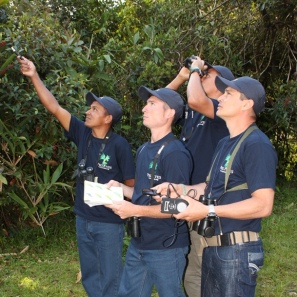
The 3rd Eco-guide Training Course was undertaken by professional guides from 13-21 June in the Las Tangaras Bird Reserve with rural community citizens and Reserve Rangers. A new generation of highly trained guides in birding and nature guiding will provide outstanding services.


Nota_Johanna_2

Biodiversity of Antioquia presented in Jardín
Friday 27 July 2012.

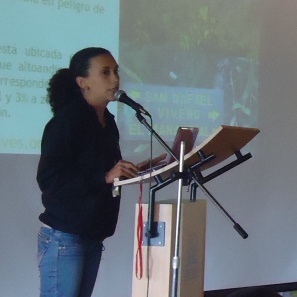
At the Regional Meeting “Southwestern Antioquia: the Biodiversity Jardín” with around 200 participants took place in May in Jardín, where ProAves presented “Bird Reserves: a strategy for the conservation of biodiversity in southwestern Antioquia”.


Grallaria

Conservation Success for three Endemic and Threatened Colombian Birds
Tuesday 3 July 2012.

The recent change in the threat category for three Colombian endemic bird species – now no longer in imminent danger of extinction – is in large part thanks to the conservation and research efforts of ProAves, particularly with its strategic network of 21 Bird Reserves across Colombia.


sloth_realease_el_pangan

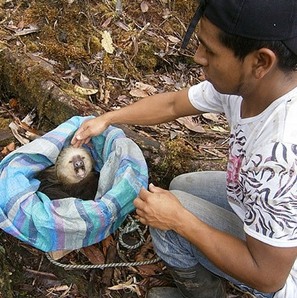
Sloth rescue in Colombia’s threatened forest
Wednesday 14 December 2011.

Generous donations to rangers help protect the forest home of the Two-toed sloth and a multitude of other threatened species.


Colombia reaffirmed as #1 nation for birds
Wednesday 19 October 2011.

ProAves published the 15th issue of its journal Conservación Colombiana, which includes five articles related to new bird records for Colombia plus the annual review of the national list of birds. To date, we confirm a total of 1,889 bird species occurring in Colombia to reaffirm that Colombia is the #1 nation of birds on earth.


Roncesvalles

Roncesvalles, pioneer town for the signing of Reciprocal Water Agreements
Thursday 29 September 2011.

In September, ProAves assisted two property owners in Roncesvalles, Tolima, to commit to preserving the majority of their land that is within the town’s watershed. As agreed, for at least ten years, the total of 3,200 acres will be saved and restored for natural habitat conservation.


inicioRonces

ProAves establishes Colombia’s first joint Municipality Environmental service agreement
Thursday 4 August 2011.

The Municipality Council of Roncesvalles approved ProAves Environmental Service Agreement to create the first joint program, funded by water users, to protect watersheds and endangered species.


Inicio_1

The wetlands of Bogotá – critical habitat for birds
Monday 1 August 2011.

At the invitation of the Association EcoVida, our collaborator Monica Parada gave a Talk: “The wetlands of Bogotá and Cundinamarca, an important habitat for waterfowl in Colombia”, in the Wetlands Course with the lakeside community of Santa Maria del Lago.


inicio-4

ProAves at the IUCN Regional Forum
Thursday 21 July 2011.

ProAves Executive Director, Lina Daza, attended the first South American Forum of Members of the International Union for Conservation of Nature (IUCN) in Lima, Peru, from 13-15 June.


Inicio-9

Fifth protected areas management course
Wednesday 29 June 2011.

The 5th meeting of protected area managers from 15 protected areas from across Colombia was held from 3-11 June, 2011 in El Paujil Bird Reserve thanks to NMBCA. Training included monitoring biodiversity, camera trapping, management planning, mapping and constructing platforms.


Heidy

ProAves presents to the GEF Council in Washington DC
Wednesday 15 June 2011.

ProAves presented its progress on establishing some of Colombia’s first environmental service agreements in Tolima to the Global Environment Facility (GEF) Council between 23 to 26 May 2011 in Washington DC.


gente

ProAves helps protect Paramo del Sol in Antioquia
Tuesday 4 January 2011.

To socialize the actions and strategies undertaken at local level aimed at the protection and management of the Páramo del Sol, on 9th December ProAves held a workshop on “Management, Conservation and Protected Areas of the Páramo del Sol”. ProAves is working to protect this highly vulnerable AZE site.


inicio-3

Life Distinction Award for Fundación ProAves
Monday 25 October 2010.

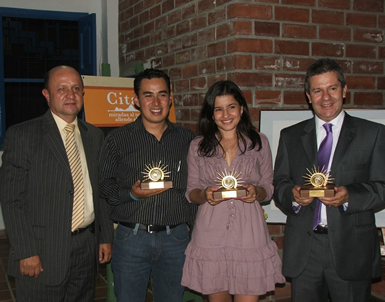
The Corporación Autónoma Regional CorAntioquia, celebrated its 15 years of work with a ceremony in which it acknowledged ProAves with a Life Distinction, the highest award given to organizations who have worked diligently and consistently for the preservation of natural resources in Antioquia.


inicio-29

Pride Campaign in Roncesvalles, Tolima
Monday 2 August 2010.

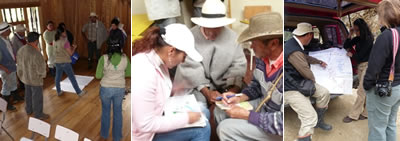
Under an agreement established with the Conservation Organization RARE and through Pride Campaign, ProAves is promoting actions aimed at the conservation of ecosystems that offer environmental goods and services to generate environmental awareness in communities.

Categorías
News

Salve un loro amenazado


{{ADOPTE UN NIDO ARTIFICIAL}}

Ayúdenos a evitar la extinción de una especie de loro en Colombia. Puede hacerlo por medio del programa {{Adopte un nido}}, en el que patrocinará la construcción e instalación de un nido artificial y su monitoreo y mantenimiento durante un año.

Este programa es resultado de siete años de investigaciones llevadas a cabo por ProAves con los loros amenazados de Colombia, durante las cuales detectó que estas aves pasan grandes dificultades para anidar porque no encuentran suficientes cavidades apropiadas; los árboles adultos que utilizan para ello son talados con fines madereros. Por esta razón, en el 2003 creó el {{[Programa de Nidos Artificiales->https://proaves.org/rubrique.php?id_rubrique=85]}} con el auspicio de {{[Loro Parque Fundación->http://www.loroparque-fundacion.org/Index_Esp.htm]}}, {{[American Bird Conservancy->http://www.abcbirds.org/]}} e {{[International Conure Association->http://www.conure.org/]}}.

Desde entonces ha resultado sorprendente observar cómo los loros pueden utilizar estas construcciones en cuestión de minutos además de que resultan más seguras contra plagas y depredadores que las cavidades naturales.

Usted puede seleccionar la especie que quiere ayudarnos a salvar de la extinción:

Periquito de Santa Marta {(Pyrrhura viridicata)}
Cotorra Aliazul {(Hapalopsittaca fuertesi)} o Loro Orejiamarillo {(Ognorhynchus icterotis)}.

{{El padre adoptivo recibirá:}}

Un certificado de adopción vía correo electrónico.

Una fotografía del nido artificial, vía correo electrónico.

Un informe dos veces al año luego de finalizada cada época reproductiva (incluye fotografías), vía correo electrónico.

Su nombre (o el nombre de su organización) será publicado en nuestra página Web: programa “Adopta un nido – Padres adoptivos”, con los detalles del nido artificial adoptado. Opcional.

Para hacer su donación, por US$85 o £ 45 o $170,000 pesos, sólo tiene que hacer click {{[aquí,->https://www.proaves.org/SisOS/FormularioAdoptaNido.php] }} para llenar el formulario de adopción.

Categorías
News

Éxito de nidos artificiales para Cotorrita Pechiparda

Transcurridos 14 días de la instalación de 48 nidos artificiales se registraron 5 nidos activos, que luego de dos semanas de ocupación dieron 40 huevos.


LA FUNDACIÓN LORO PARQUE Y PROAVES REALIZAN UN NUEVO GRAN APORTE A LA CONSERVACIÓN DE LA COTORRITA PECHIPARDA (Pyrrhura calliptera) VU

Transcurridos 14 días de la instalación de 48 nidos artificiales se registraron 5 nidos activos, que luego de dos semanas de ocupación dieron 40 huevos.

Como parte del programa Loros Amenazados adelantado por la Fundación Proaves y la Fundación Loro Parque con el apoyo de P.N.N Chingaza, ABC, Conservación Internacional y el FPAA, se ha implementado durante este año la asistencia a la reproducción con ayuda del sistema de nidos artificiales.

Previo reconocimiento de las amenazas para la especie, se evidenció e identificó una baja oferta de cavidades naturales, agravada por dos factores importantes como la caída natural de los árboles y la extracción de los mismos por parte de las comunidades campesinas para usos domésticos, lo cual constituye una grave amenaza para la especie, la cual además de utilizar las cavidades durante la época reproductiva, duerme en las mismas durante todo el año.

Teniendo en cuenta estos factores de riesgo fueron instalados 48 nidos artificiales. Para el diseño, construcción e instalación de los nidos se tuvo en cuenta factores previamente identificados en condiciones naturales como las características físicas y la composición y estructural y florística alrededor de los mismos. Los nidos son profundos y presentan entradas alargadas y angostas, fueron instalados entre los 2650 y los 2900 m.s.n.m, en alturas entre 3.5 y 10 m en árboles vivos y troncos secos de especie vegetales utilizadas para la anidación en condiciones naturales. Las zonas de instalación corresponden a bordes de bosque y potreros arbolados en donde se ha registrado la presencia constante de la especie.

Desde el primer día de instalación algunos nidos fueron explorados, grupos de 4, 5, 6 y hasta 12 individuos frecuentaron las cavidades en el transcurso del día e incluso durmieron allí durante la noche. El primer registro de ocupación permanente de los nidos con fines reproductivos se obtuvo a tan solo 14 días de instalación; hasta el momento, cinco de los 48 nidos instalados se encuentran activos y con un total de 40 huevos, sin que aun haya finalizado la etapa de postura. Los nidos han sido ocupados por grupos entre cinco y ocho individuos en donde al parecer varias hembras ponen en el mismo nido encontrándose postura de hasta 13 huevos.

Se espera que una vez pase la temporada reproductiva otros nidos artificiales sean ocupados como dormideros tal como se ha observado en condiciones naturales y que finalmente esta iniciativa contribuya al mantenimiento de poblaciones viables.

Categorías
News

PRIMER NIDO ARTIFICIAL OCUPADO POR EL LORO OREJIAMARILLO (Ognorhynchus icterotis)


Transcurridos tres años de instalados los nidos artificiales en la localidad de Jardín Antioquia, por primera vez se documenta la ocupación de un nido artificial por el {{Loro Orejiamarillo }}({Ognorhynchus icterotis}). Como parte del {{[Programa Loros Amenazados de Colombia->https://www.proaves.org/rubrique.php?id_rubrique=39] }}adelantado por la Fundación ProAves – Colombia y la Fundación Loro Parque con el apoyo de American Bird Conservancy, Conservación Internacional, el Fondo Para la Accion Ambiental y la Niñez y Corantioquia, se ha implementado el {{[Programa de Nidos Artificiales->https://www.proaves.org/rubrique.php?id_rubrique=85]}} con el propósito de aumentar la oferta {in situ }de nidos para la especie.
Este programa surgió a partir del reconocimiento de las amenazas que afronta la especie y de evidenciar la baja oferta de cavidades naturales. Esta situación se incrementa por los requerimientos tan específicos de nidación en palmas de cera ({Ceroxylon quindiuense}), la cual se encuentra también en peligro de extinción debido al despojo de la cobertura vegetal original para la ganadería y a la extracción de su cogollo para la cerebración de Semana Santa en diferentes zonas del país donde se encuentra.

Teniendo en cuenta estos factores de riesgo y los requerimientos de nidación previamente identificados se instalaron 42 nidos artificiales, a alturas entre los 10 y 20 metros en palmas de cera vivas en borde de bosque y potreros entre 2500 y 2950 m.

Tres años de intenso trabajo que incluye elaboración, instalación, monitoreo, reparación y mantenimiento a los nidos artificiales han dado su fruto. Durante una revisión de rutina en febrero del año en curso, se reporto la ocupación de un nido artificial por una pareja del {{Loro Orejiamarillo (}}{Ognorhynchus icterotis}) en etapa de incubación y con un ayudante “helper” presumiblemente un individuo de la temporada reproductiva pasada que ayuda en el cuidado de sus hermanos. Este nido se ha monitoreado desde el momento en que se reportó con dos huevos y a la fecha lo habitan dos crías de cuatro semanas de edad. Adicionalmente se registraron 4 nidos artificiales con indicios de exploración a juzgar por la presencia de plumas del {{Loro Orejiamarillo}} ({Ognorhynchus icterotis}).

Se espera que para la próxima temporada reproductiva el número de nidos artificiales ocupados por el Loro Orejiamarillo ({Ognorhynchus icterotis}) incremente como esta sucediendo con la {{Cotorra Aliazul}} ({Hapalopsittaca fuertesi)}, el {{Perico Paramuno}}{ (Leptosittaca branickii)} y el {{Periquito Aliamarillo}} ({Pyrhura calliptera)-}

Categorías
News

Periquito de Santa Marta ocupa nido artificial

Después de la instalación de 48 nidos artificiales en la {{[Reserva Natural de las Aves “El Dorado”->https://www.proaves.org/rubrique.php?id_rubrique=182]}}, el Periquito de Santa Marta ({Pyrrhura viridicata}) ocupa su primer nido artificial instalado en una Palma de Cera ({Ceroxylon ceriferum)}.


Después de la reciente instalación en mayo de 48 nidos artificiales en la {{[Reserva Natural de las Aves “El Dorado”->https://www.proaves.org/rubrique.php?id_rubrique=182]}} en la Sierra Nevada de Santa Marta, el Periquito de Santa Marta ({Pyrrhura}{ viridicata)} ocupa su primer nido artificial instalado en una Palma de Cera ({Ceroxylon ceriferum)} a una altura aproximada de 7 m en un área abierta destinada para ganadería, zona amortiguadora de la Reserva.

La cavidad se encuentra actualmente ocupada por 4 individuos que cuidan del nido, dos crías eclosionadas hace cuatro días y dos huevos. Para los investigadores ha resultado sorprendente el uso eficaz de los nidos artificiales más aun teniendo en cuenta que la temporada reproductiva para esta especie se daba por terminada hacia Abril – Mayo época en la cual hubo registros de grupos de loros con juveniles en zonas de forrajeo.

Este gran logro ha sido posible gracias al apoyo de American Bird Conservany (ABC), Fundacion Loro Parque e International Conure Association.

Categorías
News

SIMPOSIO ESTADO DE CONOCIMIENTO DE LA BIOLOGÍA REPRODUCTIVA DE LAS ESPECIES DE LOROS AMENAZADOS DE COLOMBIA, CON ÉNFASIS EN INICIATIVAS DE CONSERVACIÓN


Con el ánimo de fortalecer el intercambio científico acerca de la biología reproductiva de las especies de psitácidos amenazados de Colombia, ProAves invita a los investigadores del tema a participar en el simposio {{ {Estado de conocimiento de la biología reproductiva de las especies de loros amenazados de Colombia, con énfasis en iniciativas de conservación,} }}que se llevará a cabo durante el próximo{{ { }[Congreso Nacional de Zoología->http://congresocolombianozoologia.googlepages.com/home].{} }}


[{{Documento PDF}}->https://www.proaves.orghttps://www.proaves.org/images/stories/IMG//recursos/IMG/pdf/Invitacion_Simposio_Congreso_Nacional_de_Zoologia_-_Santa_Marta.pdf]

{{Santa Marta 26 de Noviembre 2006}}

En el marco del {{[Congreso Nacional de Zoología->http://congresocolombianozoologia.googlepages.com/home]}} que se realizará del 26 de noviembre al 1 de diciembre en la ciudad de Santa Marta, ProAves desarrollará el simposio {{ {Estado de conocimiento de la biología reproductiva de las especies de loros amenazados de Colombia, con énfasis en iniciativas de conservación.} }} Dada la calidad de los trabajos de investigación en materia de biología reproductiva de los psitácidos que se presentarán en el simposio, y con el ánimo de fortalecer el intercambio de conocimientos dentro de la comunidad científica del país, ProAves quiere extender una invitación a todos los miembros de ésta a participar en el evento. Los interesados en inscribirse deberán comunicarlo antes del 23 de octubre al correo electrónico: [dcaro@proaves.org->mailto:dcaro@proaves.org].

{{ORGANIZADORES:}}

_ {{[David Caro Sabogal->mailto:dcaro@proaves.org]}}
_ Director Análisis y Sistematización
_ Fundación ProAves

_ {{[Adriana Mayorquin Cabrera->mailto:amaryoquin@proaves.org]}}
_ Coordinadora Programa Loros Amenazados de Colombia
_ Fundación ProAves

_ {{[Nicolai Osorno Durán->mailto:nosorno@proaves.org]}}
_ Coordinador Programa Nidos Artificiales
_ Fundación ProAves

{{OBJETIVOS}}

1. Difundir el estado actual del conocimiento de la biología reproductiva de las especies de psitácidos amenazados de Colombia, con énfasis en su cronología reproductiva, su éxito reproductivo y las iniciativas de conservación en su favor.

2. Socializar el éxito del Programa Nidos Artificiales como iniciativa de conservación {in situ} de las especies de psitácidos amenazados de Colombia.

{{JUSTIFICACIÓN}}

El estado actual de amenaza y el carácter endémico, casi endémico o de rango restringido de las especies de psitácidos de Colombia, sugirió la necesidad de establecer un plan de acciones de monitoreo y conservación de las mismas. En consecuencia, ProAves creó en 2002{{ }}el programa{{ [Loros Amenazados de Colombia,->https://www.proaves.org/rubrique.php?id_rubrique=8]}} dirigido a evaluar el estado de las poblaciones de loros del país y su grado de amenaza, y a orientar los esfuerzos de sensibilización ambiental y conservación en su favor, y desde entonces viene fortaleciéndolo.

En el marco de este programa, el estudio de la biología reproductiva de las especies se ha constituido en uno de los componentes principales, fomentando el conocimiento de aspectos como cronología, comportamientos, éxito y requerimientos reproductivos, a partir de los cuales se implementan iniciativas de conservación. Entre ellas se encuentra el {{[Programa Nidos Artificiales,->https://www.proaves.org/rubrique.php?id_rubrique=85]}} cuyo objetivo es aumentar la oferta {in situ} de nidos y maximizar el éxito reproductivo de las especies de loros más amenazadas del país.

La difusión del estado actual del conocimiento de la biología reproductiva de las especies de psitácidos amenazados de Colombia permite crear un espacio de discusión para diseñar planes de acción para la conservación de las especies en forma conjunta entre todas las instituciones pertinentes.

{{INVITADOS}}

{{Adriana Mayorquin Cabrera}}. Coordinadora Programa Loros Amenazados de Colombia. Fundación ProAves.

_ {{Nicolai Osorno Durán}}. Coordinador Programa Nidos Artificiales. Fundación ProAves.

{{David Arenas.}} Estudiante de Licenciatura en Biología y Química. Universidad Distrital Francisco José de Caldas.

{{Adriana Elizabeth Tovar.}} Estudiante de Licenciatura en Biología y Química. Universidad Distrital Francisco José de Caldas.

También están invitados a participar todos los tesistas e investigadores del {{Programa Loros Amenazados}} así como toda la comunidad científica. Las inscripciones estarán abiertas hasta 12 de octubre. En la circular número VI del congreso se difundirá el listado de los simposios aprobados.

{{Presentaciones propuestas}}

1. Introducción: estado actual del conocimiento de la biología reproductiva de los psitácidos en Colombia e iniciativas de conservación. Ponente: Adriana Mayorquin.

2. Biología reproductiva de {Ognorhynchus icterotis} – Loro Orejiamarillo (CR) en Jardín, Antioquia. Ponente: David Arenas.

3. Biología reproductiva de {Pyrrhura viridicata }- Periquito de Santa Marta (EN) en la Sierra Nevada de Santa Marta, Magdalena. Ponentes: Hugo Oliveros y Christian Olaciregui.

4. Biología reproductiva de {Pyrrhura calliptera – }Periquito Aliamarillo{ }(VU){ }en la zona de amortiguación del PNN Chingaza. Ponente: por confirmar.

5. Biología reproductiva de {Hapalopsittaca fuertesi – }Cotorra de fuertesi (CR) en la Reserva El Mirador, Génova, Quindío.{ }Ponente: Adriana Tovar.

6. Biología reproductiva de {Leptosittaca branickii} – Perico Paramuno (VU) en la Reserva El Mirador, Génova, Quindío.{ }Ponente: Adriana Mayorquin.

7. Biología reproductiva de {Hapalopsittaca amazonica }- Cotorra Montañera (VU) en Roncesvalles, Tolima.{ }Ponente: Adriana Mayorquin.

8. Programa Nacional Nidos Artificiales. Ponente: Nicolai Osorno.

9. Iniciativas de conservación y educación ambiental ligadas a las investigaciones realizadas con el programa Loros Amenazados de Colombia. Ponente: David Caro, Yazmin Madeleine Tolosa y Diana P. Montealegre Moreno.

{{Otras actividades}}

1. Galería de fotos del Programa Nidos Artificiales.

2. Video sobre los loros amenazados.

3. Entrega de materiales y certificado a los asistentes.

{{Metodología}}

Síntesis orientada por un moderador después de cada subtema. Sesión de preguntas.

Discusión de temas seleccionados por el auditorio.

Duración: 3 horas

Serie de exposiciones orales de 15 minutos para los temas relacionados con la biología reproductiva de las especies amenazadas. Las exposiciones se abordarán por subtemas, en los que cada expositor incluirá una especie.

_ Sesión de preguntas.

{{E-mail: }}[iiconzool_fcbog@unal.edu.co->mailto:iiconzool_fcbog@unal.edu.co]

[congresocolombianozoologia@gmail.com->mailto:congresocolombianozoologia@gmail.com]

{{[http://congresocolombianozoologia.googlepages.com/home->http://congresocolombianozoologia.googlepages.com/home]}}

{{Tels: }}(57-1) 3165305-3165000 {{Ext: }}11504, 11503, 11538 {{Fax: }}(57-1) 3165365 ó 316500 Ext.

11504 {{Apartado: }}7495, Skype (ii-congreso-colombiano-zoologia).
Categorías
News

Periquito de Santa Marta reutiliza nidos artificiales


Por segunda vez se ha registrado la utilización de nidos artificiales por parte del Periquito de Santa Marta {(Pyrrhura viridicata)}, en la {{[Reserva Natural de las Aves El Dorado->https://proaves.org/rubrique.php?id_rubrique=182]}} y su zona amortiguadora, en la Sierra Nevada de Santa Marta.

El año pasado también se había observado el uso de estos nidos por este periquito, endémico de la Sierra Nevada y amenazado de extinción, con la salida exitosa de cinco juveniles en octubre. Posteriormente, en diciembre se registraron nuevamente comportamientos reproductivos, marcándose así el inicio de la temporada reproductiva para el 2007.

Este año, desde febrero el equipo de ProAves que lleva a cabo el proyecto, encabezado por el tesista Cristian Olaciregui, de la Universidad del Atlántico, continuó observando estos comportamientos, que incluyen inspecciones a los nidos y luego cópulas, con alternancia de parejas. A la fecha se ha registrado la ocupación de dos nidos, uno como dormitorio y otro con postura de huevos.

Por medio de un continuo monitoreo durante la temporada reproductiva, se espera seguir ampliando la información sobre el éxito reproductivo de esta especie y contribuir así a su conservación.

También se observaron cópulas de la especie con alternancia de parejas en un área de anidación natural, y el uso de Palmas de Ramo {(Ceroxylum ceriferum)} como dormitorios.

El apoyo de {{[Loro Parque Fundación->http://www.loroparque-fundacion.org/Index_Esp.htm]}} y {{[American Bird Conservancy->http://www.abcbirds.org/]}} ha sido fundamental para el desarrollo del {{[Programa Nidos Artificiales->https://www.proaves.org/rubrique.php?id_rubrique=85]}} de ProAves, que ha resultado exitoso en la recuperación de las especies de loros amenazados de Colombia.

También se ha contado en la Sierra Nevada de Santa Marta con el apoyo de la comunidad local, que ha facilitado información sobre la presencia de la especie, involucrándose con su conservación.

Categorías
News

Nest boxes provide hope for Santa Marta Parakeet

Friday 9 October 2009.

The Santa Marta Parakeet is an endangered and endemic species to the Sierra Nevada of Santa Marta, for this reason, since 2006 the nests were installed in the El Dorado Bird Reserve with the objective of the study and the conservation of the Santa Marta Parakeets (Pyrrhura viridicata).

By monitoring the artificial nests since 2006, we have gained important knowledge of various aspects of its biology, reproductive habits and filmed the interior of several active nests. It is important to highlight the importance of the maintenance of the nests in order to ensure clean and reliable boxes for successful nesting.
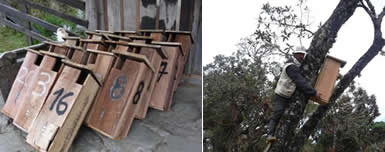
Nidos El Palmar, estado y ubicación en el sendero El Palmar.

Nests of El Palmar, the State and Location of the El Palmar’s Route.

The work done by ProAves for the parakeets, has focused their actions in relocating the artificial nests in other frequented areas by the parakeets, maintenance of the nests by refilling the substratum; closing any extraneous holes in the nests to limit competition from other species; general repairs; fixing the openings for the video cameras; changing the heights of the nests; and taking away the nests that have been colonized by bees.

By accomplishing these activities we hope that we can optimize the use of the artificial nests by the time of the Santa Marta parakeet’s mating season next year.

Adopt a nesting box

You can help us to save a species of Colombian parrot from extinction through the Adopt A Nest programme. By adopting a nest, you will be sponsoring the building and installation of a nesting box, along with the monitoring and maintenance of that box for a whole year. You can support us by donating online.

lpf


Categorías
News

95 new artificial nests in Andean Parrot Corridor

Tuesday 22 June 2010.

ProAves continues making great efforts to provide threatened parrot species, endemic Andean and almost endemic species, safe places to nest, thereby increasing and stabilizing the populations of these birds so affected by deforestation, timber extraction for industrial and artesian work and expanding the agricultural and livestock frontier that is killing the habitat.

construction and transportation of artificial nests

In the past two months and within the Artificial Nests Program, 95 new nests were installed in five villages to benefit as many species.

In Jardín, Antioquia 20 nests were installed which are hoped to be occupied by the Yellow-eared Parrot (Ognorhynchus icteriotis); in Cajamarca, Tolima 20 more were installed to be used by the Indigo-winged Parrot (Hapalopsittaca fuertesi); in Genoa, 30 were installed in Quindío for the Golden-plumed parakeet (Leptosittaca branickii) and the Indigo-winged Parrot (Hapalopsittaca fuertesi); 5 in Roncesvalles, Tolima and 20 in Urrao, Antioquia for the Rusty-faced Parrot (Hapalopsittaca amazonina).

Instalation

After installation and during the breeding season the monitoring process begins, where, periodically, observations are make to determine the use of nests by the species, once confirmed its occupation, weekly monitoring is done with the objective in mind to obtain data from the reproduction of the parrots found inside. This monitoring is done by observing the constant coming and going of one of the parents while the other is the full time process of incubation. The monitoring continues until hatching. After three weeks the nest is explored to determine the number of chicks, assessing the rate of growth through morphometry and finally ringing them to identify and monitor their post-reproductive destiny.
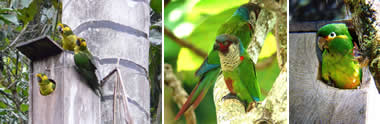

Once the chicks have left the nest its status is reviewed in order to repair cracks, replace the substrate and fumigate to eliminate parasites that may affect the health of parents or chicks and leave them in perfect condition for the next breeding season.

Acknowledgements

We appreciate the generous support of 29 adoptive parents and especially to Brenton Head and Felipe Soto who recently made the donation for the construction, installation, monitoring and maintenance for one year of five artificial nests for the following species: two for the Yellow-eared parrot, 1 for the Indigo-wingend Parrot, one for the Santa Marta parakeet and 1 for the Brown-breasted parakeet.

Program Adopt an artificial nest

You can help prevent the extinction of a species of parrot in Colombia through the program, which will sponsor the construction and installation of an artificial nest, their monitoring and maintenance for one year. You can support us through your donation online .

{youtube}_6ReMXqqoHQ|380|280|1{/youtube}

Con el apoyo de:

abc lpf parrotsociety conservacioninternacionalcolombia
Jardin roncesvalles genova
Jardín (Antioquia) Roncesvalles (Tolima) Génova (Quindío)
Categorías
News

Ecological holocaust: Serranía de San Lucas at risk

Serranía de San Lucas is an isolated 110 km massif in northern Colombia that rises to 7,500 feet (2,300 m) and covered by lush tropical rainforests. Incredibly, this spectacular massif is biologically unknown, bar a brief exploration by ProAves researchers during 1999 to 2001 at the lower elevations of 700 to 4,500 feet (200-1,400 m). This survey registered over 370 bird species including 11 endangered species plus a high concentration of endangered mammals, such as the rare Spectacled Bear and five species of primates. These preliminary results highlighted the global importance of the Serranía de San Lucas for biodiversity and led to the conclusion that there likely to be many species of flora and fauna unknown to science at higher elevations. As a result of the threatened species found during these studies, the region was declared as globally important for conservation: an Important Bird Area (IBA) in 2005.

Biologically, the Serranía de San Lucas remains the least known and most interesting area in the Western Hemisphere, a massif that potentially holds an entire community of flora and fauna unknown to science. During the 1999-2001 expedition, various new frog species for science and several new bird taxa were found, which still await description.

The “Teta” peak of the Serrania de San Lucas, an massif standing over 7,500 feet high and completely isolated from the three Cordilleras of Colombia, is the latest major frontier for biologists in Colombia and perhaps the Western hemisphere, but will be destroyed within just a few years.

Unfortunately, the San Lucas massif is facing an unimaginable environmental crisis, a victim of its own wealth of huge gold and timber resources. Until recent years, natural resource extraction on the massif has been largely artisanal owing to decades of political instability.

Despite the importance for biodiversity and in flagrant disregard for environmental impact studies, has granted mining concessions to large multinational gold mining companies as Anglo Gold Ashanti of South Africa among others. These companies already have claimed rights to destroy almost the entire area of Serranía de San Lucas (see gold mining concession maps below) with hydraulic and hardrock mining activities.

Map of Serranía de San Lucas showing forest cover (left) with surviving forest (dark green), cleared forest (gray) and recent deforestation (light green) and mining concessions (right) with mining rights in red. Source: Ingeominas 2009.

To hand over the Serranía de San Lucas to mining companies is not only irresponsible but represents a potential catastrophe to Colombia and the planet. Serranía de san Lucas is a biodiversity treasure that Colombia and the world should be proud of. Unfortunately, none of the mining companies support the protection of biodiversity and sadly, not a single hectare of the San Lucas massif is protected for biodiversity conservation. Of 2.5 million acres of original forest cover on the massif, only 10% survives and that is estimated to largely be destroyed and fragmented in just eight years. The consequences of losing 2.5 million acres of forest beside the Colombia’s most important river – the Rio Magdalena, together with heavy land degradation, are incalculable. For examples, as extreme weather events become ever more frequent, the situation for millions of people living within the Rio Magdalena valley flood area will be dire.

Absurdly, after the government had handed over Serranía de San Lucas to mining companies, a workshop was held on July 31 2009 in the city of Cartagena to establish Biodiversity Conservation Priorities for the Serranía de San Lucas, framed within the theme of Planning and Sustainable Development.The workshop was led by the Ministry of Environment, Housing and Territorial Development, The Nature Conservancy (TNC) and World Wildlife Fund (WWF). Experts in biological groups, such as the Alexander von Humboldt and Ecohabitat Foundation, among others were present with ProAves. All experts agreed on the biological and environmental importance of the San Lucas massif.

Two conclusions of the workshop included an acknowledgement of a tremendous void of biological information and the imminent concern about the lack of a national or private protected area.

Unfortunately, the Colombian government does not agree on the establishment of an effective protected area for the region, preferring a “Forest Reserve” that permits mining of the entire area.

In conclusion, the Serranía de San Lucas with its unique biodiversity and ecosystem function for Colombia and the planet is at extreme risk of extinction within a decade.

See the EBA report published by ProAves about the biodiversity of Serranía de San Lucas.

For photos of the Serranía de San Lucas on ProAves flickr account


Categorías
News

Cerulean Warbler Conservation Corridor established

Wednesday 26 August 2009.

The main objective of a Conservation Corridor is to restore natural habitat connectivity – connecting channels of forest – to allow the movement of flora and fauna species and genetic exchange between two major forested areas.

The Cerulean Warbler Conservation Corridor is uniting the Cerulean Warbler Reserve and Serranía de los Yariguíes National Park with Cerro de la Paz and the Pauxi Pauxi Reserve across a diverse landscape of coffee and cacao plantations, silvopastures and forest fragments to help the survival of biodiversity and migratory birds.

In order to create a “connection”, ProAves has been reforesting over a wide area to create living fences (hedgerows) and silvo-pasture areas between forest patches. The reforestation program has planted native and threatened tree species, such as Guamo, Leucaena, Caracolí, Abarcos, Nacederos and Mahogany.

In the area covered by the corridor we can find coffee, cocoa plantations and cattle. This has determined the type of actions that have been taken and the achieved results. Community involvement has been crucial for the success of the project. The strong commitment of the local inhabitants has helped to not only improve the environment and the soil of the region but also to increase the profitability of its livestock and the productivity of its crops.

Reforestation and corridor planning efforts began in 2006 and the corridor implementation started in April 2009. Work started from both ends of the corridor, each team starting from one of the Nature Reserves. Currently 40% of the Project has already been covered and finalized. It is estimated that the 10 km long and 1 km wide corridor will be completed with 12-24 months.

This project has been possible thanks to the support of the American Bird Conservancy and the joint work carried out by the municipality of San Vicente de Chucurí www.sanvicentedechucuri-santander.gov.co and ProAves. As well, the commitment of five landowners has been crucial.

Categorías
News

Conservation actions for the Páramo del Sol

Wednesday 3 March 2010.

The aim of the present study is to design a Conservation Plan for the Páramo del Sol in order to generate tools to decelerate the rapid loss, fragmentation and habitat loss of some of the most endangered species in Colombia and present in this important area.

As a first step, a phased environmental characterization was made emphasizing the ecosystems present, associated fauna, climate and water resources, land use, biophysical characteristics; characterization of threats, inventory of property and social characterization, economic and culture of the communities, as well as the zoning for the enabling of the management plan of the moor, aiming for the integration of the ecosystem in the study area, regulate the use of the area according to the zoning developed ,with the objective of establishing a management plan for the Paramo de Urrao with the support of key local, regional and municipal entities that aloud and facilitate the accomplishment of the conservation goals.

Inca Oscuro (Coeligena orina)

Dusky Starfrontlet (Coeligena orina).

Study Area

Urrao Municipality is located in the southwest sub-region of Antioquia department in the Cordillera Occidental, the exploration was carried out in the villages of San Matías, La Encarnación, El Sereno and Vereda Calles (Parque Nacional Natural Las Orquideas) located northwest of the urban municipality Urrao.

The target area corresponds to areas of lower mountain wet forest, very humid forest, heath lower mountain rain, the latter being predominant. The topography presents very steep slopes with inclination of the 45% approximately and numerous streams. In regards to climatic conditions ,approximate temperatures range from 12 to 24 ° C and average annual rainfall exceeds 4000 mm.

Amphibians and reptiles

Paramo Frontino Salamander (Bolitoglossa hypacra)            Cordillera Central Treefrog (Hyloscirtus larinopygion)

Paramo Frontino Salamander (Bolitoglossa hypacra) Cordillera Central Treefrog (Hyloscirtus larinopygion).

25 species were registered of which 22 species were in the group of Amphibians , 3 part of the Reptiles group and belonging to 4 orders (Anura, Caudata, Gymnophiona and Squamata).

Birds

Chestnut-bellied Flowerpiercer (Diglossa gloriossisima)        Chestnut-napped Antpitta (Grallaria nuchalis)

Chestnut-bellied Flowerpiercer (Diglossa gloriossisima) Chestnut-napped Antpitta (Grallaria nuchalis).

Partial results

The management plan and conservation plan of the Páramo del Sol is being developed for the sole purpose of prioritizing actions and uses thereof in order to ensure its future and appropriate conservation.

Listed below are the species that have been registered in the study area and which unfortunately are globally threatened with extinction according to IUCN categories:

Dusky Starfrontlet (Coeligena orina) CR,Chestnut-bellied Floerpiercer (Diglossa gloriosissima) EN, Red-bellied Grackle (Hypopyrrhus pyrohypogaster) EN, Rusty-faced Parrot (Hapalopsittaca amazonina) VU, Maustached Antpitta (Grallaria alleni) VU Olive-sided Flycatcher (Contopus cooperi) NT and Cerulean Warbler (Dendroica cerulea) VU,Black-andchestnut Eagle(Spizaetus isidori) NT, Yellow-headed Manakin (Xenopipo flavicapilla) NT, Purplish-mantled Tanager (Iridosornis porphyrocephalus)NTand Golden-winged Warbler (Vermivora chrysoptera)NT.

While the characterization of herpete allowed the registration of 5 species under some category of threat,(Centronele geckoideum VU, Pristimantis satagius DD, Bolitoglossa hypacra LC y Bolitoglossa medemi VU and Hyloscirtus larinopygion NT ) 5 amphibian morphs have been registered but we have been unable to allocate their taxon as they are in process of classification.

So far the common factor is the loss, fragmentation and reduction of habitat of anthropogenic origin.

With the support of:

abc Corpouraba


Categorías
News

Five New Ecological Easements in Santander

Friday 4 June 2010.

Thanks to the support of American Bird Conservancy, Amos W. Butler and Conservation Leadership Program, five properties and 143 acres have been permanently protected by their owners to strengthen the Cerulean Warbler Conservation Corridor. Commitments by each landowner include not cutting down trees, reforesting watershed areas, establishing living fences and silvopastoral systems and develop friendly production practices.

So far we have established nine easements in the Cerulean Warbler Conservation Corridor with 323 acres, of which 143 are part of the five new easements. The corridor is established to restore the connectivity between the Nature Reserves of Reinita Cielo Azul (Serranía de los Yariguies) and Pauxi Pauxi (Cerro de la Paz) in order to strengthen the conservation of habitat for many resident and migratory species such as Dendroica cerulea (Cerulean Warbler).

View of Reinita Cielo Azul – View of Pauxi Pauxi.

Conservation easements are a legal mechanism with a voluntary agreement between two parties to the conservation, in which civil society is responsible for protecting the biodiversity and natural resources of an area. The commitments acquired with these easements by the owners were not to clear the forest, to reforest areas of water sources on his farm, establishment of live fences and develop friendly production practices in the forest and conservation.

The Reserves of Pauxi Pauxi and Reinita Cielo Azul support the maintenance of the forests; they provide some materials for the improvement of the productive areas, seedlings are provided for reforestation and provide training to the community in sustainable production techniques.

Community meetings.

This project is been conducted by ProAves and Proyecto YARE, which is supported by the Conservation Leadership Program.

{youtube}ogiH3-DTgSc|425|344|1{/youtube}

With the support of:

abc Yar conservationleadership
audubon


Categorías
News

Pride Campaign in Roncesvalles, Tolima

Monday 2 August 2010.

For over ten years ProAves has been carrying out measures for conservation and environmental education in the town of Roncesvalles, Tolima with the support of Loro Parque Fundación, however, this year the Organization RARE Conservation has joined us to work on the development of the Campaign Pride or Campaña del Orgullo that inspires people to take pride in the natural resources that make their communities unique and take action to protect them.

Currently institutional partnerships are being established to develop actions aimed at the conservation of ecosystems that offer valuable environmental goods and services to meet local demands and regular global climate cycles regular.

Such is the case of the agreement reached with RARE to generate environmental awareness and actions to promote conservation of the moorlands and woodland habitat of the yellow-eared parrot, through the Pride Campaign and the establishment of reciprocal agreements for water.

Roncesvalles, Tolima.

This time, the town of Roncesvalles is the specific scenario in which RARE will guide efforts to promote sustainable production systems and conservation of forests at the source and in the upper basin of the Cucuana, in addition to the settlements that make up the downstream basin of the same river.

Human pressures such as the expansion of livestock and the agricultural frontier, logging, overgrazing and unsustainable production techniques; have become the main causes of deterioration of ecosystems in the town of Roncesvalles.

The high mountain ecosystems in the municipality supply hydrological environmental services including the water supply for human consumption, irrigation, power generation, climate regulation and biodiversity conservation. The values that these ecosystem services acquire have not been measured in economic terms and their deterioration has generated the need to recognize its finitude, in order to make decisions that promote the conservation and sustainable use, in order to increase their offer.

Town center and environmental education activities in Roncesvalles, Tolima.

The alliance RARE – ProAves, seeks to promote cultural values of environmental responsibility, as well as to plan the future of ecosystems to improve the quality of life of the population, guaranteeing the supply of environmental services and protecting the habitat of endangered species like the Yellow-eared Parrot.

We are convinced that it is through environmental education that the way we think and act towards ecosystems can be transformed. Therefore, through the implementation of the Pride Campaign we will support education to promote the establishment of reciprocal agreements related to the water of the Cucuana River basin, where the inhabitants of the upper basin will receive incentives for conservation as a voluntary result of institutions and people of the lower basin as the fulfillment of environmental goods produced by these ecosystems.

Community activities.

To date, the staff of the Foundation is implementing the first phase of this process, the “Participatory planning”, in which we expect to find out the current state of the ecosystems and the most appropriate way to implement the campaign. Starting next year, we will implement the first phase of the project that we hope will be as successful as its has been so far.

lpf proaves rare
Categorías
News

DISTINCIÓN VIDA PARA LA FUNDACIÓN PROAVES

El pasado 23 de Septiembre, la Corporación Autónoma Regional Corantioquia, Territorial Citará, celebró sus 15 años de labores con una ceremonia en la que hizo un reconocimiento a aquellas entidades que han trabajado de manera muy comprometida y constante por la preservación de los Recursos Naturales, haciendo la entrega de la Distinción Vida, máximo galardón que entrega la Corporación a una persona o institución.

El evento contó con la participación de las organizaciones gubernamentales y no gubernamentales más importantes que trabajan en la Territorial Citará y fueron condecorados la organización EcoRegion, la Cooperativa de Caficultores de AndesCooperan y la Fundación ProAves Colombia, destacándose por todas las acciones puntuales de conservación que ha realizado desde 1998, en especial por el desarrollo del Proyecto Ognorhynchus en el Municipio de Jardín, Antioquia.

De izquierda a derecha: Ignacio Castaños, Director Territorial Citará; Luis Felipe Barrera, ProAves; Liliana Taborda González, Ecoregion; Luis Bernardo Benjumea, Cooperan.

Terminado el acto protocolario de condecoración, se hizo presentación de la muestra fotográfica “Citará, miradas al territorio, allende el Cauca” realizada por los funcionarios de la Corporación. Además del lanzamiento del “Plan Colegas”, acuerdo de Voluntades que nos compromete a seguir con la Protección y preservación de nuestro Patrimonio Natural.

Equipo ProAves invitado a la ceremonia

En representación de la Fundación ProAves fueron invitados: Luis Felipe Barrera, Subdirector de Áreas protegidas Cordillera Central, Ana Cristina Velasquez, Educadora Ambiental de Jardín y Ana Esperanza Contreras, Coordinadora de Áreas Protegidas para el Norte de la Cordillera Occidental.

Agradecemos a La Corporación Autónoma Regional Corantioquia, por este reconocimiento y los felicitamos por sus 15 años de buena gestión en la protección de los recursos naturales de la región.

Categorías
News

ProAves helps protect Paramo del Sol in Antioquia

Tuesday 4 January 2011.

The event took place in the House of Culture in the town of Urrao (Antioquia) and was framed within the support agreement between the Corporation for Sustainable Development of Urabá CORPOURABÁ and ProAves, to implement the wilderness management plan.

The workshop was attended by 22 people among who were representatives of the community action boards of the villages of El Saladito, Guapantal and La Magdalena, the Municipal Government, the Alfa Eco Group (GEA), the Urrao Public Service Company and the Urrao Institution of Education, The Chuscal.

Grallaria fenwickorum – Coeligena orina

“Threatened species that will benefit from future conservation actions”.

The methodology used was of briefings in which presentations were made of the work of CORPOURABÁ, the study discussed the current state of the Páramo del Sol and presented its management plan.

Additionally, there was a group effort where the program and project management plan were reviewed, identified by each institution and the people who attended, on how they can articulate their plans for 2011. Proposed projects were presented and responsibilities and potential resources were defined to implement the plan in a participatory manner by the users of the goods and services provided by the wilderness.

[slickr-flickr search=”sets” set=”72157625683868304″ items=”20″ type=”gallery”]

Finally, the initiatives taken and progress in the formulation and implementation of the wilderness management plan by CORPOURABÁ, ProAves and Alfa Eco Group (GEA) were highlighted.

With the support of:

Corpouraba
Categorías
News

Successful VI Banding course with emphasis on migratory and endangered birds

Tuesday 10 May 2011.

The course was attended by high-level instructors like Ian Hunter and Dave Fletcher of The Wetland Trust and Esteban Botero-D SELVA Association, in addition to the participation of 11 students from Colombia, Peru, Chile and Uruguay.

During the same course theoretical and practical activities were developed where topics such as the migration of birds, endemic species, harvesting techniques, handling, banding and data collection, ethics of the bander, age determination by plumage, molt and ossification of the skull, determination of fitness of the bird through the records of fat and muscle and reproductive status, foraging ecology, habitat use and data analysis were discussed.

Banding activities during the course.

As a result of the practical activities 264 individuals were caught and released, of which 150 were banded, 36 were recaptured and 78 released unbanded. Some species banded were: Mionectes oleaginous, Manacus Manacus, Basileuterus rufifrons, Onychoryncus coronatus, Arremon schlegeli, Tersina Viridi, other migratory like Leiothlypis peregrina, Dendroica fusca, Contopus virens and other endemic species: Atlapetes melanocephalus, Arremon Basilicus, Basileuterus conspicillatus, Basileuterus Basilicus.

Also, participants, instructors and organizers expressed their satisfaction with the high academic standards, good logistics, facilities and human quality of all attendees.

Participants, organizers and instructors of the VI banding course.

[slickr-flickr search=”sets” set=”72157626642008146″ items=”20″ type=”gallery”]

With the support of:

wetlandtrust


Categorías
News

10 years of “Reconcile yourself with Nature” in Roncesvalles (Tolima)

The success of this campaign is measured from 10 years ago, as a result of hard work in environmental education through informative lectures, radio programs and cultural and environmental events run by ProAves Foundation with support from the Catholic Church and town institutions.

One of the main characters of the event was the parrot “Otorrico” which was created by the Foundation after the rediscovery of the Yellow-eared Parrot to promote awareness and commitment in caring for their habitat, the Wax Palm and other natural resources; thus strengthening the integration of the community primarily among children and youths.

“Otorrico” delivered pine branches to the population and green cinitilla as a symbol of their willingness to preserve the national tree.

The following video shows the participation and awareness of people in the campaign “because life is sacred … Reconcile yourself with Nature 2011”:

{youtube}_eujTxvg-0c|425|344|1{/youtube}