Fundación ProAves – por la conservación en el país de las aves

Categorías
Noticias

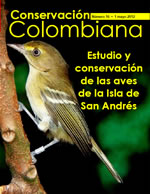
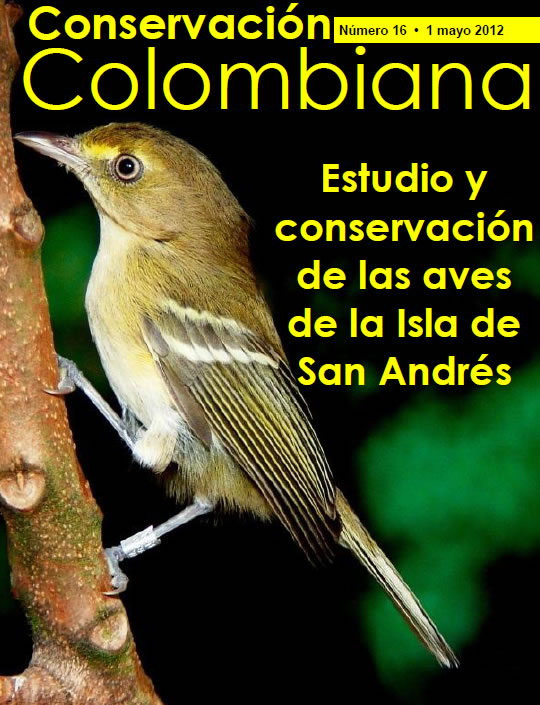
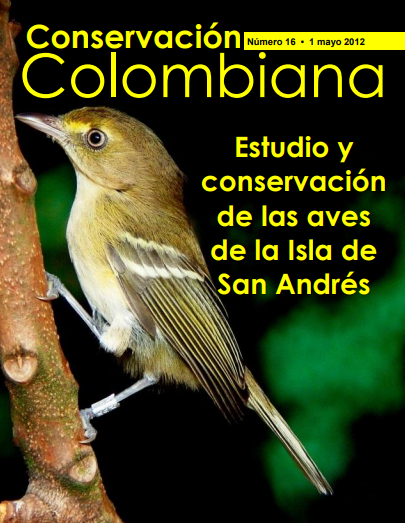
Estudio y conservación de las Aves de la Isla de San Andrés


Durante este periodo se realizaron, regularmente, durante aproximadamente 20 días de cada mes, conteos desde puntos de radio variable, transectos y redes de niebla en una variedad de hábitats presentes en la isla, todo lo anterior, el estudio incluye una descripción detallada del área, su ubicación, aspectos geomorfológicos, clima, suelos, población y ecosistemas. Igualmente se describe la metodología empleada y los resultados obtenidos a lo largo de 8 años de monitoreo constante realizado en la Isla. Así mismo, se realiza la descripción detallada de los ecosistemas prioritarios para las aves y las principales amenazas que enfrentan.

Dentro de los resultados obtenidos, se registraron 119 especies de aves silvestres en la isla de San Andrés, 26 especies fueron aves residentes y 93 especies fueron migratorias Boreales en algunos casos con rangos de migración únicos para San Andrés con respecto al resto del país (Salaman et al 2008).  De las 119 especies registradas para la isla en este estudio, solo dos especies están categorizadas como vulnerables (VU); el ave endémica de San Andrés Vireo caribaeus y la especie migratoria Dendroica caerulea. Además, tres especies han sido catalogadas como casi amenazadas (NT), 112 especies están en categoría de preocupación menor de amenaza (LC) y otras dos no han sido evaluadas debido a que aún no son reconocidos como especies.

portadaN16big

La publicación  presenta un plan de conservación puntual para las especies presentes en el archipiélago tanto para las especies residentes como para las migratorias.

Finalmente, el estudio propone un plan de acción de investigación y conservación a nivel regional, donde se especifican las acciones necesarias para que estos ecosistemas prioritarios tengan mejores oportunidades en términos de protección ambiental. El plan incluye objetivos específicos en materia de investigación, conservación y mejoramiento de calidad sanitaria, acciones concisas para alcanzar los objetivos, tiempo estimado de ejecución y los posibles actores que lleven a cabo cada proceso.

Encuentre aquí el archivo en formato PDF para consultar y descargar gratuitamente.

Conservación Colombiana es publicada gracias al apoyo de nuestros donantes:


lpf abc iucn
proaves worldlandtrust


Categorías
News

Conservation of the Magdalena Spider monkey

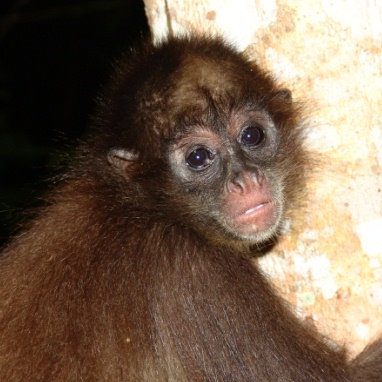
The Magdalena Spider Monkey (Ateles hybridus) is a Neotropical primate species almost endemic to Colombia and listed as one of the 25 most endangered primate species in the world, and unfortunately falls into the category of critically endangered according to the International Union for Conservation of Nature (IUCN).  Historically it was widely distributed in the Magdalena river valley and the mountains bordering NE Colombia and NW Venezuela.

The IUCN publishes its Red Data list every two years, where the Magdalena Spider monkey now appears for the fifth time after being first included in 2004. View report.

Conservation

In November 2003, with the support from the American Bird Conservancy and the Global Conservation Fund, ProAves established the El Paujil Bird Reserve located in the departments of Boyacá and Santander. The reserve has over 7,900 acres of primary forest, the natural habitat of the spider monkey, where, thanks to the implementation of conservation strategies, environmental education and research projects, hunting has been eliminated.

By permanent monitoring a recovery has been demonstrated, not only in population but also in range, which had declined in recent years due to the expansion of the agricultural frontier and selective logging. All this is possible thanks to the implementation of various programs of community inclusion among which highlight the annual reforestation with approximately 5000 plants  associated with the monkey’s biology.

[slickr-flickr search=”sets” set=”72157624616431422″ items=”20″ type=”gallery”]

ProAves, under its policy of inter-institutional cooperation, continues supporting academic institutions and NGOs to develop specific research on species of different orders that are endangered on its nature reserves. An example is Foundación Primates, led by Dr. Andres Link, who completed more than five years of study on the ecology of this species of primate. This cooperation between institutions and individuals seeks to dispel the specter of impending extinction, not only of the Magdalena Spider Monkey, but also of other species dependent on this fragile and important ecosystem.


abc global Healthy_Planet_Logo


Categorías
Noticias

Conservación para el Mono Araña


El mono araña (Ateles hybridus) es una especie de primate neotropical casi endémico de Colombia y catalogado como una de las 25 especies de primates más amenazada del mundo, desafortunadamente se encuentra bajo la categoría de Peligro crítico de extinción de acuerdo con la Unión Internacional por la Conservación de la Naturaleza UICN, distribuido históricamente en el valle interandino del río Magdalena hasta el noreste de Colombia y las montañas fronterizas del noroeste de Venezuela.

La IUCN publica cada 2 años esta desafortunada lista, donde el Mono Araña aparece por quinta vez luego de ser incluido en el año 2004. Ver Repote

Conservación

En noviembre de 2003 y gracias al apoyo de American Bird Conservancy y Global Conservation Fund, la fundación ProAves establece la Reserva Natural de las Aves El Paujil ubicada en los departamentos de Boyacá y Santander, son más de 3200 hectáreas de bosque, hábitat natural del mono araña donde, gracias a la implementación de estrategias de conservación, educación ambiental y proyectos de investigación se han disminuido los índices de cacería en un 100%.

Mediante monitoreos permanentes, se ha evidenciado la recuperación no solo de la población, sino también del rango de hogar hasta hace unos años perdido por la ampliación de la frontera agrícola y la tala selectiva. Todo lo anterior es posible gracias a la realización de los diferentes programas de inclusión comunitaria que se desarrollan entre los que sobresalen la reforestación anual de aproximadamente 5000 individuos de especies de flora asociadas a la biología del mono.

[slickr-flickr search=”sets” set=”72157624616431422″ items=”20″ type=”gallery”]

Del mismo modo la fundación ProAves en el marco de sus políticas de cooperación interinstitucional, continúa brindando apoyo a instituciones académicas y ONG’s que desarrollan trabajos de investigación específica con especies de diferentes órdenes que se encuentran en peligro de extinción y que son protegidas en la red de reservas naturales de la fundación, como es el caso de la Fundación Primates, liderada por el Doctor en Antropología Andrés Link, quienes completan más de cinco años evaluando aspectos ecológicos de esta especie de primate. Así, mediante un trabajo articulado entre instituciones y personas, se busca disipar el fantasma de extinción que carga, no solo el mono araña, sino también otras especies asociadas a este frágil e importante ecosistema.

Con el apoyo de:

abc global Healthy_Planet_Logo


Categorías
News Noticias Reinita Cielo Azul

ProAves celebrates the Ninth Migratory Bird Festival

During the celebration of the Ninth  Migratory Bird Festival, ProAves carried out events in the municipalities of San Vicente de Chucurí (Santander); Jardín (Antioquia); Génova (Quindío), Roncesvalles (Tolima) and Bogotá. In these the community had the opportunity to participate in several academic, cultural and recreational activities oriented towards the awareness of the importance of and threats to migratory birds, some of the most important birds that come to Colombia were showcased, with ideas of how we can contribute to their protection.

 Mural_edit

A DIFFERENT WORLD – Replica, Artist: Christian Ferrada Soto – Chile

Actions Taken

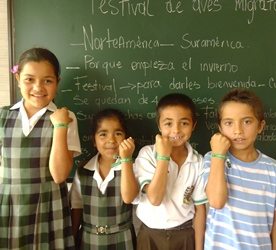
This year the epicenter  of the Festival was the municipality of San Vicente Chucurí, Santander, where several  activities and workshops in Bird Friendly Schools where  held in order to promote the children’s interest in learning about the migratory birds that come to Colombia and especially to their municipality, their importance, the major threats they face and the ways we can protect them.  In this same town, pupils of the Nuestra Señora de la Paz College painted a mural as a visible manifestation of the Ninth Migratory Bird Festival.

Meanwhile each of the cities of Jardín and Génova information and entertainment booths were set up to raise awareness of the program of activities planned for the municipalities during the Festival.

“Focus on birds” competitions were held, with prizes such as mini-guides, posters, bracelets and T-shirts, for children and adults who came to see the stands.

[slickr-flickr search=”sets” set=”72157631946430927″ items=”20″ type=”gallery”]

Observation courses for children and youths

In the town of Jardín, Antioquia, there were two observation courses, one for children and one for youths. For both initiations were made through visits to educational institutions of primary and secondary education. The objective of this activity was to promote to participants through tests of agility, speed and knowledge, an interest in migrating birds arriving in Colombia.

Neighborhood Roadshows

 The neighborhood roadshows’ aim is to have a more direct approach with the community in different municipalities, through visits to each of the neighborhoods and each of the educational institutions of the municipality, during these visits fun and educational activities are carried our that promote awareness of these birds.

The closing parade

The closing parade was held through the main streets of the town of San Vicente de Chucurí. In the main square of the town were presented the awards for best groups based on an evaluation of their knowledge about birds; the winner was the school carnival Valentín Gonzales Rangel from Nuestra Señora de la Paz College, which received school kits, bracelets, Field guides to the Birds of Colombia and mini guides.

As a final act were two dances with the theme of migratory birds, and the launch of a song dedicated to extreme travelers called “Star Color” by singer-songwriter Jorge Luis Real.

Thanks to the participation and engagement of communities of different municipalities, the Ninth Migratory Bird Festival closed successfully, and it is clearly important to recognize that these activities have developed a real significance for people in municipalities where the festival has been celebrated continuously for nine years.

The Migratory Bird Festival IX was carried out with the support of:

abc

Categorías
Aves migratorias Noticias Noticias Reinita Cielo Azul

ProAves celebró el IX Festival de Aves Migratorias

Durante la celebración del IX Festival de Aves Migratorias la Fundación ProAves desarrolló actividades en los municipios de San Vicente de Chucuri, Santander; Jardín, Antioquia; Génova, Quindío; Roncesvalles, Tolima y Bogotá; donde la comunidad tuvo la oportunidad de participar   de las diversas actividades de carácter académico, cultural y de recreación orientadas a la sensibilización sobre la importancia y amenazas de las aves migratorias;  así mismo se dieron a conocer las principales aves que llegan a Colombia y cómo podemos contribuir a su  protección.

 Mural_edit

UN MUNDO DIFERENTE – Replica, artista: Christian Ferrada Soto – Chile

Actividades Desarrolladas  

Este año el Festival tuvo como epicentro el municipio de San Vicente de Chucurí, Santander, en donde se realizaron diversos talleres en las Escuelas Amigas de las Aves con el objetivo de promover en los niños el interés por conocer las aves migratorias que llegan a Colombia y a su municipio, su importancia, las principales amenazas que enfrentan y las formas como podemos protegerlas.

En este mismo municipio se realizó un mural en el Colegio Nuestra Señora de la Paz como manifestación y estrategia de visibilización del IX Festival Aves Migratorias.

Por su parte en los municipios de Jardín y Génova se elaboraron 2 stands Informativos y lúdicos para dar a conocer la programación de las actividades planteadas para los municipios durante el Festival.

Además se realizaron concursos como “concéntrese por las aves” y se obsequiaron algunos premios como mini guías, afiches, manillas y camisetas de ProAves a los niños que participaron y a los adultos que se acercaban a observar los stands.

[slickr-flickr search=”sets” set=”72157631946430927″ items=”20″ type=”gallery”]

Carrera de observación de niños y de jóvenes

En el municipio de Jardín, Antioquia, se realizaron dos carreras de observación, una para niños y otra para jóvenes.  En las dos se hizo  la convocatoria abierta a través de las visitas a las instituciones educativas de primaria y secundaria.  El objetivo de esta actividad consistió en promover en los participantes a través de pruebas de agilidad, rapidez y conocimiento el interés por las aves migratorias que llegan a Colombia.

Tomas barriales

El objetivo de las tomas barriales es tener un acercamiento más directo con la comunidad de los diferentes municipios, en las cuales, con visitas barrio a barrio y a cada una de las instituciones educativas, se realizan actividades lúdicas y educativas que promuevan el conocimiento por estas aves.

El desfile de clausura

El desfile de clausura se llevó a cabo por las principales calles del municipio de San Vicente de Chucurí, en el parque principal del municipio se realizó la premiación a la mejor comparsa evaluando su conocimiento sobre las aves, la comparsa ganadora fue la escuela Valentín Gonzales Rangel del Colegio Nuestra señora de la Paz donde recibieron kits escolares, manillas, guías de Campo de las Aves de Colombia y mini guías.

Como acto final se presentaron dos danzas haciendo referencia a las aves migratorias y se realizó el lanzamiento de la canción dedicada a las viajeras extremas “color de estrella” por el cantante y compositor Jorge Luis Reales.

Gracias a la participación  y compromiso de las comunidades de los diferentes municipios, se logró cerrar  con éxito  el IX Festival de Aves Migratorias, donde es claro y muy valioso reconocer que este tipo de actividades tienen  mucho significado para las personas y municipios donde se ha desarrollado permanentemente el festival desde hace nueve años.

El IX Festival de Aves Migratorias se llevó a cabo gracias al apoyo de:

abc

Categorías
Colombian Conservation Journal

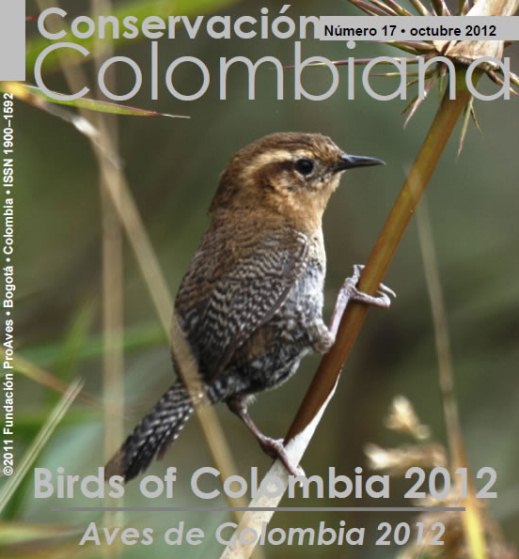
Nº 17 Birds of Colombia 2012

portadaEdit

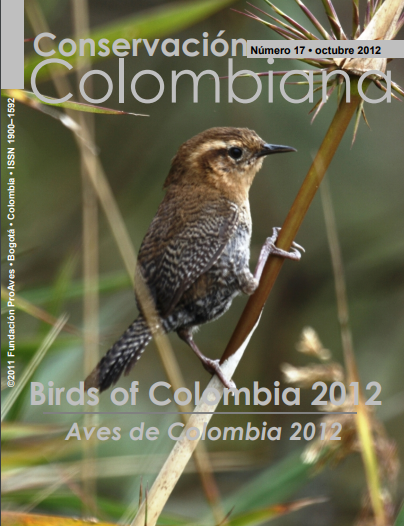
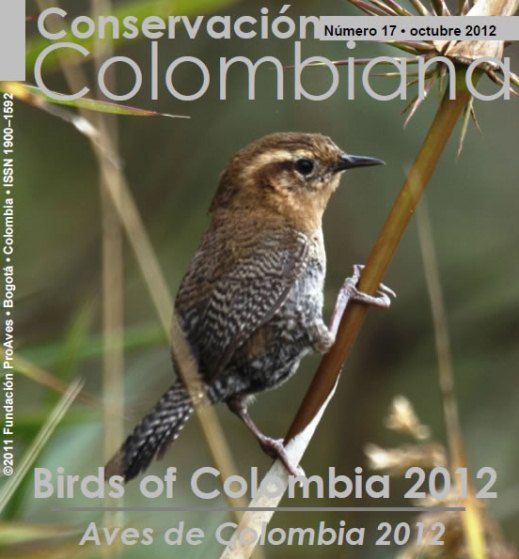
Fundación ProAves has publishes selected papers from the 17th volume of its scientific journal Conservación Colombiana. This edition includes no less than eight scientific papers discussing records of new bird species for Colombia, plus its now annual paper on revisions to Checklist of the Birds of Colombia.

Content:

Revision of the status of bird species occurring or reported in Colombia 2012. Thomas Donegan, Alonso Quevedo, Paul Salaman & Miles McMullan. Conservación Colombiana 17: 4 – 14. Download here

Vocal differentiation and conservation of Indigo-crowned Quail-Dove Geotrygon
purpurata. Thomas Donegan & Paul Salaman. Conservación Colombiana 17: 15 – 19. Download here

An apparent hybrid Heliodoxa hummingbird from the West Andes of Colombia. Thomas Donegan & Liliana Dávalos. Conservación Colombiana 17: 20 – 25. Download here

Two new bird species for Colombia from the department of Guainía. Alonso Quevedo & Juan Carlos Luna. Conservación Colombiana 17:26 – 27. Download here

New records of Forster’s Tern Sterna forsteri for Colombia. Forrest Rowland & Bernard Master. Conservación Colombiana 17:28 – 30. Download here

First photograph in its habitat and new sighting of the Santa Marta Wren Troglodytes monticola, a Critically Endangered species. Juan Carlos Luna & Alonso Quevedo Conservación Colombiana 17: 31 – 32. Download here

First record of Pacific Honero Furnarius (leucopus) cinnamomeus in Colombia. Juan Carlos Luna. Conservación Colombiana 17: 33 – 34. Download here

Records of two escaped species of parrots for Colombia. Oswaldo Cortés & Thomas Donegan. Conservación Colombiana 17: 35 -37. Download here

Corrigenda: Conservación Colombiana 15. Conservación Colombiana 17: 37. Download here

Note on the identification of Lesser Nighthawk Chordeiles acutipennis in northern
Colombia. Andrew R. Collins. Conservación Colombiana 17: 38 – 40. Download here

A new group name for the Chachalacas (Aves: Cracidae: Ortalis). Thomas Donegan. Conservación Colombiana 17: 41 – 44. Download here

First Record for the Black–and–white Tanager Conothraupis speculigera in Colombia. Yojanan Lobo–y–HenriquesJC, John Bates & David Willard. Conservación Colombiana 17: 45 -51. Dowload here

Instructions for authors. Conservación Colombiana 17: 52 – 54. Download here

Complete edition Download here

Categorías
Revista Conservación Colombiana

Revista Conservación Colombiana 17


ProAves publica la edición Nº 17 de su Revista científica Conservación Colombiana, esta edición incluye ocho artículos científicos con registros de especies de aves nuevas para Colombia y la revisión anual del Listado de Aves en Colombia.

Contenido

Revisión del estatus de las especies de aves que han sido reportadas en Colombia 2012. Thomas Donegan, Alonso Quevedo, Paul Salaman & Miles McMullan . Conservación Colombiana 17: 4 – 14. Descargar aquí

Diferenciación en la vocalización de Geotrygon purpurata y evaluación de su estado de conservación. Thomas Donegan & Paul Salaman. Conservación Colombiana 17: 15 – 19. Descargar aquí

Un aparente híbrido del género Heliodoxa en la Cordillera Occidental de Colombia. Thomas Donegan & Liliana Dávalos. Conservación Colombiana 17: 20 – 25. Descargar aquí

Dos nuevas especies de aves para Colombia en el departamento del Guainía. Alonso Quevedo & Juan Carlos Luna. Conservación Colombiana 17:26 – 27. Descargar aquí

Nuevos registros de Sterna forsteri para Colombia. Forrest Rowland & Bernard Master. Conservación Colombiana 17:28 – 30. Descargar aquí

Primera fotografía en su habitat y nuevo avistamiento del Cucarachero de Santa Marta
Troglodytes monticola, especie en Peligro Crítico. Juan Carlos Luna & Alonso Quevedo. Conservación Colombiana 17: 31 – 32. Descargar aquí

Primer registro del Hornero del Pacífico Furnarius (leucopus) cinnamomeus en
Colombia. Juan Carlos Luna. Conservación Colombiana 17: 33 – 34. Descargar aqu.í

Registros de dos especies de loros exóticos en Colombia. Oswaldo Cortés & Thomas Donegan. Conservación Colombiana 17: 35 -37. Descargar aquí

Corrigenda: Conservación Colombiana 15. Conservación Colombiana 17: 37. Descargar aquí

Nota para la identificacion de Chordeiles acutipennis en el norte de Colombia. Andrew R. Collins. Conservación Colombiana 17: 38 – 40. Descargar aquí

Un nuevo nombre para el grupo de las chachalacas (Aves: Cracidae: Ortalis). Thomas Donegan. Conservación Colombiana 17: 41 – 44. Descargar aquí

Primer registro del frutero blanco y negro Conothraupis speculigera en Colombia. Yojanan Lobo–y–HenriquesJC, John Bates & David Willard. Conservación Colombiana 17: 45 -51. Descargar aquí

Instrucciones para autores. Conservación Colombiana 17: 52 – 54. Descargar aquí

Edición Completa Descargar aquí.

Categorías
Noticias Women for Conservation (Mujeres por la Conservación)

II Feria del libro Ambiental


Acompáñanos y compra la Guí­a de Campo de las Aves de Colombia y la Lista de Aves con el 35% de descuento, solo durante la feria.

Encuentra a precio de feria los productos del proyecto Mujeres por la Conservación y con un increíble 50% de descuento el Café de Conservación Reinita Cerúlea.

ProAves: stand Nº 10

Fecha: del 30 de octubre al 02 de noviembre de 2012

Lugar: Cra 7 Nº 36 – 45 primer nivel de la sede central de la CAR. Bogotá
tel.: 3209000 ext. 1186


Invita
:
logo_car

Categorías
News Noticias Loro Orejiamarillo Noticias Reinita Cielo Azul

IX Migratory Bird Festival 2012


The Festival will be held in 4 regions of the country: Roncesvalles (Tolima); Jardín (Antioquia), Génova (Quindío) and San Vicente de Chucurí (Santander); a variety of activities have been scheduled within which we will have observational outings, workshops, lectures, neighborhood outlets, radio programs, cultural performances and parades all framed within the objective of generating knowledge about these beautiful and important visitors.

Since 2004 Fundación ProAves has held the Migratory Bird Festival continuously for the sole purpose of making known to the communities the importance of preserving the habitats of our guests of honor, trying to ensure the habitat of hundreds of birds that travel each year from North America to southern South America.

ProAves recognizes the importance of taking actions to achieve behavioral changes aimed at conservation which is why the Festival of Migratory Birds symbolically contributes to the promotion, recognition and interest in providing responsible actions and solidarity of the people in relation to the biodiversity of our country and the entire continent.

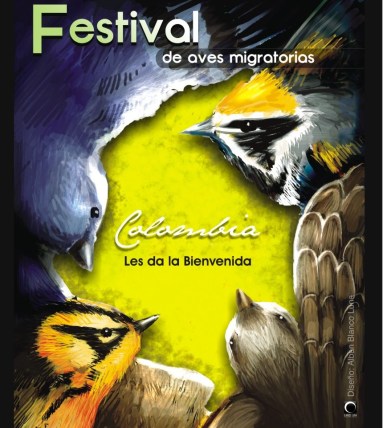
Afiche_ProAves

Poster: Alban Banco Luna

During the festival we expect the participation of more than 5,000 people including adults, children and young people from all parts of Colombia, especially in the municipality of San Vincent de Chucurí in the department of Santander, where the Cerulean Warbler Bird Reserve is located, the first Reserve created in South America for the conservation of a migratory bird.

On October 20 there will be an observational walk along the Reserve trails, where we will have the involvement of the San Vicente community, including several educational institutions and the Mayor of the municipality; during the walk we hope our migratory friends will give us a chance to admire them in all their splendor, beauty and strength.

On Saturday October 27 the closing parade, whose central theme is the habitat of migratory birds during their stay in the tropics, will close with decorated floats adorned as coffee trees, water sources, forests and birds which will roam the main streets of town, likewise, with different costumes, large banners, dances and plays by children, young people and adults around the town saying “Welcome traveling friends”

Join us in the celebration.

With support from:


abc

Escudo_jardin San_Vicente_Chucur roncesvalles genova_bandera


Categorías
Aves migratorias Noticias Noticias Loro Orejiamarillo Noticias Loros Andinos Noticias Reinita Cielo Azul

IX Festival de Aves Migratorias 2012

EL Festival se llevará a cabo en 4 regiones del país: Roncesvalles, (Tolima); Jardín (Antioquia); Génova (Quindío) y San Vicente de Chucurí (Santander); se tienen programadas una gran variedad de actividades dentro de las cuales tenemos salidas de observación, talleres, charlas, tomas barriales, programas radiales, presentaciones culturales y comparsas todo enmarcado dentro del objetivo de generar conocimiento sobre estas hermosas e importantes visitantes.

Desde el año 2004 la Fundación ProAves viene realizando ininterrumpidamente el Festival de Aves Migratorias con el único objetivo de dar a conocer a las comunidades la importancia de preservar los hábitats de nuestras invitadas de honor buscando, de esta forma asegurar el hábitat de cientos de aves que viajan cada año desde Norteamérica hasta el sur de Sur América.

La fundación ProAves reconoce la importancia de realizar acciones que logren cambios de comportamiento orientados a la conservación, es por esto que consideramos que la celebración del Festival de Aves Migratorias contribuye simbólicamente a la promoción, reconocimiento e interés por aportar acciones responsables y solidarias de los habitantes frente a la biodiversidad de nuestro país y de todo el continente.

Afiche_ProAves

Poster oficial IX Festival de Aves Migratorias 2012. Diseño: Alban Blanco Luna

Durante el festival esperamos la participación de más de 5000 personas entre adultos, niños, niñas y jóvenes de todos los lugares de Colombia; especialmente en el municipio de San Vicente de Chucurí en el departamento de Santander, donde se encuentra ubicada la  Reserva Natural de las Aves Reinita Cielo Azul, la primera Reserva en Suramérica creada para la conservación de un Ave migratoria.

El día 20 de octubre se realizará una caminata de observación por los senderos de la Reserva, donde contaremos con la participación de la comunidad chucureña, incluyendo varias instituciones educativas y la Alcandía Municipal; durante la caminata esperamos que nuestras amigas migratorias nos den la oportunidad de poderlas admirar en todo su esplendor, belleza y fortaleza.

El día sábado 27 de octubre se llevará a cabo la comparsa de clausura cuya temática central será el hábitat de las aves migratorias durante su estadía en el trópico; carrosas adornadas como cafetales, fuentes de agua, bosques y aves recorrerán las principales calles del municipio; así mismo, con diferentes disfraces, pancartas de gran tamaño, bailes y representaciones los niños y niñas; jóvenes y adultos de todo el municipio dirán: “bienvenidas amigas viajeras”

Únete a la gran celebración.

Con el apoyo de:


abc Escudo_jardin San_Vicente_Chucur roncesvalles genova_bandera


Categorías
News

Second Membership and Environmental Education Meeting 2012

The meeting was attended by the entire team of Environmental Education and ProAves Membership including: Yulied Bautista, Fernanda Martínez, Ana Velásquez, Juliana Toro, Leidy Pérez, Leidy Alarcón y Alejandro Grajales, also with the participation of our executive director Lina Daza Rojas; the event began with an overall presentation of the Chestnut-capped Piha Bird Reserve by Johanna Villa, Assistant Director Northwest Region.

During the meeting there was a presentation by the Membership and Environmental Education sections, and on educational processes developed in the municipalities of Jardín, department of Antioquia, Génova in Quindío and Roncesvalles, Tolima
.
With the assessment of the Strategic Plan and Annual Operating Plan for these areas and the activities undertaken in 2012, development plans were created and the goals to meet during the year 2013 were set; these objectives include significantly increasing the number of municipalities where ProAves conducts environmental education and therefore the number of people sensitized to these issues.

Additionally the Reciprocal Water Agreements Project (ARA’s) was explained and the role environmental groups play in different areas where ProAves is present and the importance of youth participation was analyzed and finally the methods of assessment of strategies to improve educational processes were set out.

[slickr-flickr search=”sets” set=”72157631293978054″ items=”20″ type=”gallery”]

The community also participated in the meeting. During the event recreational activities took place with members of the village of Roble, a buffer zone of the Chestnut-capped Piha Bird Reserve; a general presentation on the work of ProAves to raise awareness and knowledge about importance of protecting natural resources was made. Also, after an invitation extended to the women in the community to participate in the project “Women for Conservation”, a training workshop was held demonstrating the interest of women wishing to join in these activities.

The meeting ended with an excellent balance “we ended up very pleased with the work done and the achievements, we are sure they will be a great motivation to continue with this important work of environmental education,” Rojas Lina Daza, Executive Director.

Categorías
Noticias Noticias Arrierito Antioqueño Women for Conservation (Mujeres por la Conservación)

II Encuentro de Membresía y Educación Ambiental 2012

Al encuentro asistió el equipo completo de Educación Ambiental y Membresía de ProAves compuesto por: Yulied Bautista, Fernanda Martínez, Ana Velásquez, Juliana Toro, Leidy Pérez, Leidy Alarcón y Alejandro Grajales, igualmente con la participación de nuestra directora ejecutiva Lina Daza Rojas e inició con la presentación general de la Reserva Arrierito Antioqueño a cargo de Johanna Villa, Subdirectora de la Región Noroccidental.

Durante el encuentro se realizó la presentación del Área de Educación Ambiental y Membresía, y de los procesos educativos desarrollados en los municipios de Jardín, departamento de Antioquia, Génova en el Quindío y Roncesvalles, Tolima.

Con la evaluación del Plan Estratégico y el Plan Operativo Anual del área y las actividades realizadas durante el 2012, se crearon los planes a desarrollar y se determinaron los objetivos por cumplir durante el año 2013; estos objetivos incluyen aumentar significativamente los municipios donde la Fundación ProAves realiza actividades de educación ambiental y por consiguiente las personas sensibilizadas en estos temas.

Adicionalmente se socializó el Proyecto Acuerdos Recíprocos por Agua (ARAS) y se analizó papel que juegan los grupos ecológicos en las diferentes zonas donde hace presencia la Fundación y la importancia de la participación juvenil y finalmente se expusieron los métodos de evaluación como estrategias para mejorar los procesos educativos.

[slickr-flickr search=”sets” set=”72157631293978054″ items=”20″ type=”gallery”]

La comunidad también participó durante el encuentro. En el evento se llevaron a cabo actividades lúdicas con miembros de la vereda el Roble, zona de amortiguación de la Reserva Arrierito Antioqueño; con ellos, se realizó una presentación general sobre la labor desarrollada por ProAves con el fin de generar conciencia y conocimiento sobre la importancia de proteger los recursos naturales. Así mismo, luego de una invitación extendida a las mujeres de la comunidad para participar en proyecto de “Mujeres por la Conservación” se llevó a cabo un taller de capacitación evidenciando el interés de las mujeres por vincularse a estas actividades.

El encuentro finalizó con un excelente balance “terminamos muy satisfechos por el trabajo realizado y por los logros obtenidos, estamos seguros que serán una gran motivación para continuar con tan importante labor como lo es la educación ambiental”, Lina Daza Rojas, Directora Ejecutiva.


Categorías
News

ProAves at the World Conservation Congress of IUCN

The World Conservation Congress is the largest and most diverse conservation event in the world. It is held every four years and aims to improve the way we manage our natural environment for human, social and economic development.

Government leaders, public sector organizations, NGOs, corporates, UN agencies, and social organizations attended the event to discuss, debate and decide solutions for the most pressing issues of the world in terms of environment and development.

Discussions by participants from government, business and civil society in the Congress defined the measures necessary to conserve the biodiversity of the Earth which was divided into four main areas: Conservation on a larger scale; Sustainability in action for our Common Future; Closing the gap in the governance of the use of nature, The way forward from Jeju. See the full document Jeju Declaration.

[slickr-flickr search=”sets” set=”72157631495991176″ items=”20″ type=”gallery”]

During the congress, our Director made a presentation of the work of ProAves over the last 13 years, the formation of nature reserves and the impact in Colombia of the initiative of the Alliance for Zero Extinction to a specialized and multicultural audience, this experience gives us more opportunities and opens doors to complement our conservation experience with best practices from around the world.
Likewise, Dr. Lina participated by voting in the election of President of the Union, the Council and Regional Councilors.

For ProAves and our Executive Director this is a great experience. Having had the opportunity to participate in this important event has provided a large number of tools and information that will be taken into account in the development and implementation of our mission.

“It is our commitment to work and our passion that defines our role in the protection of the invaluable natural wealth of our country, in accordance with the policies established in Congress we will work to synch “towards a new era of conservation, sustainability and nature based solutions.” Our director added.

Supported by:

iucn

Categorías
Noticias

ProAves en el Congreso Mundial de la Naturaleza de la UICN

El Congreso Mundial de la Naturaleza es el acontecimiento relativo a la conservación más grande y de mayor diversidad del mundo. Se celebra cada cuatro años y su objetivo es mejorar la forma en que gestionamos nuestro medio ambiente natural para el desarrollo humano, social y económico.

Al evento asistieron líderes de gobiernos, sector público, organizaciones no gubernamentales, compañías, agencias de las Naciones Unidas, y organizaciones sociales, para discutir, debatir y tomar decisiones para resolver los asuntos más apremiantes del mundo en materia de medio ambiente y desarrollo.

Los debates mantenidos por los participantes gubernamentales, de las empresas y de la sociedad civil en el congreso, definieron las medidas necesarias para conservar la diversidad biológica de la Tierra divididos en 4 grandes temas: Conservación a mayor escala; La sostenibilidad en acción; Para nuestro Futuro Común: cerrando la brecha en la gobernanza de la utilización de la naturaleza; El camino hacia adelante desde Jeju.  Vea el documento completo Declaración de Jeju

[slickr-flickr search=”sets” set=”72157631495991176″ items=”20″ type=”gallery”]

En el marco del congreso, nuestra Directora realizó una presentación del trabajo realizado por ProAves durante 13 años, la conformación de reservas naturales y el impulso en Colombia a la iniciativa de la Alianza para la Cero Extinción ante una audiencia especializada y multicultural, esta experiencia nos brinda mayores oportunidades y abre las puertas para complementar nuestra experiencia en conservación con prácticas exitosas de todas partes del mundo.

Así mismo,  la Doctora Lina participó con su voto en la elección del presidente de la Unión, el Consejo y los Consejeros Regionales.

Para la fundación ProAves y nuestra Directora Ejecutiva es una gran experiencia haber tenido la oportunidad de participar en tan importante evento ya que ha brindado un gran número de herramientas e información que será tenida en cuenta en el desarrollo y cumplimiento de nuestra misión.

“Es para nosotros un compromiso adquirido con el trabajo y la pasión que nos identifica en la protección de la invaluable riqueza natural de nuestro a País, de cara y en sintonía con las políticas establecidas en el congreso trabajaremos para sincronizarnos “hacia una nueva era de conservación, sostenibilidad y soluciones basadas en la naturaleza.” Añadió nuestra directora.

Con el apoyo de

iucn

Categorías
News

Jardin, a showcase for Conservation in Colombia.

In 2006, after working seven years for the conservation of the Yellow-eared Parrot (Ognorhynchus icterotis), the ProAves Bird Reserve Loro Orejiamarillo was established and then supported by the Loro Parque Foundacion. Over these 13 years we have achieved remarkable results, most notably leading to the change in the parrot’s threat category, but also the selection of the species as the bird emblem of the municipality and its inclusion within the coat of arms of the municipality.

Today we celebrate the establishment of the conservation strategy ARA’s – (Reciprocal Water  Arrangements) – and its inclusion in the Municipal Development Plan, which was an initiative led by ProAves as a municipal policy for the 4 year plan. This ensures the conservation of the watersheds of Quebrada La Bonita and La Mendoza, which was accomplished after a strong lobbying effort with institutions that have an impact on decision-making in environmental matters such as the Mayor’s Office and Town Council, CORANTIOQUIA, Unidad Agroambiental and the Jardín community who participated in all the activities.

The importance of this agreement lies in the benefit that the water users in the town receive in terms of water quality and quantity, whilst the environmental services providers receive incentives for conservation. Additionally through this agreement the concepts of Voluntary contribution, Conservation Fund and the Committee for the Protection and Conservation of watersheds and endangered species will be created that allow the active involvement of the users of environmental services.

“From the beginning we have been perfectly willing to support this initiative, which as well as creating Reciprocal Agreements for Water also creates the program … we are ready to support such initiatives over others which are trying to threaten our natural resources, such as the issue of mining and in that the city administration has a very clear position” added the Secretary of Government of Jardín City Hall, Dr. Johan Uribe Palacio.

[slickr-flickr search=”sets” set=”72157631296204018″ items=”20″ type=”gallery”]

This great achievement would not have been possible without the tireless awareness campaign ProAves and colleagues have developed over the last 13 years in the town. Currently they are developing a variety of environmental education campaigns and festivals under 5 programs: Bird Friendly Schools, Ecological Group Friend of Birds, Sister Schools, Social Services and Youth researchers.

In these weekly activities about 1,000 people are involved, including children, youths and adults, in environmental education, cultural and recreational activities whose primary purpose is to encourage behavioral changes, generating knowledge, a sense of belonging, and respect for the  biodiversity of the region and thus ensuring its protection, in this specific case the protection of the two areas mentioned above.

Actions taking place in Jardín have shown the institutional will to address the concern for preserving and protecting environmental services, thus ensuring resources for future generations and improving the quality of life of its inhabitants; also demonstrated was the high commitment and interest of landowners and the sustained effort in environmental, social and community work by ProAves with the essential support of Loro Parque Fundación during these 13 years.

lpf

Categorías
Noticias

Jardín, ejemplo de conservación en Colombia.

En 2006, luego de trabajar 7 años por la conservación del Loro Orejiamarillo (Ognorhynchus icterotis), la fundación ProAves establece la Reserva Natural de las Aves Loro Orejiamarillo con el apoyo de la Fundación Loro Parque; durante estos 13 años hemos obtenido grandes resultados, desde el cambio de categoría de amenaza del loro hasta el nombramiento de la especie como ave emblema del municipio y su inclusión dentro del escudo del municipio.

Hoy celebramos el establecimiento de la estrategia de conservación ARA’s – Acuerdos Recíprocos por Agua – y su inclusión en el Plan de Desarrollo Municipal quedando la iniciativa que lidera la fundación ProAves como una política municipal para el cuatrienio donde se asegura la conservación de las cuencas Quebrada La Bonita y La Mendoza; lo anterior se logra luego de un fuerte trabajo de socialización con las instituciones que tienen incidencia en la toma de decisiones en materia ambiental tal es el caso de la Alcaldía y Concejo Municipal, CORANTIOQUIA, la Unidad Agroambiental y la comunidad jardineña quienes han participado en todas las actividades realizadas.

La importancia de este acuerdo radica en el beneficio que reciben los usuarios del casco urbano al obtener calidad y cantidad de agua, y los proveedores de los servicios ambientales al recibir incentivos por la conservación. De igual forma, mediante este acuerdo se crean las figuras del Aporte voluntario, Fondo para la conservación y el Comité de protección y conservación de cuencas hidrográficas y especies amenazadas que permitirá la vinculación activa de los usuarios del servicio ambiental.

Desde el principio hemos tenido toda la voluntad de apoyar esta iniciativa que además de crear los Acuerdos Recíprocos por Agua también crea el programa de… estamos dispuestos a apoyar este tipo de iniciativas por encima de otras que están pretendiendo amenazar nuestros recursos naturales, como es el tema de la minería y en eso la administración municipal ha tenido una posición muy clara” añadió el Secretario de Gobierno Alcaldía Municipal de Jardín, doctor Johan Uribe Palacio.

[slickr-flickr search=”sets” set=”72157631296204018″ items=”20″ type=”gallery”]

Este gran logro no sería posible sin el incansable trabajo de sensibilización que la fundación ProAves y sus colaboradores han venido desarrollando durante los últimos 13 años en el municipio; en este momento se desarrollan gran variedad de actividades de educación ambiental diferentes campañas y festivales en el marco de 5 programas: Escuelas amigas de las Aves; Grupo Ecológico Amigo de las Aves; Escuelas Hermanas; Servicio Social y Jóvenes investigadores.

En estas actividades participan semanalmente alrededor de 1000 personas entre niños, jóvenes y adultos en torno a actividades educativo ambientales, culturales y lúdicas cuyo objetivo principal es propiciar cambios de comportamiento, generando conocimiento, sentido de pertenencia, valor sobre la biodiversidad de la región y de esta forma asegurar su protección; en este caso específico la protección de las dos cuentas mencionadas.

Las acciones emprendidas en Jardín han evidenciado la voluntad institucional frente a la preocupación de conservar y proteger los servicios ambientales y así asegurar los recursos a las generaciones futuras y mejorar la calidad de vida de sus habitantes; asimismo, se demuestra el alto compromiso e interés de los propietarios de predios y la ardua labor de trabajo ambiental, social y comunitario que ha realizado la Fundación ProAves con el apoyo fundamental de Loro Parque Fundación a lo largo de estos 13 años.

lpf

Categorías
News

Conservation

Ognorhynchus_icterotis-RoncesvallesProAves is a purely conservationist NGO, which for more than 10 years has been implementing and developing tools and conservation activities, in order to mitigate the impact caused by the man on the habitats of endangered species.

The ProAves conservation area works to contribute to maintaining the quality and availability of habitat for conservation of priority bird species through the establishment and management of nature reserves in civil society and to develop other forms of protection supported by a concept of self-sustainability and community integration, influencing local, regional and national environmental protection.

Its objectives are:

  • To establish, expand and manage comprehensively the protected areas of the Foundation, ensuring compliance of the function in perpetuity.
  • To implement, evaluate and strengthen programs and tools for conservation in nature reserves and areas of influence.
  • To promote and develop self-sustaining actions to ensure the perpetuity of the reserves.
  • To participate in and influence the formulation, management and implementation of conservation policies.

We have thus managed to retain under our Natural Bird Reserves 30,503 hectares of various kinds of ecosystems, and restore and reforest 1,200 hectares and establish 3,600 hectares under figures of Payments for Environmental Services.


Related news


Inicio_ecoguas

A new generation of Eco-Guides in Colombia
Thursday 2 August 2012.

The 3rd Eco-guide Training Course was undertaken by professional guides from 13-21 June in the Las Tangaras Bird Reserve with rural community citizens and Reserve Rangers. A new generation of highly trained guides in birding and nature guiding will provide outstanding services.


Nota_Johanna_2

Biodiversity of Antioquia presented in Jardín
Friday 27 July 2012.

At the Regional Meeting “Southwestern Antioquia: the Biodiversity Jardín” with around 200 participants took place in May in Jardín, where ProAves presented “Bird Reserves: a strategy for the conservation of biodiversity in southwestern Antioquia”.


Grallaria

Conservation Success for three Endemic and Threatened Colombian Birds
Tuesday 3 July 2012.

The recent change in the threat category for three Colombian endemic bird species – now no longer in imminent danger of extinction – is in large part thanks to the conservation and research efforts of ProAves, particularly with its strategic network of 21 Bird Reserves across Colombia.


sloth_realease_el_pangan

Sloth rescue in Colombia’s threatened forest
Wednesday 14 December 2011.

Generous donations to rangers help protect the forest home of the Two-toed sloth and a multitude of other threatened species.


Colombia reaffirmed as #1 nation for birds
Wednesday 19 October 2011.

ProAves published the 15th issue of its journal Conservación Colombiana, which includes five articles related to new bird records for Colombia plus the annual review of the national list of birds. To date, we confirm a total of 1,889 bird species occurring in Colombia to reaffirm that Colombia is the #1 nation of birds on earth.


Roncesvalles

Roncesvalles, pioneer town for the signing of Reciprocal Water Agreements
Thursday 29 September 2011.

In September, ProAves assisted two property owners in Roncesvalles, Tolima, to commit to preserving the majority of their land that is within the town’s watershed. As agreed, for at least ten years, the total of 3,200 acres will be saved and restored for natural habitat conservation.


inicioRonces

ProAves establishes Colombia’s first joint Municipality Environmental service agreement
Thursday 4 August 2011.

The Municipality Council of Roncesvalles approved ProAves Environmental Service Agreement to create the first joint program, funded by water users, to protect watersheds and endangered species.


Inicio_1

The wetlands of Bogotá – critical habitat for birds
Monday 1 August 2011.

At the invitation of the Association EcoVida, our collaborator Monica Parada gave a Talk: “The wetlands of Bogotá and Cundinamarca, an important habitat for waterfowl in Colombia”, in the Wetlands Course with the lakeside community of Santa Maria del Lago.


inicio-4

ProAves at the IUCN Regional Forum
Thursday 21 July 2011.

ProAves Executive Director, Lina Daza, attended the first South American Forum of Members of the International Union for Conservation of Nature (IUCN) in Lima, Peru, from 13-15 June.


Inicio-9

Fifth protected areas management course
Wednesday 29 June 2011.

The 5th meeting of protected area managers from 15 protected areas from across Colombia was held from 3-11 June, 2011 in El Paujil Bird Reserve thanks to NMBCA. Training included monitoring biodiversity, camera trapping, management planning, mapping and constructing platforms.


Heidy

ProAves presents to the GEF Council in Washington DC
Wednesday 15 June 2011.

ProAves presented its progress on establishing some of Colombia’s first environmental service agreements in Tolima to the Global Environment Facility (GEF) Council between 23 to 26 May 2011 in Washington DC.


gente

ProAves helps protect Paramo del Sol in Antioquia
Tuesday 4 January 2011.

To socialize the actions and strategies undertaken at local level aimed at the protection and management of the Páramo del Sol, on 9th December ProAves held a workshop on “Management, Conservation and Protected Areas of the Páramo del Sol”. ProAves is working to protect this highly vulnerable AZE site.


inicio-3

Life Distinction Award for Fundación ProAves
Monday 25 October 2010.

The Corporación Autónoma Regional CorAntioquia, celebrated its 15 years of work with a ceremony in which it acknowledged ProAves with a Life Distinction, the highest award given to organizations who have worked diligently and consistently for the preservation of natural resources in Antioquia.


inicio-29

Pride Campaign in Roncesvalles, Tolima
Monday 2 August 2010.

Under an agreement established with the Conservation Organization RARE and through Pride Campaign, ProAves is promoting actions aimed at the conservation of ecosystems that offer environmental goods and services to generate environmental awareness in communities.
Categorías
Noticias Noticias Loro Orejiamarillo

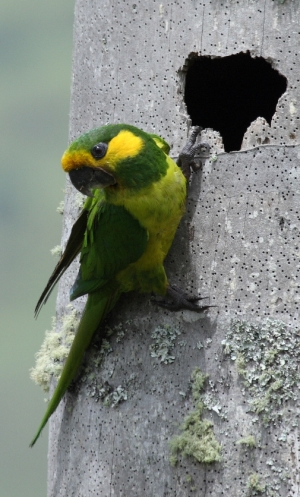
Conservación Loro Orejiamarillo

La clave para la conservación es involucrar a las comunidades locales y comprometerlas hacia la meta de proteger las especies. Esta estrategia, usada en muchos otros proyectos de conservación, ha sido exitosa y es considerada como parte vital para la sobreviviencia del Loro Orejiamarillo (Ognorhynchus icterotis).

Los investigadores de campo trabajan continuamente con la comunidad para de esta formna reunir elementos necesarios para la conservación de esta especie conocida localmente como “Guacamaya”. Las campesinos tienen la crencia que al tocar las alas de esta ave en vuelo les traerá buena suerte. Através del acercamiento con la comunidad se ha logrado obtener información valiosa sobre aspectos como localización, movimientos y hábitat de esta especie con apoyo constante del Área de Educación Ambiental , cuyo objetivo principal es mantener a la comunidad involucrada en salvar a las especies.

22

Se continuará las investigaciones sobre esta especie en aspectos tales como biología reproductiva, comportamiento, movimientos poblacionales, requerimientos de hábitat y preferencias de alimentación.

Se continuará con el Programa de Nidos Artificiales  como una estrategia de conservación del Loro Orejiamarillo (Ognorhynchus icterotis), especialmente en áreas donde los sitios de anidación son limitados, así mismo sal y suplementos minerales serán ubicados en árboles bajos en los sitios de descanso como método de atraer bandadas. Todos los datos recolectados de las investigaciones de campo serán usados para desarrollar futuras estrategias de conservación.

El proyecto (Ognorhynchus icterotis) tiene, entre otras metas comprar tierras destinadas para la conservación de escosistemas estratégicos a través de un sistema de Áreas Protegidas , que serán administradas específicamente para el beneficio de las especies.

Otra de las metas, es promover la administración de la tierra y programas de reforestación. Este plan anima voluntariamente a los terratenientes a donar cuestas y áreas escarpadas para la reforestación. Los terratenientes voluntarios son proporcionados de materiales para cercar y plantas con el acuerdo de que el área no puede ser convertida en pastizales en los próximos 20 años.


Categorías
Revista Conservación Colombiana

Revista Conservación Colombiana 16


ProAves publica la edición Nº 16 de su Revista científica Conservación Colombiana; esta edición incluye un monitoreo completo  de la avifauna de la isla de San Andrés entre noviembre de 2003 y abril de 2010. Durante este periodo se realizaron, regularmente, durante aproximadamente 20 días de cada mes, conteos desde puntos de radio variable, transectos y redes de niebla en una variedad de hábitats presentes en la isla, todo lo anterior con el objetivo de incrementar el conocimiento de la avifauna de la zona.


 Encuentre aquí el archivo en formato PDF para consultar y descargar gratuitamente.

pdf-distConservación Colombiana Nº 16 Estudio y sonservación de las aves de la Isla de  San Andrés

Categorías
Colombian Conservation Journal News

Nº 16 Study and conservation of the birds of San andrés Island

portada

Fundación ProAves has publishes the 16th volume of its scientific journal Conservación Colombiana, this edition includes a monitoring of the avifauna of the island of San Andres conducted by ProAves between November 2003 and April 2010. During this period we conducted regularly for about 20 days every month variable radius point counts, transects and mist-netting in a variety of habitats present in the island. All of the above with the aim of increasing the knowledge of the avifauna of the archipelago.


Find here the PDF file to view and download for free.

pdf-distConservación Colombiana Nº 16 Estudio y sonservación de las aves de la Isla de  San Andrés

Categorías
Noticias Noticias Ranita Terribilis

La Alianza para la Cero Extinción anuncia el lanzamiento de la campaña “Siete Maravillas”

Wonders

Vote por la Rana Dardo Venenoso (Golden poison frog) de ProAves aquí

ProAves es miembro de la AZE desde hace 7 años. Hasta el momento hemos establecido 10 reservas naturales en las zonas catalogas como AZE por el comité global, con el propósito de conservar por siempre estas especies AZE que allí se encuentran.

Golden poison frog

Golden poison frog – ProAves.

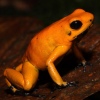
En mayo de 2012 la Fundación ProAves anunció la creación de la primera Reserva Natural dedicada a la protección de esta especie la Reserva Natural Rana Terribilis, ubicada en el departamento del Cauca, Colombia; la rana esta considerada al borde de la extinción y hasta ahora estaba totalmente desprotegida.

Dependiente de los bosques primarios, el rango de distribución de la Rana Terribilis ocurre irregularmente un área muy pequeña. La Alianza para la Cero Extinción, ha identificado a la Rana Terribilis como una de las criaturas mas amenazadas del mundo debido a su rango de distribución y a su población restringida.

“Estas especies han vivido en la Tierra más que cualquier estructura hecha por el hombre, y no podemos permitir que desaparezcan”, dijo Mike Parr, Presidente de la AZE  “Esperamos que las persona sientan orgullo por sus especies y voten por las más carismáticas, especies que sólo se encuentran en lugares únicos en su país”.

Encuentre los 20 lugares y sus especies en peligro de extinción y vota por la Rana Dardo Venenoso o Golden poison frog aquí.

La campaña es patrocinada por un miembro de la AZE, American Bird Conservancy. AZE (www.zeroextinction.org) es una iniciativa conjunta que tiene como objetivo prevenir la extinción de especies mediante la identificación y protección de sitios clave, siendo cada uno último refugio para una o más especies en peligro o en peligro crítico. El objetivo de la AZE es crear una primera línea de defensa contra la extinción mediante la protección de muchos de estos sitios. Los datos están disponibles en todos los lugares AZE y en un mapa donde se ilustra gráficamente la ubicación de cada uno de los sitios en todo el mundo.

abc aze
Categorías
News

“Zero Extinction” Seven Wonders Campaign Announced


Wonders

Vote for the Golden poison frog by ProAves here

AZE has posted a list of 20 candidate sites from which voters can select their choice of seven. The 20 shortlisted sites were chosen from among 587 sites around the world identified by scientists working with AZE; sites that are the last refuges for one or more endangered species. The 20 sites represent a variety of taxonomic groups, including birds, mammals, amphibians, and reptiles, as well as diverse geographies. Voting will be open through November and can be carried out at the campaign website: www.AZE7Wonders.org

Golden poison frog

Golden Poison frog by ProAves.

Fundación ProAves has been a member of the Alliance for Zero Extinction for 7 years, and uses the AZE list of threatened sites and species to prioritize its work. ProAves has established 10 nature reserves in areas classified as AZE by global committee, in order to preserve forever AZE species found there.

Vote for the Golden poison frog by ProAves here

“The world rallies to preserve the heritage of priceless historical places like the Great Pyramid of Giza or the Colosseum, and we should also protect the places on Earth that harbor the most endangered species,” said Mike Parr, AZE Chair and Vice President of American Bird Conservancy. “By highlighting seven places out of the 587 sites that are most important to the preservation of the Earth’s biodiversity, in the tradition of the ‘Seven Wonders of the World,’ we can help draw attention to the importance of saving these sites.”

“The idea is to stimulate interest in – and hence action to save – threatened species that only occur in one place. Local pride will go a long way towards protecting these species,” said Tom Brooks, AZE Steering Committee member and Vice President for Science and Chief Scientist at NatureServe.

The campaign was launched today at the World Conservation Congress, which is being hosted by the International Union for the Conservation of Nature (IUCN), and where some 8,000 people have gathered to address global conservation issues. The IUCN Red List of Threatened Species was used by AZE to help identify the 920 Endangered and Critically Endangered species restricted to 587 single sites worldwide.

“These species have lived on Earth longer than any man-made structure, and we cannot allow them to disappear in the shadows, unnoticed,” said Parr. “We hope citizens feel a sense of pride and vote for the charismatic species found only at the unique places in their country.”

The following 20 sites (in random order) and their endangered species were selected for voting in the AZE’s 7 Wonders campaign:

1. Gough Island, UK – Tristan Albatross

2. Isla Robinson Crusoe, Chile – Juan Fernandez Firecrown

3. Abra Patricia, Peru – Long-whiskered Owlet

4. Raso da Catarina, Brazil – Lear’s Macaw
5. Hellshire Hills, Jamaica – Jamaican Ground Iguana
6. Anhui Chinese Alligator Nature Reserve, China – Chinese Alligator
7. Roti Island, Indonesia – Roti Island Snake-necked Turtle
8. Baly Bay National Park, Madagascar – Angonoka Tortoise
9. Yadua Taba Island, Fiji – Fiji Crested Iguana
10. Río Saija, Colombia – Golden poison frog

11. Bale Mountains, Ethiopia – Malcom’s Ethiopia Toad
12. Morningside and Handapan Ella Plains, Sri Lanka – Shrub Frog
13. Manas National Park, India – Pygmy Hog
14. Menabe – Andranomena, Madagascar – Madame Berthe’s Mouse Lemur
15. Helan Shan Nature Reserve, China – Helan Shan Pika
16. Rodrigues Mainland, Mauritius – Rodrigues Flying Fox
17. Massif de la Hotte, Haiti – La Hotte Glanded Frog
18. Lower Tana River, Kenya – Tana River Mangabey (monkey)
19. Chatham Islands, New Zealand – Shore Plover
20. Poyang Hu, China – Siberian Cran

The campaign is sponsored by AZE member, American Bird Conservancy. AZE (www.zeroextinction.org) is a joint initiative that aims to prevent species extinctions by identifying and safeguarding key sites, each of which is the last remaining refuge for one or more Endangered or Critically Endangered species. AZE’s goal is to create a frontline of defense against extinction by protecting as many of these sites as possible. Data are available on all AZE sites and an accompanying map graphically illustrates the location of each of the sites around the world.

abc aze


Categorías
Noticias

Día Nacional de la Biodiversidad

Colombia ocupa el segundo lugar a nivel mundial en diversidad biológica y está considerado como uno de los más ricos del planeta (megadiversos). Poseemos un alto endemismo y concentración de especies, y somos el país con mayor diversidad de aves del mundo con 1889 especies.

{youtube}Bpo3qwnEOoM|425|344|1{/youtube}

Este es un pequeño mensaje para que nos comprometamos a respetar a las especies en su propio hábitat, no alterando los ecosistemas que brindan bienes ambientales como: el agua, el aire y protección a los suelos, evitando la captura de fauna silvestre, su comercio ilegal; no destruyendo bosques y afectando aquellos ecosistemas vulnerables como son los páramos, los humedales y áreas de reserva hídrica y de biodiversidad.

La conservación de la biodiversidad de nuestro país es responsabilidad de todos los colombianos”.


Categorías
Noticias Noticias El Dorado

Guía para la Reserva Natural de las Aves El Dorado

La Fundación ProAves es propietaria y gestiona las 1052 hectáreas de la Reserva Natural de las Aves El Dorado, con excelentes instalaciones de ecoturismo encontradas en la Sierra Nevada de Santa Marta – la montaña costera más alta del mundo. Esta reserva se está convirtiendo en uno de los mejores sitios de observación de aves del trópico, donde habitan 22 aves endémicas (al igual que muchas especies endémicas de anfibios, plantas, etc.); situada a pocos pasos de un maravilloso lugar de observación de aves y a dos horas de las playas del Mar Caribe. ProAves ha renovado recientemente las instalaciones con más de 26 camas y conexión a internet de alta velocidad, recibiendo un flujo constante de grupos de observadores de aves y de  naturaleza.

Estamos buscando un Guía de aves que pueda trabajar en la Reserva El Dorado, para comenzar labores desde octubre/noviembre de 2012 hasta abril de 2013 (con posibilidad de prórroga);. Se ofrece alojamiento y otros beneficios, más el pago por cada día de orientación. El candidato debe ser un observador de aves experimentado y muy trabajador (no necesariamente con experiencia de avistamiento en Colombia), debe guiar con frecuencia y por largas horas durante muchos días. La experiencia con el ecoturismo y/o conservación es necesaria y debe tener licencia de conducir.

¿Cómo aplicar?

Enviar carta de presentación explicando por qué sería el candidato ideal y Hoja de Vida al siguiente correo electrónico: fundacion@proaves.org

Categorías
News

Birding Guide for Colombian Bird Reserve

The Colombian charity Fundación ProAves owns and manages the 2,600 acre El Dorado Bird Reserve with excellent ecotourism facilities perched on the Sierra Nevada de Santa Marta Mountains – the highest coastal mountain on earth. This reserve is fast becoming the top birding site the entire tropics – 22 endemic birds (not to mention many endemic amphibians, plants, etc.) within a stones throw of a wonderful birding Eco-Lodge and two hours from Caribbean beaches. ProAves has recently upgraded facilities with over 26 beds and high-speed internet and has a constant stream of birding and nature groups staying.

We are seeking a birder that can live at the El Dorado Eco-Lodge from Oct/Nov 2012 until April 2013 (with the possibility of an extension) to guide birders and naturalists. We would offer accommodation and other benefits, plus payment for each day of guiding. Candidates must be experienced birders (although not necessarily experienced in Colombia) and hard-working, often guiding for long hours over many days. Experience with ecotourism and/or conservation is useful. A US or other driving license is essential.

How to apply?

Send cover letter explaining why you would be the ideal candidate and resume to the following email address: fundacion@proaves.org


Categorías
News

Spectacular images from the Amazon

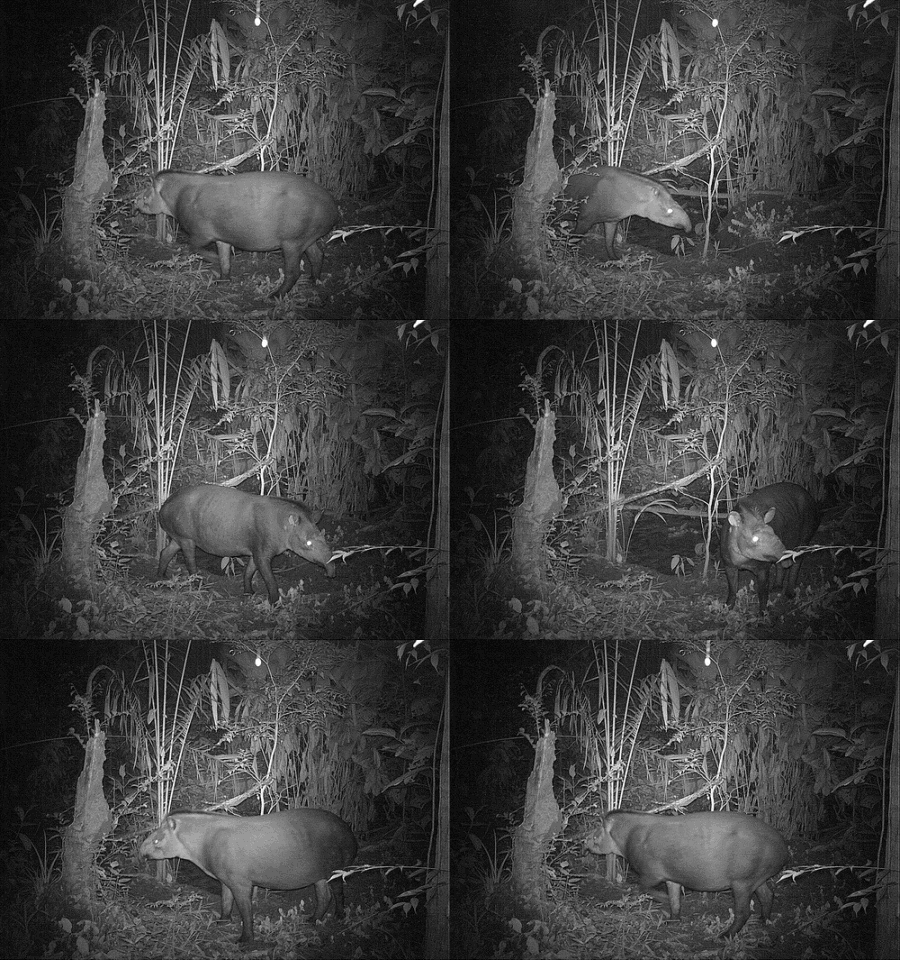
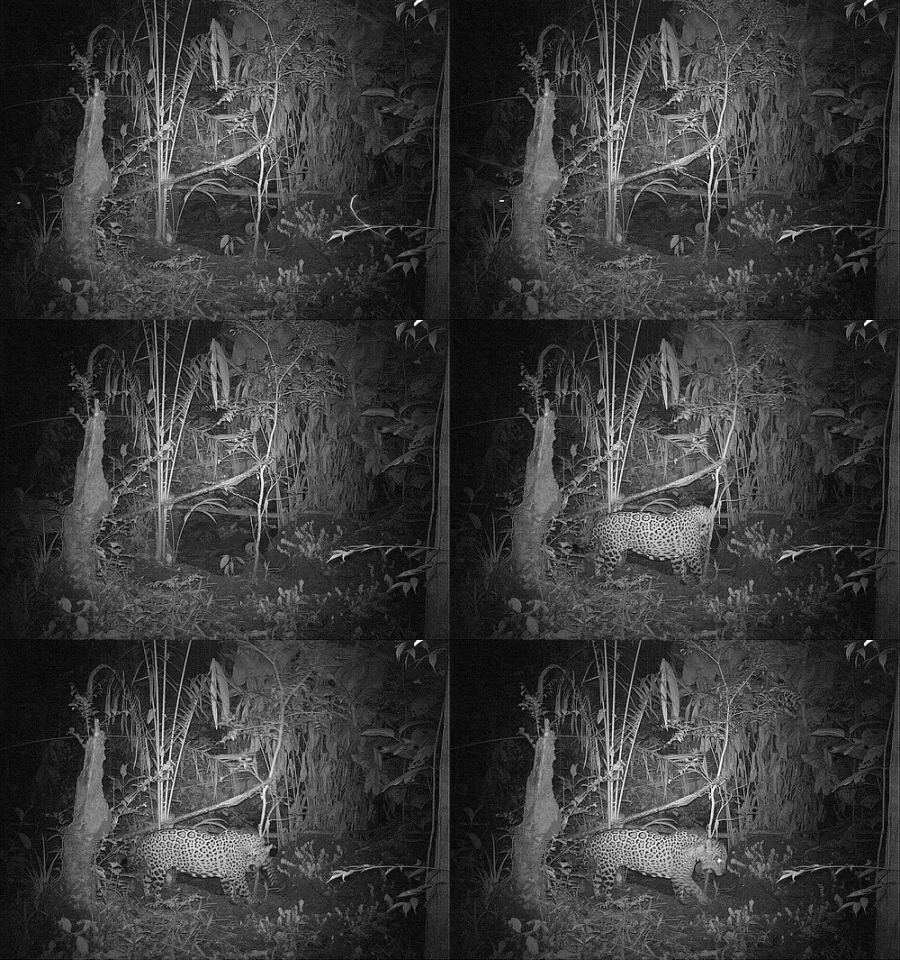
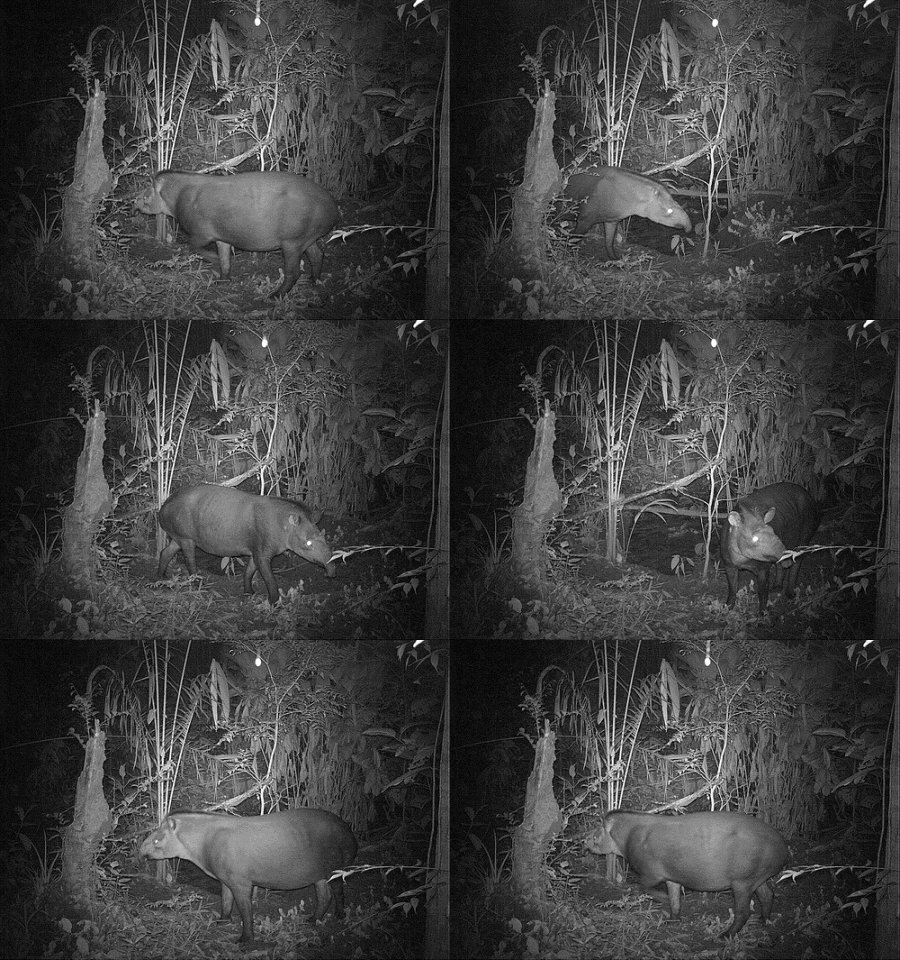
ProAves has used this technique for many purposes, from identifying individual species to assessing population size and various aspects of their ecology and behavior, the use of trap cameras is one of the most important and versatile methods for biological research for conservation purposes; they allow behavioral studies, activity patterns and population estimate, among others to be made.

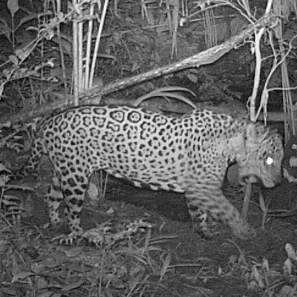
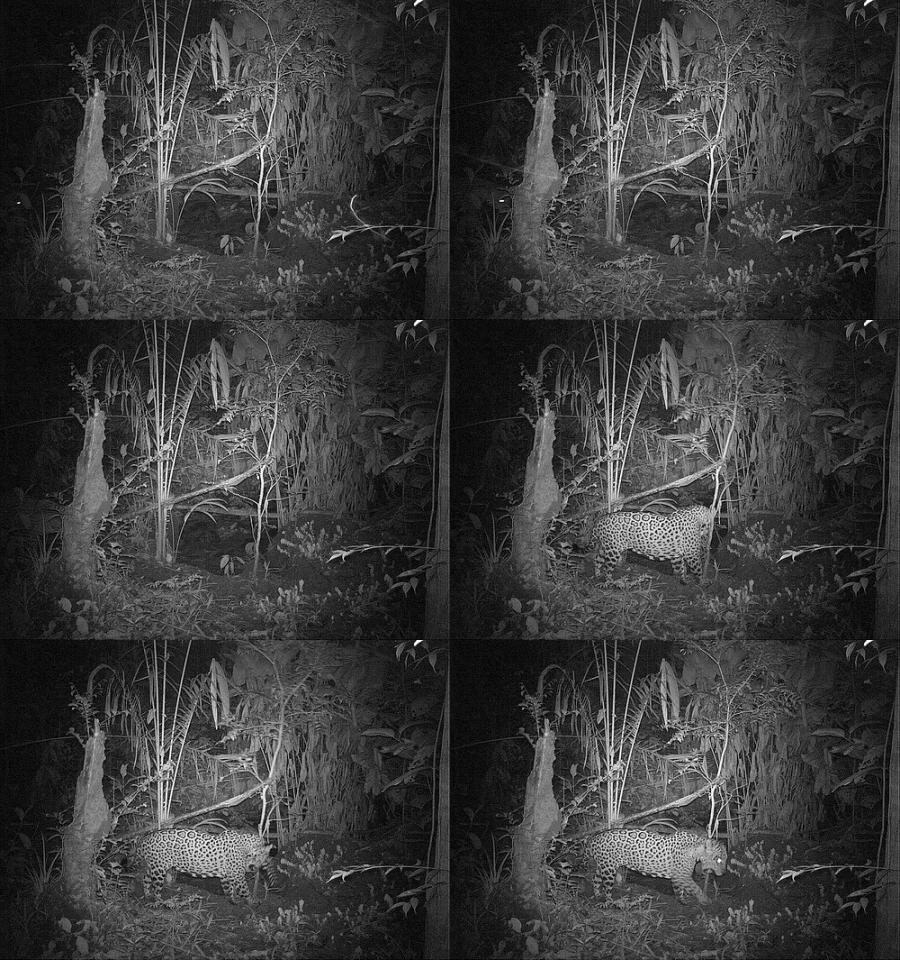
The trap cameras were installed in July and during the 20 days spent capturing photographic records it was possible to identify a female deer (Mazama americana), apparently pregnant, while we also got a spectacular record of a Jaguar (Panthera onca), almost extinct in the department of Casanare, which shows the importance of ProAves conservation actions in transitional forests of the Orinoco to the Amazon.

Jaguar
Register with camera traps a Jaguar (Panthera onca).
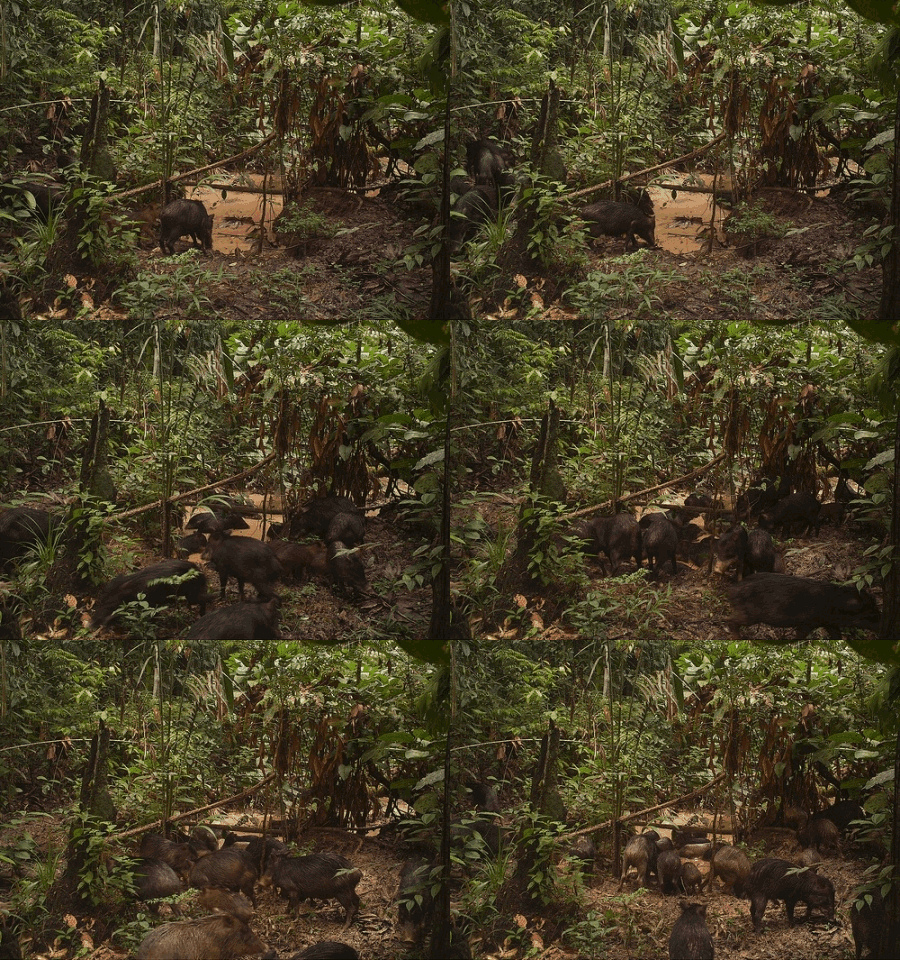
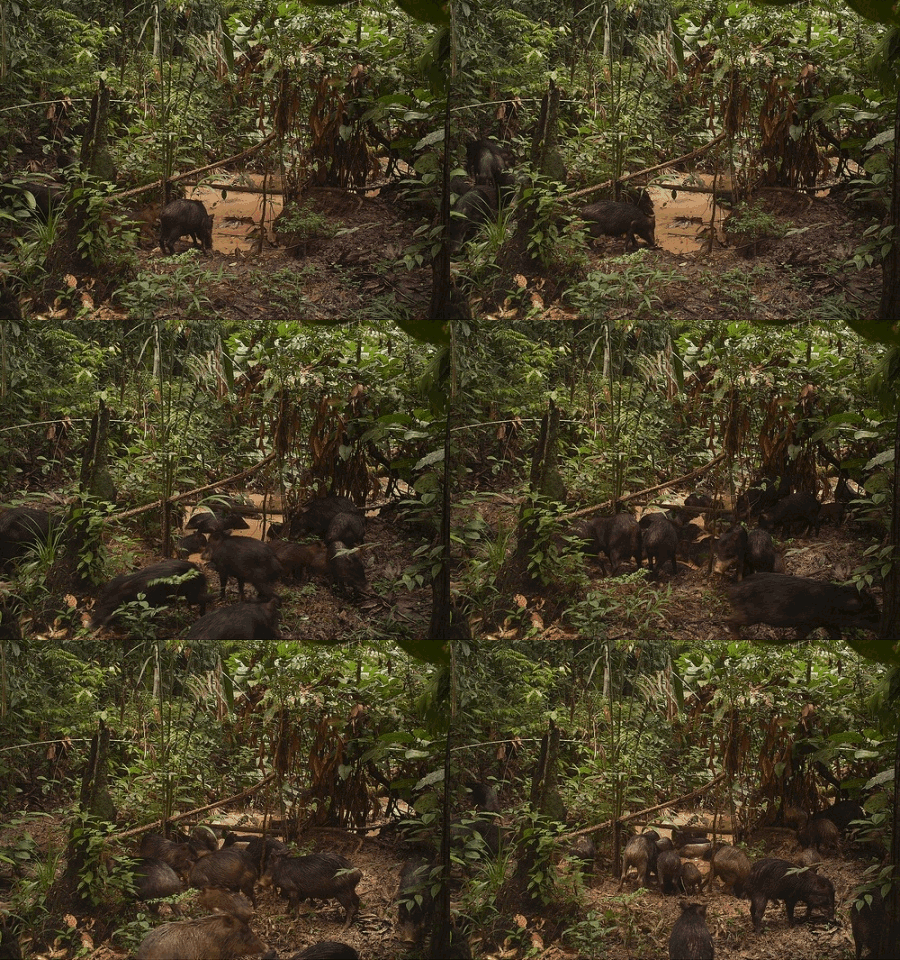
cajuches
Register with camera traps individuals Cajuches (Tayassu pecari).
Danta
Register with camera traps of Danta (Tapirus terrestris)

A herd of Collared Peccary (Tayassu pecari) of around 150 individuals, among adults and juveniles, was identified for the first time; likewise a very important register of a Crestless Curassow (Mitu tomentosum) was made.

This time the cameras were installed in lakesides or salty wetlands, a favorable environment where these species find vital nutrients and minerals.

This tool has been used by ProAves in studies while monitoring the population of Crax Alberti, Ateles hybridus and Tremarctos ornatus, among others and to check for the presence of other species of mammals and birds in protected areas located in the most threatened ecosystems in our country.

Thanks to its implementation, at least 40 species, between birds and mammals, have been registered, the majority of special interest for their conservation status or level of endemism, and others for their scarce records and being considered as rare species.

At ProAves we hope to continue to use this method in studies of biodiversity, abundance and population monitoring and of special interest for the conservation of several species of flora and fauna in our country.

Categorías
Noticias Noticias El Tapir

Espectaculares registros de la selva amazónica

ProAves ha utilizado esta técnica con múltiples propósitos,  desde identificar individualmente especies hasta para evaluar tamaño de poblaciones y varios aspectos de su ecología y comportamiento; el uso de cámaras trampa es una de las más importantes y versátiles metodologías para los estudios de investigación biológica con fines de conservación; permite realizar estudios de comportamiento, patrones de actividad y estimación poblacional, entre otros.

Las cámaras trampa fueron instaladas en julio y durante los 20 días empleados para capturar los registros fotográficos fue posible identificar una hembra venado (mazama americana) aparentemente preñada, igualmente obtuvimos el espectacular registro de un Jaguar (Panthera onca)  casi extinto en el departamento del Casanare, lo que muestra la importancia de ProAves en la conservación de los bosques en transición de la Orinoquía al Amazonas.

Jaguar
Registro con cámaras trampa de un Jaguar (Panthera onca).
cajuches
Registro con cámaras trampa de individuos Cajuches (Tayassu Pecari).
Danta
Registro con cámaras trampa de una Danta (Tapirus terrestris)

Por primera vez fue identificada una manada de alrededor de 150 individuos entre adultos y juveniles de Cajuches (Tayassu pecari); así mismo es muy importante el registro de un Paujil culicastaño (Mitu tomentosum).

En esta oportunidad las cámaras fueron instaladas en lacustres o humedales tipo salado, ambiente propicio donde estas especies encuentran nutrientes y minerales vitales.

Esta herramienta ha sido implementada en la Fundación ProAves en estudios de monitoreo de la población de Crax Alberti, Ateles hybridus y Tremarctos ornatus, entre otros y para verificar la presencia de otras especies de mamíferos y aves en las áreas protegidas ubicadas en los diferentes ecosistemas en su mayoría amenazados en nuestro país.

Gracias a su implementación se ha obtenido el registro de al menos 40 especies entre aves y mamíferos; la mayoría de especial interés por su estado de conservación o nivel de endemismo, y otras por sus escasos registros y por ser consideradas como especies raras.

En la Fundación ProAves, esperamos continuar utilizando este método en estudios de biodiversidad, abundancias y monitoreos poblacionales, de interés para la conservación de varias especies de fauna y flora en nuestro país.

Categorías
News

ARA’s and Pride campaigns now in Génova and Jardín

“If you want to have a future, forests and water you must protect” – that accompanies the campaign slogan in Jardín, Antioquia.

The objective of the campaign is to encourage high mountain farmers to conserve their sources and other natural resources, especially the basins Quebrada La Bonita and La Mendoza.

Past June we launched the Pride Campaign in the town of Jardín, Antioquia, which included the active participation of the public institutions of the town like the Town Hall, Undersecretary of Rural Development and Environment, DMI cuchilla Jardín-Támesis, Public Companies, City Council, the Caramatarruba Indigenous Community and urban residents.

With the delivery of the project according to the Mayor of Jardín in May, great buzz and interest was created in implementing the Reciprocal Water Agreements (RWA/ARAS) as a key measure for the town, one of the activities that raised most motivation among the inhabitants of Jardín was the development of the logo and the slogan that champion the campaign, this activity helped to promote pride and awareness to help the conservation of flagship species such as the Yellow-eared Parrot.

[slickr-flickr search=”sets” set=”72157630275105524″ items=”20″ type=”gallery”]

ProAves Foundation has developed a strong working socialization with institutions that have an impact on decision-making in environmental matters, as in the case of the Mayor and City Council, and CORANTIOQUIA & the Agri-environmental Unit who were present during the activities.

“If you take care of Río Gris, Génova will be happy “- slogan that accompanies the campaign in the town of Genova, Quindío.

During the month of May we make the official launch of the Pride Campaign in this county with the slogan “If you take care of Río Gris, Génova will be happy.” Event allowed the community to socialize and institutions the project by presenting cultural events (puppet plays, spots and banners); in addition to encouraging, motivating and initiating actions for the conservation of biodiversity in the town.

Likewise, a consensus workshop was established with the High mountain inhabitants of the villages of Río Gris which identified what kind of incentive landowners required to conserve waterbasins and watersheds that supply municipal aqueduct. Among the inhabitants interest was perceived in participating in the process to improve and recover their natural resources.

The event was attended by the Mayor of Génova Mr. Albert Cañas, City Council members, some educational institutions, the Environmental Police and Community officials of the Autonomous Regional Corporation of Quindío (CRQ), members of the Avizor Foundation, and owners of high mountain farms, the Civil Defense and representatives of Community Action Committees, among others.

Actions in the two municipalities have shown institutional willingness to address the concern of preserving and protecting environmental services and resources and ensure future generations and improve the quality of life of its inhabitants also demonstrated high commitment and the interest of landowners and hard work of environmental work, social and community that ??ProAves has made supported by Loro Parque Fundación over these 13 years.

Supported by:

lpf Gnova Escudo_jardin


Categorías
Noticias

ARA’s y Campañas por el Orgullo ahora en Génova y Jardín

“Si futuro quieres tener, los bosques y el agua debes proteger” – lema que acompaña la campaña en Jardín, Antioquía.

El objetivo fundamental de la campaña es motivar a los campesinos de alta montaña a conservar sus nacimientos y demás recursos naturales, especialmente las cuencas Quebrada La Bonita y La Mendoza.

EL pasado mes de junio realizamos el lanzamiento de la Campaña por el Orgullo en el municipio de Jardín, Antioquia, el cual contó con la participación activa de las instituciones públicas del municipio como: la Alcaldía, Subsecretaría de Desarrollo Rural y Ambiente, DMI cuchilla Jardín-Támesis, Empresas Públicas, Concejo Municipal, Comunidad Indígena Caramatarruba y los habitantes del casco urbano.

Con la entrega del proyecto de acuerdo al Alcalde Municipal de Jardín en el mes de mayo, se creo gran expectativa e interés en implementar los Acuerdos Recíprocos por Agua (ARAS) como una medida fundamental para el municipio; una de las actividades que despertó más motivación entre los habitantes de Jardín fue la elaboración del logo y el slogan que abanderan la Campaña, esta actividad permitió fomentar el orgullo y la conciencia para ayudar a la conservación de su especie insignia como es el caso del Loro Orejiamarillo.

[slickr-flickr search=”sets” set=”72157630275105524″ items=”20″ type=”gallery”]

La Fundación ProAves viene desarrollando un fuerte trabajo de socialización con las instituciones que tienen incidencia en la toma de decisiones en materia ambiental, tal es el caso de la Alcaldía y Concejo Municipal, CORANTIOQUIA y la Unidad Agroambiental quienes han hecho presencia en las actividades realizadas.

“Si cuidas Río Gris, Génova estará feliz” – lema que acompaña la campaña en el municipio de Génova, Quindío.

Durante el pasado mes de mayo realizamos el lanzamiento oficial de la Campaña del Orgullo en este municipio con el slogan “Si cuidas Río Gris, Génova estará feliz”. El evento permitió socializar a la comunidad e instituciones el proyecto mediante la presentación de actos culturales (títeres, obra de teatro, spots y pancartas); además de incentivar, motivar e iniciar acciones para la conservación de la biodiversidad del municipio.

Igualmente, se estableció con los habitantes de alta montaña de la vereda Río Gris un taller de consenso que permitió identificar qué tipo de incentivo requieren los propietarios de predios para conservar cuencas y microcuencas que abastecen el acueducto municipal. Se percibe entre los campesinos el interés por participar en los procesos que permitan mejorar y recuperar sus recursos naturales.

El evento contó con la participación del Alcalde de Génova el señor Albert Cañas, integrantes del Concejo Municipal, de algunas Instituciones Educativas, de la Policía Ambiental y Comunitaria, funcionarios de la Corporación Autonoma Regional del Quindío (CRQ), integrantes de la Fundación Avizor, propietarios de alta montaña, la Defensa Civil y representantes de las Juntas de Acción Comunal, entre otros.

Las acciones emprendidas en los dos municipios han evidenciado la voluntad institucional frente a la preocupación de conservar y proteger los servicios ambientales y así asegurar los recursos a las generaciones futuras y mejorar la calidad de vida de sus habitantes; asimismo, se demuestra el alto compromiso e interés de los propietarios de predios y la ardua labor de trabajo ambiental, social y comunitario que ha realizado la Fundación ProAves con el apoyo de Loro Parque Fundación a lo largo de estos 13 años.

Con el apoyo de:

lpf Gnova Escudo_jardin


Categorías
News

Ranita Dorada Amphibian Reserve Reforested

For the past three years the restoration and reforestation in Ranita Dorada Amphibian Reserve has been developed with the aim of promoting connectivity, recovery of open areas and to provide plants used for foraging wildlife, especially birds.

Located in the department of Tolima, the Amphibian Reserve Ranita Dorada is the first Reserve in the world created for the conservation of threatened species belonging to this order.

Thanks to the work done so far, a remarkable regeneration of native plant species can be seen in primary and secondary succession in what were previously pastures, recovering part of the habitat for several species of amphibians including two spectacular endemic and endangered frogs, and Ranitomeya doriswainsonae and Ranitomeya tolimense found here.

[slickr-flickr search=”sets” set=”72157631198764082″ items=”20″ type=”gallery”]

With these activities, ProAves is meeting the objectives in establishing silvopastoral systems, implementing hedges, reforestation at water sources, along the banks of rivers and streams, natural regeneration of stocks in pastures, coffee and cocoa shade plantations, working with the community and towns for the recovery of watersheds and the donation of trees for meeting the commitments in the easements.

Finally, during these years of work over 1,850 acres of pastures, margins of streams and rivers in different parts of country have been replanted and restored, not only giving proper management of these areas but also providing food supply for wildlife.

Supported by:

dendro NMBCA


Categorías
Noticias Noticias Ranita Dorada

Reforestado el 40% de la Reserva ProAves Ranita Dorada

Desde hace tres años se vienen desarrollando trabajos de restauración y reforestación en la Reserva de Anfibios Ranita Dorada con el objetivo de propiciar la conectividad, la recuperación de zonas abiertas y proporcionar plantas usadas para el forrajeo de la fauna silvestre, en especial las aves.

Ubicada en el departamento de Tolima, la Reserva de Anfibios Ranita Dorada es la primera Reserva en el mundo creada para la conservación de especies amenazadas pertenecientes a este orden.

Gracias a los trabajos realizados hasta el momento, se puede apreciar una regeneración vegetal  notable de especies nativas en sucesión primaria y secundaria en lo que anteriormente eran potreros, recuperando parte del hábitat para varias especies de anfibios incluyendo dos espectaculares ranas endémicas y amenazadas, Ranitomeya doriswainsonae y Ranitomeya tolimense que se encuentran en este lugar.

Con estas actividades, ProAves está cumpliendo con los objetivos en el establecimiento de sistemas silvopastoriles, implementación de cercas vivas, reforestación en los nacimientos de agua y en los márgenes de los ríos y quebradas; regeneración natural en potreros de las reservas, sombríos de café y cacao, trabajo con la comunidad y alcaldías para la recuperación de microcuencas y donación de árboles para cumplimiento de los compromisos en las servidumbres.

Finalmente, durante estos años de trabajo se han reforestado y restaurado más de 1.850 hectáreas de potreros, márgenes de quebradas y ríos en diferentes zonas del país; no sólo dando un manejo adecuado a estas zonas sino también brindando oferta alimenticia para la fauna silvestre.

Con el apoyo de:

dendro NMBCA
Categorías
News

Climate change study on Colombian birds highlights the need for new protected areas

Climate change is expected to cause shifts in species distributions worldwide, threatening their viability due to range reductions and altering their representation in protected areas. Biodiversity hotspots might be particularly vulnerable to climate change because they hold large numbers of species with small ranges which could contract even further as species track their optimal habitat.

In July 2012, Stony Brook University PhD student and ProAves founder member Jorge Velásquez-Tibatá together with Drs Catherine Graham of Stony Brook University and Paul Salaman of World Land Trust-US and an advisory council member of ProAves published an article titled “Effects of climate change on species distribution, community structure, and conservation of birds in protected areas in Colombia ” in the journal Regional Enviromental Change. Copies are available on email request fundacion@proaves.org.

Using field data shared by ProAves, together with publically accessible data from BioMap data containing 230,000 records of Colombia bird specimens, together with field data compiled by Dataves, eBird, and xeno-canto, the extent to which climate change could cause distribution shifts in threatened and range-restricted birds in Colombia was analyzed. The online Darwin Database by Project BioMap was a collaboration of over 70 bird collections across the world, and lead by The Natural History Museum (UK), Instituto de Ciencias Naturales de la Universidad Nacional de Colombia, and Conservación Internacional-Colombia.

Mapa_2

Results highlighted that threatened and range-restricted birds in Colombia are projected to lose on average between 33 and 43 % of their total range under future climate, and up to 9 Colombian endemic species may lose their climatically suitable range completely and therefore could go extinct. Worryingly, 8 of the 9 species that could go extinct are endemic to the Sierra Nevada de Santa Marta and represent almost half of all the endemic bird species restricted to the Sierra Nevada de Santa Marta, including the spectacular Santa Marta Parakeet Pyrrhura viridicata.  An important population stronghold for many of the eight Santa Marta endemics is in the El Dorado Bird Reserve, but this 2,500 acre reserve is inadequate to sustain populations and greater efforts are needed to connect this reserve and the San Lorenzo ridge to the main National Park some 5 km away which holds higher elevations that could temporarily buffer the impacts of climate change.

Furthermore, one of those species at risk of extinction from the effects of climate change is the Endangered Chestnut-capped Piha Lipaugus weberi from the northern slopes of the Central Cordillera – with the core surviving population contained within the ProAves reserve “Arrierito Antioqueño Bird Reserve”.

The article predicted that in the future, potentially between 5 to 70% of threatened and range-restricted birds in Colombia will be inadequately represented is protected areas.

This article provides recommendations for future research and conservation needs in Colombia, including:

(1) monitoring populations of birds for which future suitable climate is predicted to completely disappear;

(2) conducting field surveys, especially aimed toward species known in few locations, to improve distribution models;

(3) including predictions of the effect of climate change on species distribution as part of IUCN assessments of species extinction risk, and

(4) identifying sites that would complement the current protected area network to meet species representation targets.

It is critical that existing reserves, parks and other protected areas be better protected and expanded, while new protected areas be established in the most under-represented regions and ecosystems, particularly the Sierra Nevada de Santa Marta, the Chocó, northern slope of the Western and Central Andes and the northern half of the Eastern Cordillera.

Overall, the article lays an important foundation for scaling up conservation efforts in the race to combat the effects of climate change on Colombian birds.

Citation:

Velásquez-Tibatá, J., Salaman, P., y Graham, C. (2012) Effects of climate change on species distribution, community structure, and conservation of birds in protected areas in Colombia. Regional Environmental Change. Vol. 12, 329-342.

Alianza BioMap (Museo de Historia Natural del Museo Británico, Instituto de Ciencias Naturales de la Universidad Nacional de Colombia, y Conservación Internacional) 2006. Base de Datos Darwin: Proyecto BioMap base de datos de distribución de la avifauna Colombiana. http://www.biomap.net.

Figure 3 on page 8: Future pattern of species richness, under climate scenario A2: predicted percent of species’ losses relative to current richness (Velásquez-Tibatá et al. 2012).


Categorías
Noticias Noticias Arrierito Antioqueño

Estudio sobre cambio climático para las aves de Colombia resalta la necesidad de nuevas áreas protegidas

Según el artículo, se espera que el cambio climático cause cambios en la distribución de las especies en todo el mundo, poniendo en peligro su viabilidad debido a la reducción del área de distribución y la modificación de sus poblaciones en las áreas protegidas. Los puntos críticos de biodiversidad podrían ser particularmente vulnerables al cambio climático, porque tienen un gran número de especies con rangos pequeños, cuyos hábitat se podrían reducir aún más.

En julio de 2012, el estudiante de doctorado de la Universidad Stony Brook y miembro fundador de ProAves Jorge Velásquez Tibatá, junto con los doctores Paul Salaman de World Land Trust-US y miembro del Consejo Asesor de ProAves, y Catherine Graham de la Universidad de Stony Brook publicaron un artículo titulado “Efectos del cambio climático sobre la distribución de especies, estructura de la comunidad y la conservación de las aves en áreas protegidas de Colombia” en la revista Regional Enviromental Change. Copias disponibles solicitándolas por correo electrónico a fundacion@proaves.org

Utilizando los datos realizados en campo por ProAves, junto con los datos de acceso público de Proyecto BioMap, que contiene 230.000 registros de especímenes de aves de Colombia, más los datos de campo compilados por Dataves, eBird y xenocanto, se analizó el alcance que el cambio climático podría causar en la distribución de las aves amenazadas y de rango restringido en el país. La Base de Datos Darwin, del Proyecto BioMap, que se encuentra en línea, fue una colaboración de más de 70 colecciones de aves en todo el mundo, dirigida por el Museo de Historia Natural del Reino Unido, el Instituto de Ciencias Naturales de la Universidad Nacional de Colombia y Conservación Internacional-Colombia.

Mapa_2

Los resultados mostraron que las aves amenazadas y de rango restringido en Colombia, podrían perder en promedio entre el 33 y el 43% de su área de distribución total en el futuro, y hasta 9 especies endémicas colombianas pueden perder su rango climático por completo y por lo tanto podrían extinguirse. Es preocupante ya que 8 de las 9 especies que podrían extinguirse, son endémicas de la Sierra Nevada de Santa Marta y representan casi la mitad de todas las especies de aves endémicas que se encuentran en este lugar, incluyendo el espectacular Periquito de Santa Marta (Pyrrhura viridicata). Importantes poblaciones de muchas de las especies endémicas encontradas en Santa Marta se hallan en la Reserva Natural de las Aves El Dorado, pero esta reserva de mas de 1200 hectáreas es insuficiente para sostener a las poblaciones y es necesario lograr conectar esta reserva y la Cuchilla de San Lorenzo con el Parque Nacional Natural ubicado a 5 km, el cual mantiene las elevaciones más altas que, temporalmente, podrían amortiguar los impactos del cambio climático.

Por otra parte, una de las especies en peligro de extinción debido a los efectos del cambio climático es el Arrierito Antioqueño (Lipaugus weberi) (EN), que se encuentra en las laderas septentrionales de la cordillera central con un núcleo de población superviviente ubicado en la Reserva Natural de las Aves Arrierito Antioqueño de ProAves.

El artículo prevé que en el futuro, posiblemente entre el 5 y el 70% de las aves amenazadas y de rango restringido en Colombia están insuficientemente protegidas en las reserva naturales.

No obstante, este artículo proporciona recomendaciones para futuras investigaciones y necesidades de conservación en Colombia, incluyendo:

(1) Monitorear las poblaciones de aves para las que se pronostica desaparecer en el futuro,

(2) Realización de estudios en campo, dirigidos especialmente hacia las especies conocidas en pocos lugares, para mejorar los modelos de distribución;

(3) Incluir las predicciones de los efectos del cambio climático sobre la distribución de las especies como parte de las evaluaciones de la UICN de especies en peligro de extinción, e

(4) Identificar los sitios que complementen la actual red de áreas protegidas para cumplir con los objetivos de protección de las especies.

Es fundamental que las reservas existentes, parques y otras áreas protegidas estén mejor protegidas y ampliadas, mientras que las nuevas áreas protegidas se puedan establecer en las regiones y ecosistemas más vulnerables, en particular los de la Sierra Nevada de Santa Marta, el Chocó, la vertiente noroccidental y central de los Andes y la mitad norte de la cordillera Oriental.

En general, el artículo establece una base importante para la ampliación de los esfuerzos de conservación en la carrera para combatir los efectos del cambio climático sobre las aves de Colombia.

Citas:

Velásquez Tibatá, J., Salaman, P., y Graham, C. (2012) Efectos del cambio climático sobre la distribución de especies, estructura de la comunidad, y la conservación de las aves en las áreas protegidas en Colombia. Cambio Ambiental Regional. Vol. 12, 329-342.

Alianza BioMap (Museo de Historia Natural del Museo Británico, Instituto de Ciencias Naturales de la Universidad Nacional de Colombia, y Conservación Internacional) 2006. Base de Datos Darwin: Proyecto BioMap base de datos de distribución de la avifauna Colombiana. http://www.biomap.net.

Abajo: Figura 3 de página 8: “Modelo futuro de la riqueza de las especies, bajo un escenario climático A2: predicción del porcentaje de perdida de especies en relación con la riqueza actual” (Velásquez-Tibatá et al. 2012).

Categorías
News

Please support the conservation work of ProAves

piha_low


Why Support ProAves:

ProAves has dedicated 15 years to saving the most endangered habitats and species in Colombia.

Our science-based targeted actions have saved 627,773 acres across Colombia, including the direct acquisition of over 66,718 acres of forests at imminent risk of destruction, now protected forever.

We are saving the planet’s most imperilled biodiversity. We work with rural communities to develop sustainable economies and improve livelihoods.

When you support us you are supporting real conservation actions

100% of your donation will buy and save critical habitats:

$1,000 will save 435,000 sq feet (10 acres)

$100 will save 43,500 sq. feet (1 acre)

$50 will save 21,780 sq. feet

$25 will save 10,890 sq. feet

Donate online here: through our partner Rainforest Trust (U.S. tax deductible)Follow this link if you prefer to make a donation online through our partner American Bird Conservancy.

Thank you for donating to ProAves and making a difference for biodiversity in Colombia.

Please contact ProAves Executive Director for assistance in English or Spanish:

Telephone: (57-1) 340-3261 or (57-1) 340-3229 (Bogotá, Colombia) 

Email: fundacion@proaves.org


Categorías
News

First nest box occupied by the Rusty-faced Parrot

intro_1


We celebrate the first nest attempt of the Rusty-faced Parrot (Hapalopsittaca amazonina) in a nest-box provided by ProAves in the Colibri del Sol Reserve.

The nest box was occupied by a pair of Rusty-faced Parrot who laid a single egg on April 11, and then raised the single chick until 13 July when the chick successfully fledged from the nest.

“The first record of the use of nest-boxes provided by ProAves for the Rusty-faced Parrot is of great importance and provides hope for the conservation of the Rusty-faced Parrot. With the support from Fundación Loro Parque, we implemented the program of artificial nest boxes in the Colibrí del sol Bird Reserve with the intention of assisting the species recovery through providing optimal conditions for breeding.” said Lina Daza, Executive Director of ProAves.
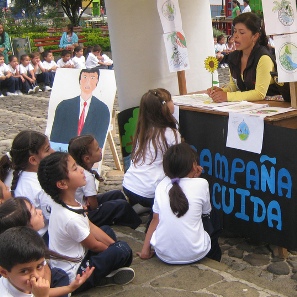
ProAves created the Artificial Nest box Program in 2003 with the support of Fundación Loro Parque as a conservation initiative, which is a response to the lack of natural cavities for threatened parrots across Colombia as mature trees and palms with cavities are often cut down for timber and firewood. ProAves has been developing the Program as a means to increase potential nesting sites for endangered parrots.
With the occupation of the nest boxes the reproductive behavior of each species can be studied.
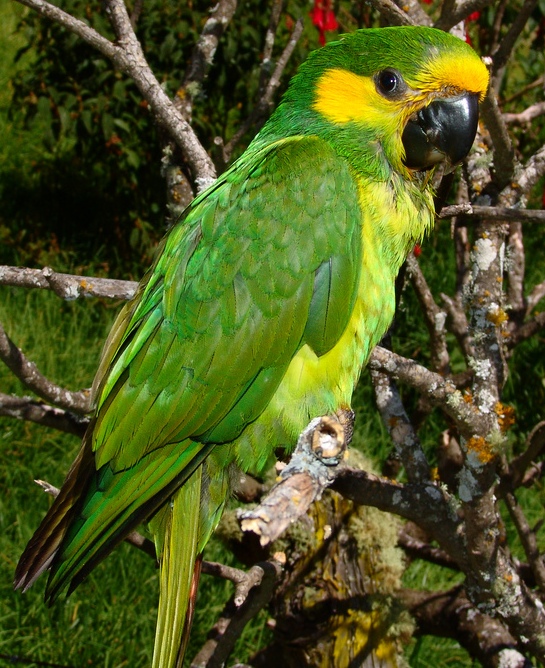
Many individuals of the Rusty-faced Parrot made explorations of the 41 nest boxes provided, so perhaps more pairs of the species could occupy nests in the next breeding season.

Fundación ProAves performs monthly activities of Conservation, Research and Environmental Education in the Colibrí del Sol Bird Reserve for the Hapalopsittaca amazonina to raise awareness in the community regarding the protection and conservation of the species.
The Colibrí del Sol Nature Reserve was created in 2005 with the support of American Bird Conservancy, and is located in the municipality of Urrao, Antioquia, with and an area of 1,800 acres of high Andean forest and páramo habitat for the Dusky starfrontlet (Coligena orina) and Fenwick’s Antpitta (Grallaria fenwickorum), which are both Critically Endangered.

Adopt a nest

To prevent the extinction of a species of parrot in Colombia, you can support us through your donation online to Adopt a nest, which is sponsoring the exploration, construction, monitoring and evaluation of natural and artificial nests for a year of some of the most endangered parrot species in the country. To donate, simply click Here to complete the adoption form.

Home and visits:

Contact EcoTurs headquarters in Carrera 20 No. 36 – 61, Bogotá, phone (57) (1) 245-5134 and ( 57) (1) 340-3285, email e-info@ecoturs.org or visit www.ecoturs.org

With support from:

lpf FbP SPS ZGAP
Categorías
Noticias

Primer nido artificial ocupado por la Cotorra Montañera

intro_1


Celebramos el primer evento reproductivo de la Cotorra Montañera (Hapalopsittaca amazonina) en los nidos artificiales instalados por ProAves en la Reserva Natural de las aves Colibrí del Sol.

El nido artificial fue ocupado por una pareja de la Cotorra Montañera quien crio un solo polluelo, desde el 11 abril, cuando fue puesto el huevo, hasta el 13 de julio cuando el polluelo salió del nido, lo cual significa el éxito reproductivo de la especie.

“El primer registro monitoreado del uso de los nidos artifíciales instalados por ProAves para la cotorra montañera, es de gran importancia y brinda una esperanza para la conservación de esta especie, ya que después de 5 años de conservación e  investigación en la biología reproductiva de la Cotorra Montañera; gracias al apoyo de Loro Parque Fundación, se implementó el programa de nidos artificiales en la Reserva Colibrí del Sol con el firme propósito de brindar lugares óptimos donde esta especie pudiera llevar con éxito su reproducción y de esta manera apoyar su dinámica poblacional”, dijo Lina Eugenia Daza Rojas, Directora Ejecutiva de la Fundación ProAves.
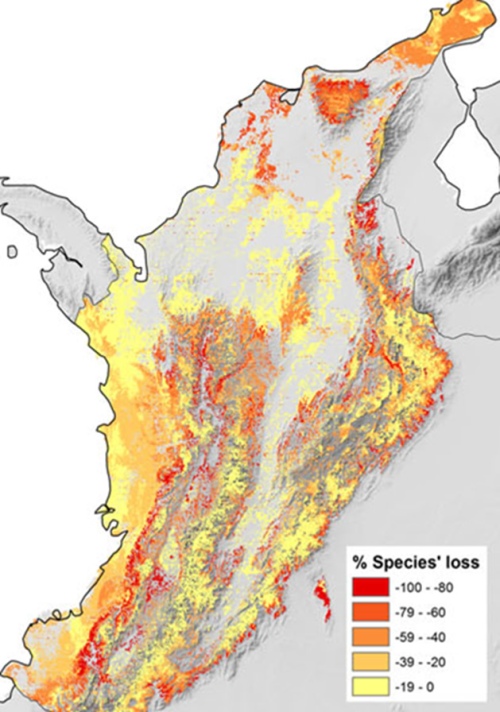
ProAves creó el Programa de Nidos Artificiales en el año 2003 con el apoyo de la Fundación Loro Parque, como una iniciativa de conservación que surge como respuesta a la falta de las cavidades naturales para varias especies de loros en Colombia donde ProAves viene desarrollando el Programa y cuyo propósito fundamental es aumentar la oferta en lugares potenciales de anidación para las especies de loros incluyendo los endémicos.
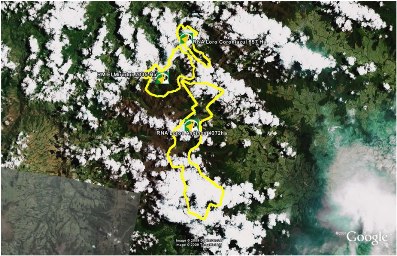
Con la ocupación de los nidos artificiales se logra estudiar el comportamiento reproductivo de las parejas de cada especie, desde la exploración hasta el momento del abandono del nido.
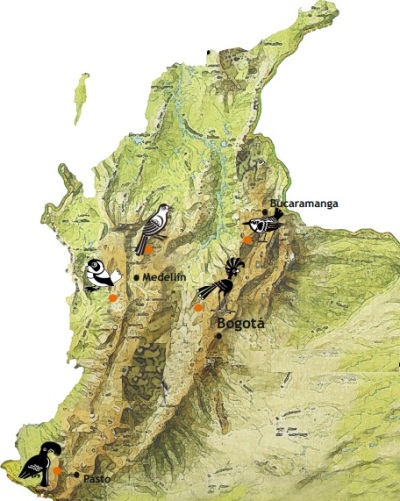
Muchos individuos de la especie realizaron exploraciones en los 41 nidos artificiales instalados, lo que significa que más parejas de la especie podrían ocupar los nidos en la próxima temporada reproductiva.

La Fundación ProAves realiza mes a mes actividades de Conservación, Investigación y educación ambiental en la Reserva Colibrí del Sol para la Hapalopsittaca amazonina, con el objetivo de sensibilizar a la comunidad en cuanto a la protección y conservación de la especie.

La Reserva Natural de las Aves Colibrí del Sol fue creada en el año 2005 gracias al apoyo de American Bird Conservacy, está ubicada en el municipio de Urrao, Antioquia, y tiene una extensión de 731 hectáreas de bosque alto andino y páramo, hábitat del colibrí del Sol (Coligena orina), que se encuentra en peligro crítico.

Adopte un nido

Para evitar la extinción de una especie de loro en Colombia, usted puede apoyarnos por medio de su donación en línea al programa Adopte un nido, en el que patrocinará las actividades de exploración, construcción, monitoreo y evaluación de nidos naturales y artificiales durante un año de algunas de las especies de loros mas amenazados del país.Para hacer su donación, sólo tiene que hacer clic Aquí para completar el formulario de adopción.

Con el apoyo de:

lpf FbP SPS ZGAP
Categorías
News

Extinction crisis predicted for Colombian birds

Article principal:

Climate change is expected to cause shifts in species distributions worldwide, threatening their viability due to range reductions and altering their representation in protected areas. Biodiversity hotspots might be particularly vulnerable to climate change because they hold large numbers of species with small ranges which could contract even further as species track their optimal habitat.

In July 2012, Stony Brook University PhD student and ProAves founder member Jorge Velásquez-Tibatá together with Drs Catherine Graham of Stony Brook University and Paul Salaman of World Land Trust-US and an advisory council member of ProAves published an article titled “Effects of climate change on species distribution, community structure, and conservation of birds in protected areas in Colombia ” in the journal Regional Enviromental Change. Copies are available on email request fundacion@proaves.org

Using field data shared by ProAves, together with publically accessible data from BioMap Data, containing 230,000 records of Colombia bird specimens, together with field data compiled by Dataves, eBird, and xeno-canto, the extent to which climate change could cause distribution shifts in threatened and range-restricted birds in Colombia was analyzed. The online Darwin Database by Project BioMap was a collaboration of over 70 bird collections across the world, and lead by The Natural History Museum (UK), Instituto de Ciencias Naturales de la Universidad Nacional de Colombia, and Conservación Internacional-Colombia.

Mapa

Furthermore, one of those species at risk of extinction from the effects of climate change is the Endangered Chestnut-capped Piha Lipaugus weberi from the northern slopes of the Central Cordillera – with the core surviving population contained within the ProAves reserve “Arrierito Antioqueño Bird Reserve”.

The article predicted that in the future, potentially between 5 to 70% of threatened and range-restricted birds in Colombia will be inadequately represented is protected areas.

This article provides recommendations for future research and conservation needs in Colombia, including:

(1) monitoring populations of birds for which future suitable climate is predicted to completely disappear;

(2) conducting field surveys, especially aimed toward species known in few locations, to improve distribution models;

(3) including predictions of the effect of climate change on species distribution as part of IUCN assessments of species extinction risk, and

(4) identifying sites that would complement the current protected area network to meet species representation targets.

It is critical that existing reserves, parks and other protected areas be better protected and expanded, while new protected areas be established in the most under-represented regions and ecosystems, particularly the Sierra Nevada de Santa Marta, the Chocó, northern slope of the Western and Central Andes and the northern half of the Eastern Cordillera.

Overall, the article lays an important foundation for scaling up conservation efforts in the race to combat the effects of climate change on Colombian birds.

Citation:

Velásquez-Tibatá, J., Salaman, P., y Graham, C. (2012) Effects of climate change on species distribution, community structure, and conservation of birds in protected areas in Colombia. Regional Environmental Change. Vol. 12, 329-342.

Alianza BioMap (Museo de Historia Natural del Museo Británico, Instituto de Ciencias Naturales de la Universidad Nacional de Colombia, y Conservación Internacional) 2006. Base de Datos Darwin: Proyecto BioMap base de datos de distribución de la avifauna Colombiana. http://www.biomap.net.

Figure 3 on page 8: Future pattern of species richness, under climate scenario A2: predicted percent of species’ losses relative to current richness (Velásquez-Tibatá et al. 2012).

Categorías
Noticias

Extinción prevista para las aves de Colombia por cambio climático

Artículo principal:

Según el artículo, se espera que el cambio climático cause cambios en la distribución de las especies en todo el mundo, poniendo en peligro su viabilidad debido a la reducción del área de distribución y la modificación de sus poblaciones en las áreas protegidas. Los puntos críticos de biodiversidad podrían ser particularmente vulnerables al cambio climático, porque tienen un gran número de especies con rangos pequeños, cuyos hábitat se podrían reducir aún más.

En julio de 2012, el estudiante de doctorado de la Universidad Stony Brook y miembro fundador de ProAves Jorge Velásquez Tibatá, junto con los doctores Paul Salaman de World Land Trust-US y miembro del Consejo Asesor de ProAves, y Catherine Graham de la Universidad de Stony Brook publicaron un artículo titulado “Efectos del cambio climático sobre la distribución de especies, estructura de la comunidad y la conservación de las aves en áreas protegidas de Colombia” en la revista Regional Enviromental Change. Copias disponibles solicitándolas por correo electrónico a fundacion@proaves.org

Utilizando los datos realizados en campo por ProAves, junto con los datos de acceso público de Proyecto BioMap, que contiene 230.000 registros de especímenes de aves de Colombia, más los datos de campo compilados por Dataves, eBird y xenocanto, se analizó el alcance que el cambio climático podría causar en la distribución de las aves amenazadas y de rango restringido en el país. La Base de Datos Darwin, del Proyecto BioMap, que se encuentra en línea, fue una colaboración de más de 70 colecciones de aves en todo el mundo, dirigida por el Museo de Historia Natural del Reino Unido, el Instituto de Ciencias Naturales de la Universidad Nacional de Colombia y Conservación Internacional-Colombia.

Mapa

Los resultados mostraron que las aves amenazadas y de rango restringido en Colombia, podrían perder en promedio entre el 33 y el 43% de su área de distribución total en el futuro, y hasta 9 especies endémicas colombianas pueden perder su rango climático por completo y por lo tanto podrían extinguirse. Es preocupante ya que 8 de las 9 especies que podrían extinguirse, son endémicas de la Sierra Nevada de Santa Marta y representan casi la mitad de todas las especies de aves endémicas que se encuentran en este lugar, incluyendo el espectacular Periquito de Santa Marta (Pyrrhura viridicata). Importantes poblaciones de muchas de las especies endémicas encontradas en Santa Marta se hallan en la Reserva Natural de las Aves El Dorado, pero esta reserva de mas de 1200 hectáreas es insuficiente para sostener a las poblaciones y es necesario lograr conectar esta reserva y la Cuchilla de San Lorenzo con el Parque Nacional Natural ubicado a 5 km, el cual mantiene las elevaciones más altas que, temporalmente, podrían amortiguar los impactos del cambio climático.

Por otra parte, una de las especies en peligro de extinción debido a los efectos del cambio climático es el Arrierito Antioqueño (Lipaugus weberi) (EN), que se encuentra en las laderas septentrionales de la cordillera central con un núcleo de población superviviente ubicado en la Reserva Natural de las Aves Arrierito Antioqueño de ProAves.

El artículo prevé que en el futuro, posiblemente entre el 5 y el 70% de las aves amenazadas y de rango restringido en Colombia están insuficientemente protegidas en las reserva naturales.

No obstante, este artículo proporciona recomendaciones para futuras investigaciones y necesidades de conservación en Colombia, incluyendo:

(1) Monitorear las poblaciones de aves para las que se pronostica desaparecer en el futuro,

(2) Realización de estudios en campo, dirigidos especialmente hacia las especies conocidas en pocos lugares, para mejorar los modelos de distribución;

(3) Incluir las predicciones de los efectos del cambio climático sobre la distribución de las especies como parte de las evaluaciones de la UICN de especies en peligro de extinción, e

(4) Identificar los sitios que complementen la actual red de áreas protegidas para cumplir con los objetivos de protección de las especies.

Es fundamental que las reservas existentes, parques y otras áreas protegidas estén mejor protegidas y ampliadas, mientras que las nuevas áreas protegidas se puedan establecer en las regiones y ecosistemas más vulnerables, en particular los de la Sierra Nevada de Santa Marta, el Chocó, la vertiente noroccidental y central de los Andes y la mitad norte de la cordillera Oriental.

En general, el artículo establece una base importante para la ampliación de los esfuerzos de conservación en la carrera para combatir los efectos del cambio climático sobre las aves de Colombia.

Citas:

Velásquez Tibatá, J., Salaman, P., y Graham, C. (2012) Efectos del cambio climático sobre la distribución de especies, estructura de la comunidad, y la conservación de las aves en las áreas protegidas en Colombia. Cambio Ambiental Regional. Vol. 12, 329-342.

Alianza BioMap (Museo de Historia Natural del Museo Británico, Instituto de Ciencias Naturales de la Universidad Nacional de Colombia, y Conservación Internacional) 2006. Base de Datos Darwin: Proyecto BioMap base de datos de distribución de la avifauna Colombiana. http://www.biomap.net.

Abajo: Figura 3 de página 8: “Modelo futuro de la riqueza de las especies, bajo un escenario climático A2: predicción del porcentaje de perdida de especies en relación con la riqueza actual” (Velásquez-Tibatá et al. 2012).


Categorías
News

University training and research in our reserves

mapa

ProAves has 5 reserves open to the public and placed in several of the most important maintained ecosystems in Colombia.

These reserves have excellent accommodation, meeting rooms, canteens, electricity, mobile communication and trails; besides it is also possible to observe species of several orders in different degrees of threat, allowing researchers, academia and visitors to increase logistically knowledge of biodiversity in the environment as a formative experience.

It is a target for ProAves to make available and provide the best conditions for the academic community to develop university practices and field research for undergraduate work, master’s or doctoral degrees, with subsidized entry costs and all-risk insurance.

We want this opportunity to be the beginning of investigations of flora and fauna that contribute to the knowledge of our biodiversity and academic practices that facilitate the training of future professionals.

Research interest: ecology, biology and inventories of all Infrastructure orders

Infrastructure:

Rooms / beds Hiking / Km Camping Meeting workspace
El Paujil Bird Reserve
6/32 8 Yes Yes
Las Tángaras Bird Reserve
8/22 5 No Yes
Chestnut-capped Piha Bird Reserve 4/12 6 Yes No
El Pangán Bird Reserve
12/45 12 No Yes
Cerulean Warbler Bird Reserve
6/25 5 No Yes


Costs:

Income (including insurance)*
Group 4 – 10* $15.000 x night 
Researchers $35.000  x week / min 4 weeks
Food
Groups (with remittance) $30.000 x group / max 10
Researches / groups (no remittance) $20.000 day / night

All bookings include:

  • Services like electricity, water, 3G internet
  • Research permits

Description of the Birds Nature Reserves

Paujil Tángaras Chestnut-capped Piha
Pángan Cerulean Warbler
Habitat Rain forest to tropical rain forest Super-tropical montane tropical Premontane rainforest   Very wet tropical basal forest to premontane   Premonate rainforest
Location
Eastern Cordillera, Magdalena River valley of Boyacá and Santander West of the western range of the central area high Atrato, Chocó Northeast of the central mountains of Antioquia South Pacific slope, Nariño Mountains of Yariguíes, western slopes of the Cordillera Oriental of Santander
Elevation 623-3116 6223-12467 4921-6233 1640-6223 4412-6561
T max and min 91ºF y 71ºF 66ºF y 51ºF 68ºF y 53ºF 71ºF y 59ºF 60ºF y 82ºF
320 sp of birds (8 endemic and 8 threatened) 250 sp of birds (7 endemic and 15 threatened) 216 sp of birds (5 endemic and 8 threatened) 369 sp of birds (49 endemic and 19 threatened) 297 sp of birds (8 endemic and 9 threatened)
Biodiversidad 43 sp non-flying mammals (18 threatened) and 24 sp mammals 24 sp of mammals 36 sp non-flying mammals (10 threatened)
32 sp of amphibians and 46 reptiles 16 sp of amphibians and 9 reptiles 20 sp of amphibians and 9 reptiles 21 sp of amphibians and 17 reptiles

For more information contact:

Research Director: Alexander Monsalve

ProAves, Cra 20 No. 36-61, Bogota, DC

Tel: (57-1) 3403229 / 340326 Fax (57-1) 3403285

Email: amonsalve@proaves.org

Categorías
Noticias

Prácticas universitarias e investigaciones en nuestras reservas

mapa

ProAves cuenta con 5 reservas abiertas al público y ubicadas en varios de los ecosistemas más importantes y conservados de Colombia.

Estas reservas cuentan con una excelente acomodación, salón de reuniones, servicio de comedor, energía eléctrica, comunicación móvil y senderos; además es posible la observación de especies de varios órdenes en diferentes grados de amenaza, lo que permite logísticamente a investigadores, grupos académicos y visitantes ampliar los conocimientos en biodiversidad del medio ambiente como una experiencia formadora.

Es un objetivo para ProAves poner a disposición y facilitar las mejores condiciones a la comunidad académica para el desarrollo de prácticas universitarias e investigaciones de campo para trabajos de pregrado, maestría o doctorado, con costos de ingreso subsidiados y un seguro todo riesgo.

Queremos que esta oportunidad sea el inicio de investigaciones de fauna y flora que aporten al conocimiento de nuestra biodiversidad y prácticas académicas que faciliten la formación de los futuros profesionales.

Interés de investigación: ecología, biología e inventarios de todos los órdenes

Infraestructura:

Habitaciones / camas Senderos / Km Zona de camping Área de reuniones
RNA El Paujil 6/32 8
RNA Las Tángaras 8/22 5 No
RNA Arrierito Antioqueño 4/12 6 No
RNA El Pangán 12/45 12 No
RNA Reinita Cielo Azul 6/25 5 No

Costos:

Ingreso (incluye seguro)*
Grupo 4 – 10* $15.000 x noche 
Investigadores $50.000  x semana / min 4 semanas
Alimentación
Grupos (con remesa) $30.000 x grupo / max 10
Investigadores / grupos (sin remesa) $20.000 día / noche

Todas las reservas cuentan con:

  • Servicios de luz, agua e internet 3G
  • Permisos de investigación

Descripción Reservas Naturales de las Aves

Paujil Tángaras Arrierito Antioqueño Pángan Reinita Cerulea
Hábitat Bosque húmedo a bosque muy tropical Bosque súper-húmedo montano tropical Bosque húmedo premontano Bosque muy húmedo basal tropical a premontano Bosque húmedo premontano
Ubicación geográfica Cordillera oriental, valle del río Magdalena de Boyacá y Santander Occidente de la cordillera occidental zona cental del alto Atrato, Chocó Nororiente de la cordillera central de Antioquia Vertiente sur del pacífico, Nariño Serranía de los Yariguíes, vertiente occidental de la cordillera oriental de Santander
Elevación 190-950 1900-3800 1500-1900 500-1900 1345-2000
T max y min 33ºC y 22ºC 19ºC y 11ºC 20ºC y 12ºC 22ºC y 15ºC 16ºC y 28ºC
320 sp de aves (8 endémicas y 8 amenazadas) 250 sp de aves (7 endémicas y 15 amenazadas) 216 sp de aves (5 endémicas y 8 amenazadas) 369 sp de aves (49 endémicas y 19 amenazadas) 297 sp de aves (8 endémicas y 9 amenazadas)
Biodiversidad 43 sp mamíferos no voladores (18 amenazados) y 24 sp mamíferos 24 sp de mamíferos 36 sp mamíferos no voladores (10 amenazadas)
32 sp de anfibios y 46 de reptiles 16 sp de anfibios y 9 de reptiles 20 sp anfibios y 9 de reptiles 21 sp de anfibios y 17 de reptiles

Para mas información contáctenos:

Director de Investigación: Oswaldo Cortés

Fundación ProAves, Cra. 20 No. 36 – 61, Bogotá, D.C.

Tel: (57-1) 3403229 / 3403261 Fax (57-1) 3403285

Email: ocortes@proaves.org