
Fundación ProAves – por la conservación en el país de las aves

Categorías
Noticias Noticias El Pangán

Descubren nueva especie de planta en la Reserva El Pangán de ProAves

Durante varias salidas de campo a la Reserva El Pangán y otras localidades de la cordillera occidental de Colombia investigadores realizaron un importante descubrimiento de una nueva especie endémica de planta para Colombia.
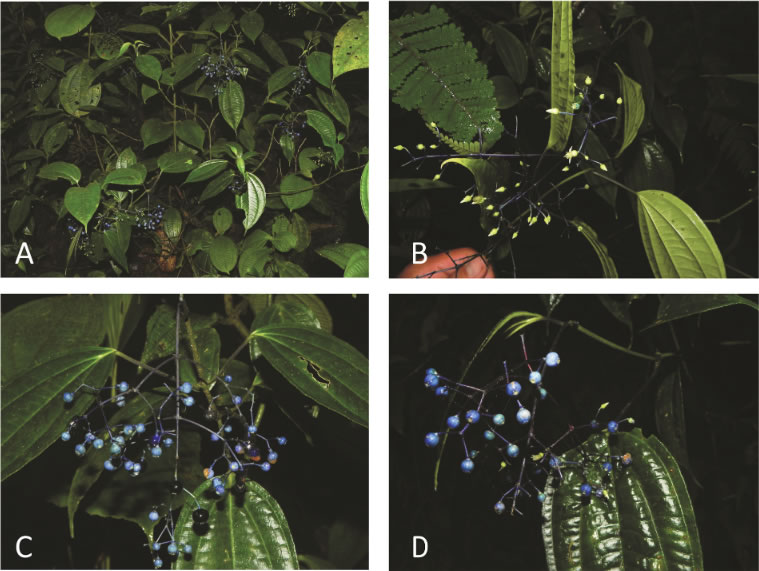
A. Hábitat. B. Inflorescencia. C y D. Infrutescencias

El descubrimiento fue  publicado en la Revista Phytotaxa por los investigadores  Diana Gamba, Frank Almeda y Marcela Alvear integrantes del proyecto: Miconieae Planetary Biodiversity Inventory (Inventariode la Biodiversidad de Miconias), se trata de una nueva especie vegetal asociada a la familia Melastomatacea (donde se agrupan los siete cueros y amarrabollos). “La nueva Miconia indicolviolacea tiene  flores de  color morado a azul oscuro y frutos de color azul celeste, presenta importancia ecológica para colibríes y atrapamoscas que consumen sus flores y frutos”.

Este tipo de descubrimientos resaltan la importancia de las áreas protegidas a perpetuidad; la Reserva Natural de las Aves El Pangán fue creada en el año 2002 gracias al interés de ProAves por conservar los bosques aún prístinos del sur del país en el piedemonte del pacífico nariñense.

Catalogada por la Alianza para la cero extinción como un sitio AZE www.zeroextinction.org, la reserva cuenta con más de 8.342 hectáreas de conservación protegidas de manera directa y a perpetuidad,  donde se han realizado procesos de bioalfabetización con la comunidad aledaña y los poblados cercanos, entre los que se encuentran Junín, San Francisco de Cuchirrabo, Mirador de Tajadas, El Gualte y El Gavilán.

En la Reserva Natural de las Aves El Pangán habitan aproximadamente 360 especies de aves, entre las que se encuentran 21 amenazadas, 2 en peligro, 13 casi amenazadas, 4 vulnerables y 49 endémicas (EBA 041-Stattersfield et al. 1998).  En cuanto a la Herpetofauna (anfibios y reptiles) se tiene un registro aproximado de 21 especies de anfibios distribuidos en 6 familias y 17 especies de Reptiles distribuidos en 7 familias. En cuanto a mamíferos se tiene un registro aproximado de 36 especies distribuidos en 21 familias de los cuales 10 se encuentran globalmente amenazados. Así mismo cuenta con una gran variedad de lepidópteros (mariposas) diurnos, 91 especies distribuidos en 68 géneros, 6 familias y 14 subfamilias, de las cuales 28 especies son endémicas, 20 especies son raras o muy raras y 66 especies comunes.

Artículo completo http://mapress.com/phytotaxa/content/2014/f/pt00177p176.pdf

Referencia del artículo: Diana Gamba, Frank Almeda & Marcela Alvear. 2014. Miconia indicoviolacea (Melastomataceae: Miconieae): a new Colombian species from the western flanks of the cordillera Occidental. Phytotaxa 177 (3): 171–176.
Categorías
News

Discovered a species of plant in ProAves El Pangan Bird Reserve

During several field trips to the El Pangan Bird Reserve and other locations in the western cordillera of Colombia researchers made ​​an important discovery of a new plant species endemic to Colombia

The discovery was published in the Phytotaxa Magazine by researchers Diana Gamba, Frank Almeda and Marcela Alvear, members of the project: Miconieae Planetary Biodiversity Inventory. It is a new plant species associated to the Melastomatacea family. “The new Miconia indicolviolacea has purple to dark blue flowers and azure fruits which are of ecological importance for hummingbirds and flycatchers that consume their flowers and fruits”


planta_collage
A. Habitat. B. Inflorescence. C and D. infructescences.


Apparently, this group of plants, which currently has 985 different species, many of which are endemic or unique, further studies must be done and perhaps new discoveries may come to light in the near future.

Such findings highlight the importance of protected areas in perpetuity. The Natural Bird Reserve El Pangan was created in 2002 thanks to the interest of ProAves in preserving the still pristine forests of the south in the foothills of Nariño Pacific.

Cataloged as an Alliance for Zero Extinction (AZE) site www.zeroextinction.org, the reserve has more than 20.600 acres of directly and in perpetuity protected conservation, where there have been bioliteracy processes with the surrounding community and the nearby villages, including Junín, San Francisco de Cuchirrabo, Mirador de Tajadas, El Gualte and El Gavilán.

El Pangan Bird Reserve is home to approximately 360 birds species, among which are 21 endangered, 2 endangered, 13 Near Threatened , 4 vulnerable and 49 endemic (EBA-041 Stattersfield et al. 1998). As for the Herpetofauna (amphibians and reptiles) we have an approximate record of 21 species of amphibians divided into 6 families and 17 species of Reptiles, distributed in 7 families. As for mammals there are approximately 36 species logged distributed in 21 families, of which 10 are globally threatened. It also has a variety of Lepidoptera (butterflies), 91 species in 68 genera, 6 families and 14 subfamilies, of which 28 species are endemic, 20 species are rare or very rare and 66 common species.

Complete article http : //mapress.com/phytotaxa/content/2014/f/pt00177p176.pdf

SKU: Diana Gamba, Frank Almeda & Marcela Alvear. 2014 indicoviolacea Miconia (Melastomataceae: Miconieae): a new species from the Colombian western flanks of the Cordillera Occidental. Phytotaxa 177 (3): 171-176.