Fundación ProAves – por la conservación en el país de las aves

Categorías
News

Paujil Festival 2009 – Saving the Blue-billed Curassow

Friday 9 October 2009.

“Understanding and protecting the Blue-billed Curassow”

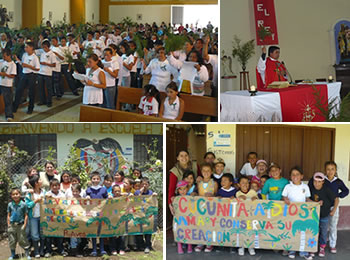
The Festival is a dynamic and educational event where different activities like workshops, talks, tree planting days, dances, plays and painting designed to awaken the interest of the community about the understanding and the importance of the conservation of the Blue-billed Curassow, locally called the “Paujil de Pico Azul”.

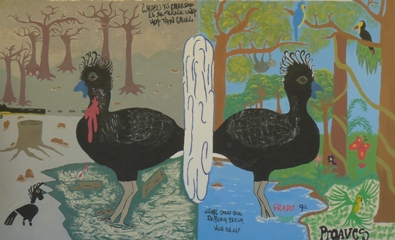
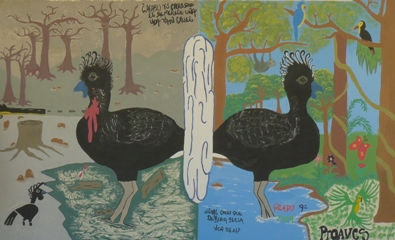
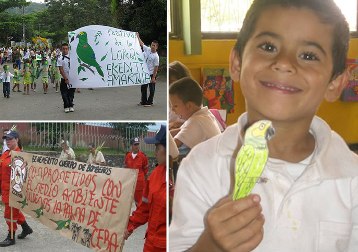
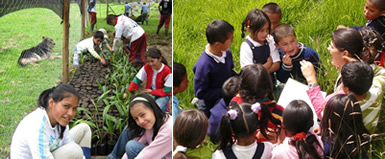
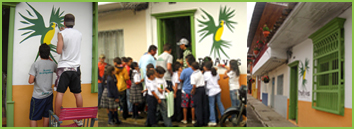
Within the activities workshops on the making of masks & talks about the Paujil took place in which 303 people took part mainly boys and girls, they also made bracelets and cards in 3 workshops and a wall painting painted by the students from the Educational Institution Puerto Pinzón where the school children wanted to put over a message alluding to the conservation of the Paujil, for this reason they divided the wall painting in two, on one side they drew the positive aspects of the species environment and on the other they drew the species environment when it’s changed by man.

mural

Wall painting done by the school children from the Educational Institution Puerto Pinzón.

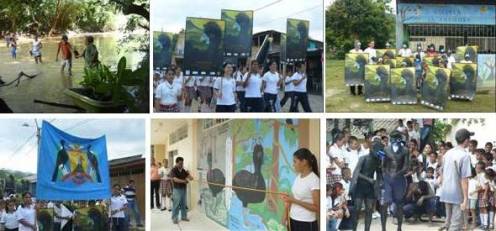
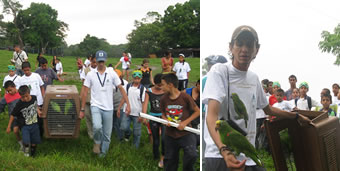
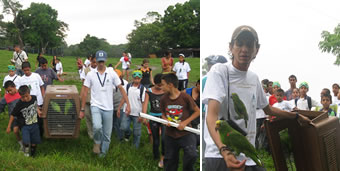
With the holding of the Festival ProAves seeks to join the community of the area of influence of the RNA El Paujil directly in the conservation efforts of this species, to this end they made 4 visits of school children and teachers and they held an observation race, where the participants, by means of clues had to find an egg that Albertis (a Paujil de Pico Azul) had lost and give it in at the end of the race.

collage2
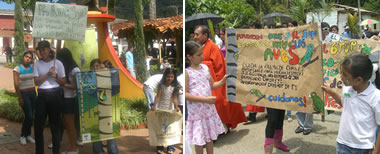
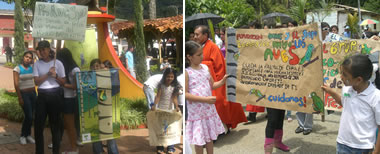
Closing of the Festival.

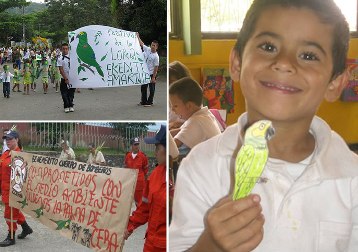
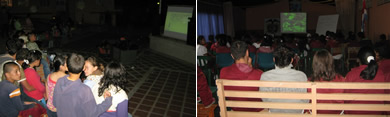
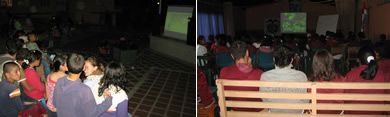
Finally the activities of the Festival ended with a parade in the municipality of Puerto Pinzón, in which all the participants and all the community mostly children and young people joined in.

With the support of:

abc birdlife worldlandtrust usfish
Categorías
News

Conservation Plan for Fuertes’s Parrot

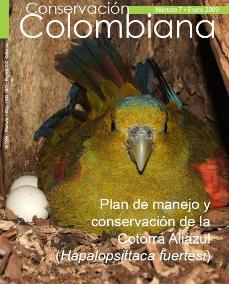
The 7th edition of Conservation Colombiana journal is dedicated to a Management and Conservation Plan for Fuertes’s Parrot , a Critically Endangered species endemic to montane forest in the Central Cordillera of Quindío and Tolima. Thanks to the support of Loro Parque Fundación, American Bird Conservancy and the Corporación Autónoma del Quindío, ProAves researchers Esteban Carrillo and Carlos Andres Páez compiled years of research and conservation on the parrot since its rediscovery by ProAves President Alonso Quevedo in 2002. The conservation plan aims to guide future actions to save the species.

CC7

Fuertes’s Parrot is an endemic species to Colombia, currently restricted to a narrow altitudinal range between 2600 and 3500 m on the western side of the Central Cordillera, covering the southern department of Caldas, eastern Risaralda, north-eastern Quindío and western Tolima. The species is known from just three breeding populations and has a global population of approximately 200 individuals.

Fuertes’s Parrot is Critically Endangered due to rapid and continuing deterioration of its natural habitat, because the Andean forest, have been subjected to intensive agriculture practices for many centuries, which has led to 22 species of montane parrots being threatened with extinction.

Extremely range restricted species, such as Fuertes’s Parrot, are highly susceptible to extinction if we fail to preserve its natural habitat. Therefore, the preservation of montane forests is critically in maintaining healthy populations.

To create the Management and Conservation Plan for Fuertes’s Parrot in the Cordillera Central, it was necessary to take into account the different political, legal and environmental aspects of the region and country, in order to strengthen conservation for the species and reduce threats. We hope the strategy will serve as a guide for the prioritization of activities to ensure the conservation of the species.

We are grateful to the tremendous support of Loro Parque Fundación, American Bird Conservancy and NMBCA to continue saving the Fuertes’s parrot and critical montane forest habitat in the Central Cordillera.

Click to download the PDF.

With the support of:

lpf

Corpoquindio abc NMBCA


Categorías
News

2009 Wax palm campaign begins!

Monday 9 March 2009.

With more than 500 people, Fundación ProAves and its partners launched the 8th “Reconcile with Nature” campaign on 7 March, 2009, in the municipality of San Francisco, Cundinamarca, Colombia, to generate awareness for the protection of the Quindío Wax Palm and Yellow-eared Parrot.

The event was launched by Alonso Quevedo, President of ProAves; Claudia Luz Rodríguez, Director of Ecosystems of the Environmental Ministry, Andrés Barreto Rozo, Secretary of Environment of Cundinamarca; Mauricio Martínez, Major of San Francisco; Fabio Arjona, Executive Director of Conservación Internacional-Colombia. Other special guests were majors of other municipalities of the department, directors of schools, regional authorities, etc.

Reconciliate_2009_San_Francisco_Cundinamarca_208-2

Max Enríquez, José Vicente Rodríguez, Andrés Barreto Rozo, Amanda Fúquene, Arnulfo Urquijo, Alonso Quevedo, Fabio Arjona and Mauricio Martínez.

Since the year 2000, when ProAves highlighted the plight of the Yellow-eared Parrot and Colombia’s national tree, the Quindío Wax Palm, the campaign has been growing in strengthen thanks to the many partners, particularly the Catholic Church, Conservación Internacional-Colombia and the Ministry of the Environment. The Critically Endangered Wax Palm is cut down to adorn churches and processions on Palm Sunday. Sadly, the palm takes centuries to mature and is the sole habitat for the Yellow-eared Parrot.

The Campaign was launched the municipality of San Francisco because they have helped support the conservation of the Critically Endangered Sasaima Wax Palm (Ceroxylom sasaimae).

Categorías
News

Yellow-eared Parrot and Wax Palm parade

Wednesday 15 April 2009.

Despite a rainy day, the community of Jardín, Antioquia, hit the streets on March 17, 2009, celebrating the beginning of the eighth campaign, led by Fundación ProAves and supported by Loro Parque Fundación, to promote Yellow-eared Parrot and Wax Palm conservation awareness in Colombia.

Collage_desfile_Jardin_copy

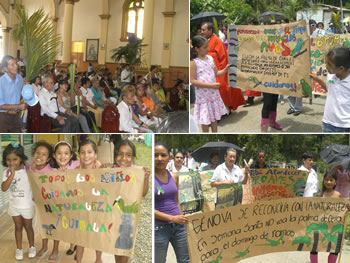
With banners inviting to conserve the parrot and the palm, Jardín’s community paraded along the town’s main streets, and reached the principal park where a closing session was performed. It involved Ana Cristina Velásquez, ProAves’ environmental educator in the town, and the municipality, Immaculate Conception parish, Empresas Públicas de Jardín, Fire Department, National and Environmental Police, and trade representatives of the town.

The parade was lead by students from ten Bird Friendly Schools, and the Bird Friendly, Social Service and Young Researchers groups, all from ProAves, as well as students and teachers from the other municipality schools and the community in general. Participants came from all parts, even distant parts of the countryside – showing their willingness to campaign for conservation.

Collage_nueva_oficina_copy

Thanks to ProAves leadership, this town has become a symbol of the two species conservation and has contributed significantly to the recovery of the Parrot population. Throughout March, the campaign continued with television and radio broadcasted programs, ecological workshops and activities for the entire community. One of these was the campaign to collect litter along the roads close to the population and their subsequent separation and recycling. The campaign coincided with the inauguration of the new regional headquarters of ProAves in Jardín.

ProAves wishes to thank many who supported the parade: Papelería y Confitería Eddy, Zapatería Don Chepe, Servicios.com, Panadería La Monera, Café Internet Jerry.net, Panadería Tortas Pan, Restaurante Las Margaritas, Cooperativa Integral de Jardín, Almacén El Bebé, Miscelánea Mil Colores, Supermercado J. J., Bar Lunática and Restaurante Zodíaco. ProAves also acknowledges the continue support of Radio Jardín, Fundación Loro Parque, and municipality of Jardín.

Collage_taller_copy

 If you want to support our environmental educational activities please donate on line or write to fundacion@proaves.org

lpf
Categorías
News

Palm Sunday without Wax Palms!

Wednesday 15 April 2009.

At sites across the Andes of Colombia, the Palm Sunday celebration held on April 5, 2009, was wax palm free! This is conclusive evidence of the overall success of the 8th campaign to protect the Wax Palm and Yellow-eared Parrot. Environmental authorities, including the police, reported no use of Wax Palm during the procession at important sites where both the wax palm and parrots occur. These wonderful results are largely the product of years of efforts by ProAves staff over ten years, plus the constant support of Fundación Loro Parque.

collage_domingo_de_ramos
lpf
Categorías
News

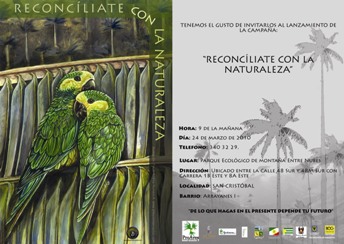
Reconcile with Nature Campaign 2010

Wednesday 17 March 2010.

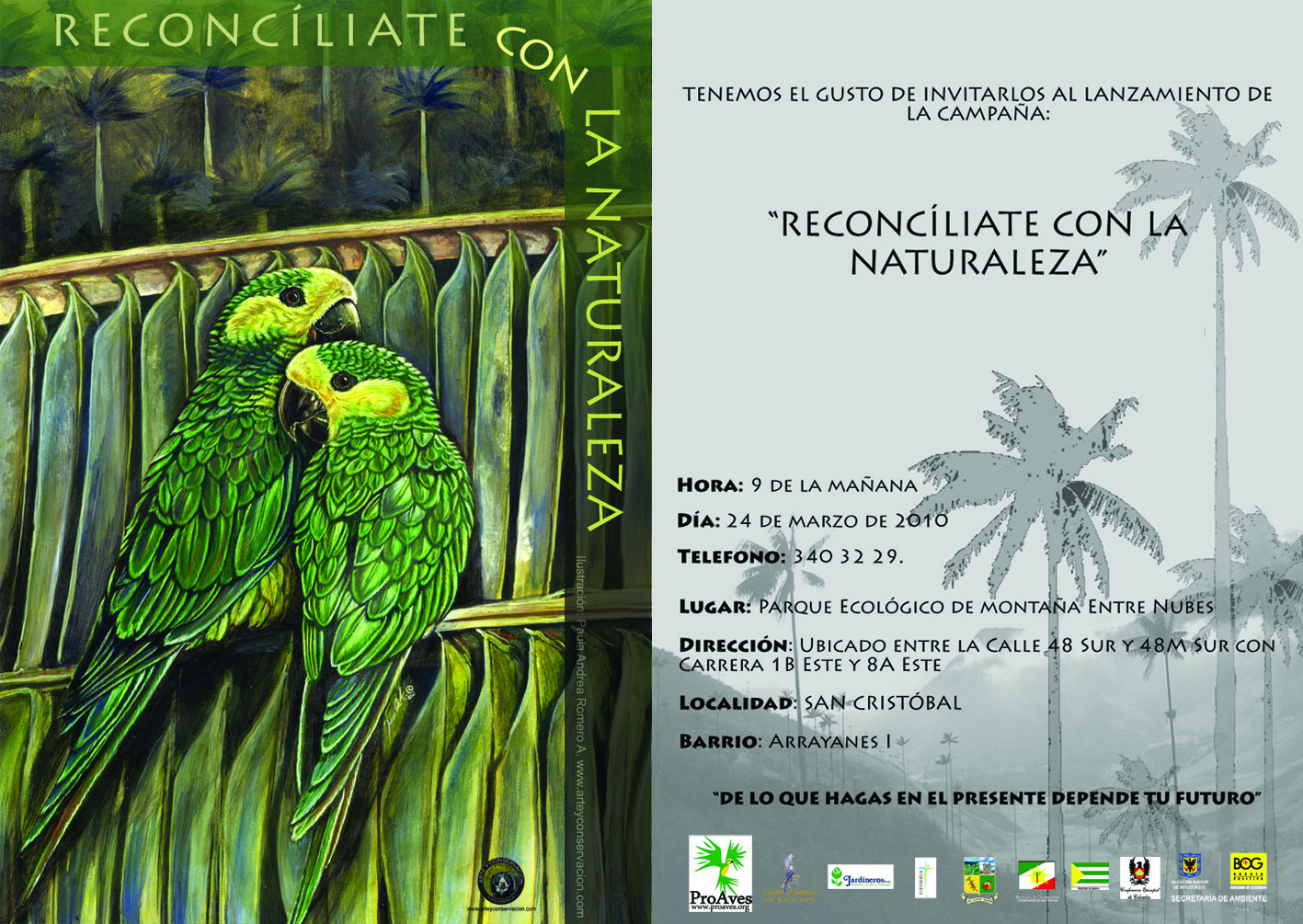
From 24 to 26 March the Campaign has as its motto: “Your future depends on what you do in the present, Reconcile with Nature” will be held across Colombia, in this, our 9th campaign with the aim that this Holy Week Colombians refrain from using palm fronds of the Wax Palm, and instead use live plants or maize leaves. (See the step-by-step guide to maize leaves)

Launch

On March 24 at 9 am the official launch of the campaign Reconcile with Nature will be held in the Ecological mountain Park Entre Nubes, where we will count on the participation of governmental and nongovernmental organizations, media, community members church and college studentsfriends of birds with whom we have been developing, educational lectures and recreational activities around the theme.

During the launch we will have a sample of the work which the Foundation has been developing during the last 9 years of campaigning, we will also have presentations from acting and music groups from Francisco José de Caldas College.

The campaign Reconcile with Nature is a nationwide activity which also extends to the municipalities of Jardín, Antioquia; Genova in the department of Quindío and Roncesvalles, Tolima, where the participation of more than 6,000 people in parades, processions, competitions, workshops, lectures, exhibits and other activities is expected.

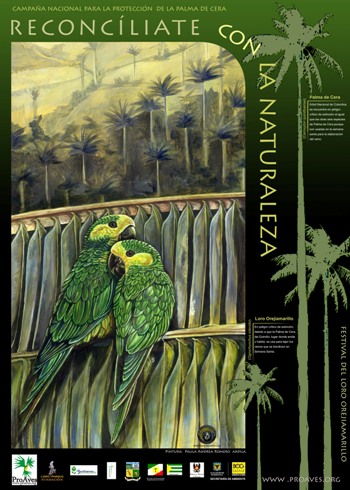
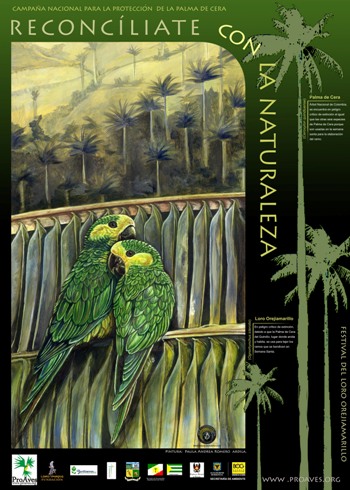
Poster

Edit_FINAL_Afiche_Reconciliate

The poster, that is part of the disclosure, is a work of art made by plastic artists and illustrators of the Paula Romero Fernando Laverde and Art Foundation and Conservation.

Invitation to Event

Edit_invitaciondosladosFINAL

Download your invitation here

Endangered Species

The yellow-eared parrot is an Andean parrot that depends on the Quindío Wax Palm tree from which it feeds and nests and roosts. Today it is the most endangered species of parrots threatened with extinction in Colombia, it is categorized as critically endangered (CR) by the IUCN as it has a restricted distribution and this makes it more vulnerable to the threats it faces. The Quindío Wax Palm, critically endangered, is cut down to adorn the churches and be carried as branches on Palm Sunday.

Results of the campaign and direct conservation activities

Throughout the eight versions made of the campaign interagency partnerships have been successfully established which has tended to concentrate efforts and strengthen the work of awareness in different regions of the country, with successful results that are reflected in the protection and conservation of two endangered species that are the centerpiece of this campaign. Moreover, it has achieved a gradual replacement of traditional Wax Palm branch by branches of maize husks or amero or alternative species like Iraca, Areca palm or live plants.

Whit the support of:

lpf Ecoteologia jardineros conferencia
secretaria_ambiente

Jardin

Jardín, Antioquia

roncesvalles

Roncesvalles, Tolima

genova

Génova, Quindío

Categorías
News

Nature Conservation celebrated on Palm Sunday in Colombia

Wednesday 14 April 2010.

The campaign launch was held in Bogotá on Wednesday 24th March at the ecological park Entre Nubes, we had the company of Father Alejandro Londoño who opened the event blessing one of the Areca palms donated by Jardineros S.A and the District Department of Environment which were later presented to those attending the event.

The launch was attended by students of the Industrial Technical College Francisco José de Caldas who made a presentation of the work done during the lectures given in March, residents of the town of San Cristobal and staff of the District Department of Environment among other guests also attended.

Bogota

Released in Bogotá.

The campaign was conducted nationwide with the participation of municipalities and cities throughout the country; Roncesvalles in Tolima was one of them, during the campaign workshops, lectures in educational institutions were held, posters and radio programs on local radio with the participation of Father Luis Fernando as special guest. The campaign was widely echoed in the town of Roncesvalles and Wax Palms were not used during Palm Sunday. The town community showed its willingness to preserve the symbol of an ecologically fragile ecosystem.

Roncesvalles-3
Activities and Palm Sunday in Roncesvalles, Tolima.

Another municipality that joined the campaign was Jardin in the department of Antioquia, a stand was installed where information was given to the community by passing out flyers and promoting the use of Iraca Palm on Palm Sunday and different activities were carried out such as neighbourhood games, painting in the park, posters, lectures and workshops, we shared in the television show “Friends of Nature” on channel Antena 4 to which Father José Angel Pareja of the Basílica Menor la Inmaculada Concepción de Jardín was invited.

Jadin

Activities & Palm Sunday in Jardín, Antioquia.

In Genoa, department of Quindio, the campaign was well received in the community and during the Palm Sunday procession no Wax Palm plant was seen demonstrating the change in attitude towards conservation and natural resources. The procession attendees were given pine branches, brooches in the form of the Wax Palm and posters of the campaign.

Genova-3

Activities and Palm Sunday in Génova, Quindío.

With the support of:

lpf Ecoteologia jardineros conferencia
secretaria_ambiente

Jardin

Jardín, Antioquia

roncesvalles

Roncesvalles, Tolima

genova

Génova, Quindío

Categorías
News

Slingshot amnesty campaign success!

Thursday 20 September 2007.

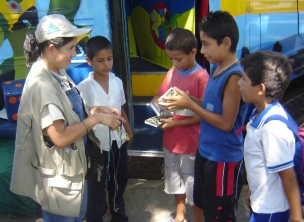
After many trips conducted by the Parrot Bus in different regions of Colombia, ProAves have launched a new amnesty campaign to request children to hand in their slingshot and other objects use to attempt against birds. The initiative began in August 2007, in 13 municipalities of the department of Caldas by means of an agreement established between ProAves and the regional environmental corporation, Corpocaldas.

Entrega_caucheras_1

Children handed their slingshot in exchange for books.

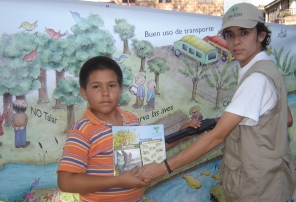
In the first days of the amnesty 12 slingshots and 3 guns were handed in by 15 children of the municipalities of Victoria, Pácora and La Merced; in return, they received mini-field guides donated by Conservation International and ProAves, which will allow them to learn about the importance of conserving Colombia’s rich fauna.

Entrega_caucheras_2

A new conservationist who handed his gun in La Merced municipality.

The campaign will continue in the municipalities of Salento, Pijao, Córdoba, and Génova from September 17 to October 4, in agreement with the Regional Environmental Corporation of Quindío (CRQ), and will be followed in the departments of Santander and Córdoba.

With the support of:

lpf abc fpaa conservacioninternacionalcolombia
Categorías
News

ProAves y el Día de la Tierra

Para el 22 de abril, Día Internacional de la Tierra, ProAves realizará una programación especial de actividades educativas en tres reservas naturales de la Fundación y en Roncesvalles, Tolima. El 23 y el 24 se harán actividades en Bogotá con el {{[Aula Ambiental Móvil Loro Bus->https://www.proaves.org/amigosdelasaves/lorobus.php]}}


Para el 22 de abril, Día Internacional de la Tierra, ProAves realizará una programación especial de actividades educativas en cinco regiones de Colombia, teniendo como centro de trabajo tres reservas naturales de la Fundación y nuestra sede del municipio de Roncesvalles, departamento del Tolima. El 23 y el 24 se harán actividades en Bogotá con el {{Loro Bus}}.

En las reservas {{[Loro Orejiamarillo->https://www.proaves.org/rubrique.php?id_rubrique=281]}} en el municipio de Jardín, Antioquia, {{[El Mirador->https://www.proaves.org/rubrique.php?id_rubrique=41]}} en Génova, Quindío, y {{[Hormiguero de Torcoroma->https://www.proaves.org/rubrique.php?id_rubrique=278]}} en Ocaña, Norte de Santander, así como en nuestra sede del municipio de Roncesvalles, Tolima, se realizarán conferencias y sesiones de “pintura al parque”. También se pintarán nuevos murales en varias escuelas rurales y se restaurarán otros. El día terminará con cine y música al parque. A estas actividades se invitará a vincularse a toda la comunidad, en especial niños, niñas y jóvenes.

En Bogotá, el {{[Aula Ambiental Móvil Loro Bus->https://www.proaves.org/amigosdelasaves/lorobus.php]}} visitará las instituciones educativas Eduardo Umaña Mendoza (en la localidad de Usme), el 23, y Cardenal Sancha (en la localidad de Usaquén), el 24, llevando actividades lúdico-pedagógicas por medio de la cuales niños y niñas se acercarán al conocimiento de la Tierra y de los seres con los que la compartimos.

Con el apoyo de:

Categorías
News

Parrot Bus visits department of Boyacá

Monday 9 March 2009.

With the support of Corporación Autónoma Regional de Chivor, and Disney Wildlife Conservation Fund, Fundación Loro Parque and American Bird Conservancy, the Parrot Bus visited southwestern Boyacá Department in February 2009, as part of the Eastern Biodiversity Ecological Route, one of four routes run by our mobile environmental class room in Colombia.

nuevo_loro

During this four day visit to the municipalities of Garagoa, Chinavita and Ramiriquí almost 1000 people, especially children, were educated on the wonderful biodiversity of Colombia participating in 30 environmental workshops offered by the Parrot Bus in 10 urban and rural education institutions.

“Children were excited to participate in the activities and enjoyed our education games, the presentation on birds and nature, and our Threatened Parrots of Colombia video”, said Johanna Villa, Parrot Bus’ coordinator. “They also received booklets on parrots, migratory birds and birdwatching, from our character, Otto Rico (a representation of the Yellow-eared Parrot) as well as stickers about birds and shirts on parrots”.

If you want to support Parrot Bus and its educational activities around Colombia please donate on line or write to fundacion@proaves.org

abc lpf disney
Categorías
News

ProAves wins Energy Globe Award

Wednesday 15 April 2009.

ProAves’ Parrot Bus is an environmental education and awareness tool that has travelled around Colombia since 2005 to develop recreational and educational activities with children, youth and adults, reaching hundreds of thousands of people in over 145 municipalities in 16 departments, nationwide. The Parrot Bus has travelled over 80,000 km of Colombia and visited more than 2392 schools in often the poorest communities, to give a message of conservation to a new generation of conservationist.

LORO_BUS

We are extremely grateful that this effective and efficient tool for conservation has been given huge international recognition of the Energy Globe World Awards. The ceremonious presentation of ProAves was carried out at the international television gala for the ENERGY GLOBE World Awards, 13 April 2009 in the city of Prague, Czech Republic. At the request of the Czech EU presidency, the ENERGY GLOBE Gala will serve as the opening of the meeting of the European environmental ministers in Prague.

Among the guests at the honoring of the global best environmental projects were the EU Council President Mirek Topolánek, President of the Council of Environmental Ministers Martin Bursík, and naturally Europe’s top environmental policy makers. 769 projects participated from 111 nations.

We are grateful to the support of Fundación Loro Parque, Disney Conservation Wildlife Fund, American Bird Conservancy and Conservación Internacional-Colombia to sustain the Parrot Bus.

If you want to support Parrot Bus and its educational activities around Colombia please donate on line or write to fundacion@proaves.org

abc conservacioninternacionalcolombia lpf disney
Categorías
News

Parrot Bus visits the department of Córdoba

Monday 7 December 2009.

Logo_Lorobus

The “LoroBus” (Parrot Bus) is a tool for environmental education and awareness since 2005. It travels throughout the country developing fun and educational activities with children, youth and adults. 

Ecological Route through the department of Córdoba

For 20 days it travelled more than 400 Km through the municipalities of Canalete, Los Córdobas, Montería, Tierra Alta, Valencia, Planeta Rica, Buena Vista, Ayapel and Sahagún.

By means of talks, workshops, games and videos in the interior of the bus, they tried to involve the communities that they visited, in respect for biodiversity; to generate in these a sense of belonging and respect for nature, especially in birds.

On this occasion a variety of activities; in Canalete, for example, was launched, with a parade, the cultural week of San José de Canalete school; in the municipality of Los Córdobas there already exist bird friendly schools and groups of birdwatchers and the newspaper El Meridiano, in Montería, issued a press release about the visit of the Parrot Bus.

collage1-2

Group of birdwatchers Nuevo Nariño – Participants in a workshop in Tierra Alta.

collage2-5
Children from all over the department of Córdoba took part, enjoyed themselves & learnt with the Mobile Environment Classroom Parrot Bus.

With the support of:

cvs
Categorías
News

Kids from the Ecological Group speak up

Friday 31 July 2009.

The kid Jhoan Sebastián Colorado lives in the community of Jadin, department of Antioquia (habitat of the Yellow-eared Parrot, Ognosrhynchus icterotis) in Colombia. Several miles from there, in the municipality of Génova, Quindío (habitat of the Indigo-winged Parrot, Hapalopsittaca fuertesi), lives another kid, Andrés Felipe Alzate. These two kids have in common being part of the Ecological Group Friends of the Birds. They are both proud of being part of this initiative supported by Disney Conservation Wildlife fund and Loro Park Foundation.

otros_dos_ninlos

Jhoan Sebastián says: “I know about ProAves much before joining the group, since I always participated in the activities organized in school by the Environmental education teacher, and also thanks to the Loro Bus . Now that I’m part of the group I take advantage of all the activities organized, and each time I can, I visit the website of ProAves to know about the latest news”

“I think birds are quite intelligent and gaudy”, he adds. “ I have always been keen on nature, hence my favorite subject at school is Natural Science. Once I reach the required age, I want to join the group Young Researchers to support, like their members, in the fulfillment of bird census.

On the other hand, Andrés Felipe Alzate, Friend of the Birds from the municipality of Génova, Quindío, is always pretty active within the group and in all activities carried out. He is 12 years old and currently studying 4th year of elementary school at Guillermo Ángel. “I like all the activities organized within the group, such as flied trips, and participation in parades where I can represent ProAves”.

He adds: “I want to invite other kids to join this group, which helps us compromise with conservation of natural resources. Besides, I would like that grownups take their time in listening to us, since we have pretty interesting things to tell and teach”.

Both kids have participated in the campaign “Wax Palm tree and Yellow-eared Parrot”, and they are both happy to know that this year there was no use of bouquets made of Wax Palm tree during Holy Week in their communities.

If you wish to support the Friends of Birds Ecological Group or provide general support in the educational activities of ProAves, please write to fundacion@proaves.org or call (571) 245-5134.

lpf
Categorías
News

Release of 13 Yellow-crowned Parrots in Caldas

Friday 23 April 2010.

The liberation of 13 beautiful Yellow-crowned Parrots (Amazona ochrocephala) back into the wild was held on March 18th in the presence of 35 local people including children and adults who watched the release.

The main objective of the project is to release confiscated wild parrots of this species back into the wild and document aspects of their biology and ecology and to work with the communities through multifaceted educational environmental strategies.

Liberacion1

Liberation of Yellow crowned Parrots.

First results:

After several months in a recovery process, 13 parrots that had been subjected to captivity for several years, were released under strict control by the Corporación Autónoma Regional de Caldas CORPOCALDAS and ProAves, in the presence of students and parents of the Habana y la Garrucha Educational Institution, located between the towns of La Dorada and Victoria, in the department of Caldas.

Parrots are all too frequently caught by people to keep them as pets, in often poor conditions. The pet trade contributes to declining wild populations.

Educacion2

Environmental education activities – La Dorada and Victoria, Caldas.

After saving these individuals in captivity, they go through a long process of rehabilitation to recover from problems, such as eating disorders, health, social and physical amongst others. After this process where they acquire the capacity of flight and recover flight feathers they are released back into the wild.

With the support of:

corpocaldas proaves

Categorías
News

ProAves Celebrated Earth Day

Sunday 25 April 2010.
 

Earth Day and Year of Biodiversity, a commitment of ProAves

Framed within 2010 Year of Biodiversity, the Foundation ProAves and its entire staff celebrated on April 22nd the Earth Day, the celebration included a special program in Roncesvalles, Tolima, Jardín, Antioquia, Genova, Quindio and Bogotá.

Within these activities we had workshops and conferences, sessions of “Cinema in the Park”, painting contests and poetry alluding to the celebration, games and activities for people seeking to know and value the importance of conservation and take immediate action in preserving natural resources.

educacion

Always with the participation of environmental groups, young researchers, bird-friendly schools and the community at large, we made an invitation to the entire community to link with the Foundation, especially children and young people.

In Bogotá, the school Eduardo Umaña Mendoza (in the locality of Usme), was visited, leading educational and leisure activities through which children came to a knowledge of the Earth and its biodiversity.

paisajes
Categorías
News

Celebrate World Environment Day

Thursday 10 June 2010.

ProAves extended the celebration of World Environment Day throughout the month of June with the goal of making more activities, raising awareness in more people and generating greater impact on communities on the protection of the environment. These activities were mainly implemented at Genova, Quindío, and Roncesvalles in the department of Tolima and at Jardín, Antioquia.

collage1-8

In addition, we have one more reason to celebrate, and thanks to the commitment of rural communities, municipal councils and the Catholic Church, among others, the threatened status of the Yellow-eared Parrot changed from “critically endangered” to “endangered.” Eleven years after starting the conservation efforts to save this bird, we can conclude that its population now has more than 1,000 individuals, a key threshold for recovery of the population.

During these first days activities were carried out with schools and colleges that are part of groups led by the Foundación, like the Sisters Schools, friends of birds schools, young researchers and youth social service in order to provide knowledge through creative activities conservation-themed habitat of the species and the appropriation of practices aimed at sustainable development.

collage2-12

Through radio programs that air during the month, see that the wider community has first hand information on the importance of conserving natural resources, why it is important to celebrate this day and the scheduling of different activities that will be held. These activities include painting competitions, cultural outlets and culture on Fridays where environmental videos will be projected that will lead us to reflect on the damage that man has done to our only home.

We make an invitation to celebrate this day, all year, being aware of our consumption habits and asking ourselves about the impact our way of life is having on the planet and how we can help conserve our natural resources.

With the support of:

abc lpf conservacioninternacionalcolombia

Jardin

Jardín (Antioquia)

roncesvalles

Roncesvalles (Tolima)

genova

Génova (Quindío)

·

·


Categorías
News

Environmental Education and Conservation

Thursday 16 September 2010.

For more than 10 years ProAves has been developing different educational activities like “Environmental Friday”. This activity takes place every month and in it documentary films and films related to the subject are shown, this space is consolidated as a stage for cultural interaction to strengthen the bonds of participation and solidarity of the inhabitants of the municipality.

inicio_Educacion

Also, in 5 Bird Friendly Schools “environmental education workshops” were held for more than 107 children in the municipality. In the Educational Institution, La Voz de la Tierra, thematic briefings relating to environmental calendar 2010 and its impact on the town of a youthful population of approximately 150 students were held.

The community radio station has been a valuable support for the dissemination of information, in addition to becoming a meeting place of youths for creative production of audio-clips related to the conservation of biodiversity and climate change. These become primary sources of updated information which respond to the specific circumstances of the municipality, contributing to the strengthening of environmental awareness.

collage1

The constant development of the above activities, and others that arise in the learning process and implementation, become important inputs to the consolidation of environmental education processes which promote the conservation of valuable ecosystems for their biodiversity and the provision of environmental services they provide to their inhabitants and the global climate.

No conservation strategy is successful if the population living in the ecosystem is not aware of the need to conserve. Knowing the environment and how to intervene in it is the basis to produce and reproduce ourselves sustainably.

collage2

With the support of:

lpf

Categorías
News

Birds of Colombia: more species but more endangered!

Wednesday 20 May 2009.

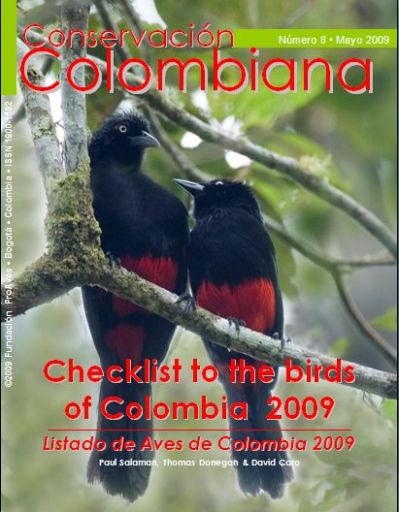
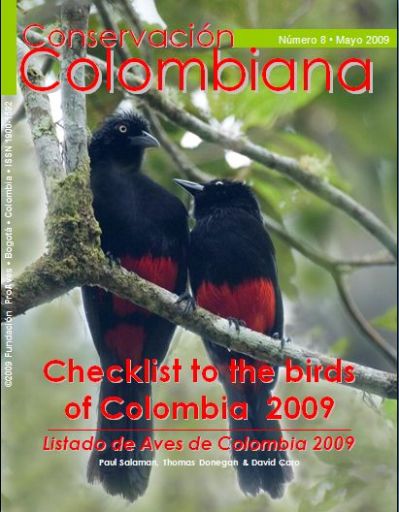
The “Checklist to the birds of Colombia 2009” has been published by ProAves which documents an increase in the number of bird species in Colombia from 1,870 species in 2008 to 1,871 species in 2009. Colombia officially remains the most diverse country for birds on the planet, with Peru and Brazil with 1,822 and 1,777 species, respectively.

ProAves has maintained the “Checklist to the Birds of Colombia” since 2007 and same lead author since first publication in 2001. The checklist updates information in the distribution and taxonomy of birds that occur in Colombia. The 2009 checklist has undertaken a major revision of confirmed species for the country and provides the first confirmed record of the Neotropical migrant – the Yellow-throated Warbler.

cover_N8

The checklist also updates the threatened status of all species following an extensive review process by BirdLife International with the collaboration of ProAves and many others. Sadly, a further four bird species are threatened with extinction in Colombia, including two Critically Endangered species, the Gorgeted Puffleg Eriocnemis isabellae and Antioquia Brush-finch Atlapetes blancae that appear for the first time on the BirdLife/IUCN Red List. Both species were recently described from extremely small areas lacking any protection. Searches by ProAves and other researchers for the Antioquia Brush-finch have failed to locate any surviving populations, although hope remains that a small population survives.

Furthermore, two species dependant on the Chocó Pacific coastal forests – the Great Curassow Crax rubra and Five-colored Barbet Capito quinticolor – are now considered threatened, being upgraded from near-threatened to reflect the horrific rate of forest destruction in the Chocó lowlands, primarily fueled by illegal logging, African oil palm plantations and coca plantations.

Presently, Colombia has a total of 97 threatened bird species, 60 Near-threatened species and 6 Data Deficient species that are pending further information.

If you would like to contribute to the checklist, please email listado@proaves.org. Presently, the National Bird Records Forum for Colombia is being organized to oversee the national list.

The checklist is bi-lingual and freely available as a líne. An Excel version of the checklist will also shortly be available online for researchers and birders. You can buy the 81 page 2008 checklist from Fundación ProAves or online at http://www.nhbs.com/title.php?tefno=160362.

Categorías
News

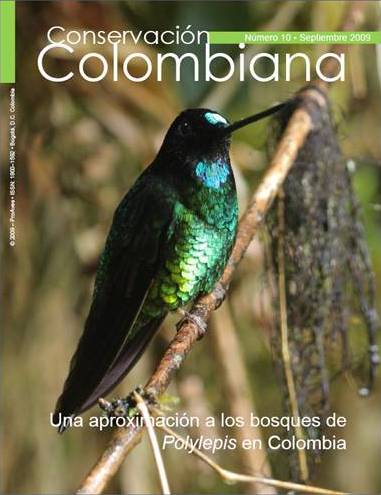
The plight of Polylepis forests in Colombia exposed

Monday 19 October 2009.

This document is a basic input that will serve as a tool for establishing the guidelines for preserving, protecting and restoring forests of Polylepis in Colombia.

The Polylepis genus includes 25 species distributed throughout the Andean region from Venezuela to northern Argentina and Chile, and its importance is that they are ecosystems that contain a unique fauna and flora, characterized by high levels of endemism generally altitudinal distribution ranges from 3400 m. and in some exceptional cases up to 5200 m. in Bolivia, in many cases these habitats are sanctuaries for birds in critical danger of extinction and a large bank of genetic resources and a conservation target.

Unfortunately, these high mountain forests also represent one of the most vulnerable ecosystems with less than 3% of the original coverage due to the heavy pressures that they are continuously subjected to, either by logging, fire, overgrazing or by extending the agricultural boundaries.

portada_N10

This edition of the Conservación Colombiana journal, is in recognition of the importance of these forests for the survival of other species of wildlife, especially birds and their current vulnerability that has motivated the creation of the component “Polylepis” within the project “Conserving biodiversity of the tropical Andes”, funded by American Bird Conservancy, Gordon and Betty Moore Foundation, Comunidad Andina and with the cooperation of ECOAN.

This component aims at combining efforts of all the Andean countries, with ProAves the representative in Colombia, to propose specific strategies for the conservation of these ecosystems. The current goal is aimed at the identification of priority forests for conservation at the regional level.

With the support of:

abc Comunidad_andina


logos_para_taller_polylepis-3

Categorías
News Noticias Cucarachero de Chicamocha

A Brighter future for the endangered Niceforo’s Wren

Tuesday 2 June 2009.

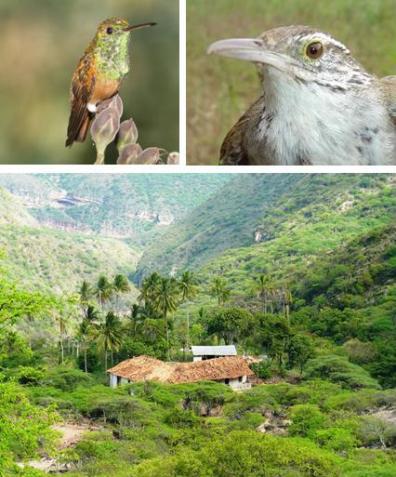
ProAves together with World Land Trust-US, American Bird Conservancy and the Corporación Autónoma de Santander (CAS) have taken a significant step forward in their efforts to protect the Critically Endangered Niceforo’s Wren – restricted to the last remnants of dry forest in the Chicamocha Valley of the eastern Andes of Colombia. The purchase by ProAves of over 3,200 acres of vital remaining dry forest habitat – some of the highest quality remaining forest of this type in the entire region – will result in the creation of a new reserve to protect the Niceforo’s Wren. It constitutes the first protected area within the Chicamocha Valley for these and many endemic flora and fauna species.

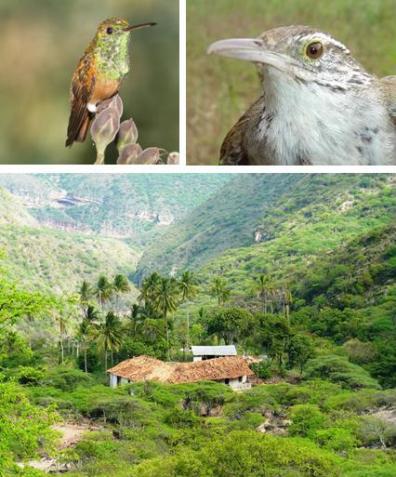
collage_chicamocha-2
Chesnut-bellied Hummingbird, Niceforo’s Wren and an image of Cucarachero del Chicamocha Natural Bird Reserve.

Despite high levels of endemism at both the species and subspecies level in birds, reptiles, and flora in the Chicamocha valley, this extraordinary ecosystem is completely unprotected. Unfortunately very little vegetation remains in a natural state, with intense seasonal burning and grazing from goats and cattle. For example, the endemic and attractive Chicamocha Cavanillesia tree (Cavanillesia chicamochae) is Critically Endangered.

Intensive surveys and studies by ProAves’ “Project Chicamocha”, supported by the BP Conservation Leadership Program, established that the wren is one of the most imperiled bird species in the world, with a global population of fewer than 25 pairs with a core population of 14 pairs at imminent risk of extinction from man-made fires and intensive goat grazing ABC and ProAves acted decisively to acquire the private properties containing the core population and remove over 500 goats and 50 cattle.

“To be able to give a species that is so close to extinction another chance at survival is a thrilling opportunity, and we are tremendously indebted to the supporters who have made this a reality,” said George Wallace, ABC’s Vice President for International Programs. “Now begins the work of protecting the habitat on the ground as well as on paper, and we are working hard with ProAves to ensure the success of the project.”

Sara Lara, Executive Director with ProAves said, “This is another example of how international cooperation is making a tangible difference to the most threatened birds in the Americas. For the first time we can say that tomorrow holds a brighter outlook for the Niceforo’s Wren and many other threatened and endemic animals and plants that share its unique habitat.”

Héctor Murillo, Director of the CAS, the environmental authority of the department and of the region underlying the reservation, said: “I exalt the initiative of ProAves to protect this area because it will protect the habitat of this endemic species and of others that are part of this unique ecosystem in the department of Santander”.

In addition to the wren, the reserve supports populations of many endemic species, such as the endangered Chestnut-bellied Hummingbird (a stronghold site for the species), Colombian Chachalaca, and Apical Flycatcher, as well as protecting endemic subspecies of the Blue-crowned Motmot, Golden-winged Sparrow, and Biocolored Wren.

The new reserve, located near the town of Zapatoca, is 1 hour from Bucaramanga and open to visitors and students to learn about this important and spectacular ecosystem.

Categorías
News Noticias Cucarachero de Chicamocha

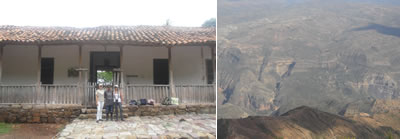
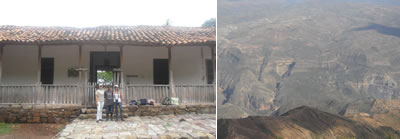
A solar panel for the Cucarachero Chicamocha RNA, An economic and

Thursday 4 February 2010.

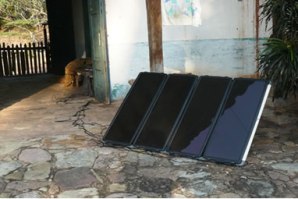
The solar panel is a glass panel that collects the energy from sunlight, which is converted into rechargeable energy; it is then transformed from watts to volts and stored in a common battery of 90 amps.

The main advantage is that solar panels are harmless to the environment, do not generate pollution and deliver clean energy that does not need to be transported and that is generated in the same place where it will be used, in addition to being a saver, it is really the appropriate use of solar energy, also known as clean energy or green energy.

The Panel has already been successfully tested in the Reserve on computer equipment, flashlights, cellular phones and lights. The object is to supply facilities with energy, preparing for the accommodation of future researchers and visitors, for food production and conservation, the use of equipment and general lighting.

Reserva

Niceforos’s wren bird reserve.

chicamocha1
instalacion-2
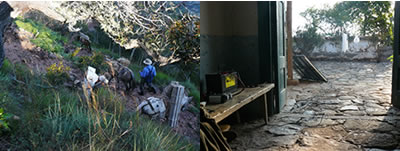
Transportation and installation of the Panel.

The panel is a piece of armable structure with low weight, simple and robust and contains a converter, a battery to store power, connector cables, as well as the equipment needed and this type of solar panels also works on very cloudy days, the panel is small and catches light, which is stored in the battery.

worldlandtrust abc cas
Categorías
News

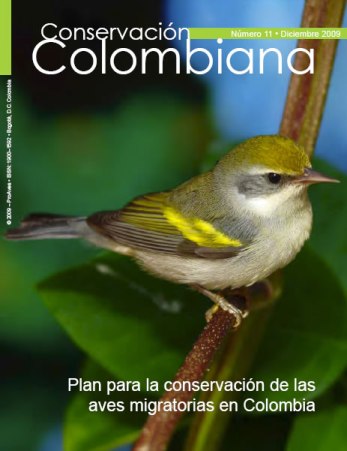
Colombian Migratory Bird Conservation Plan published

Tuesday 23 February 2010.

Colombian Migratory Bird Conservation Plan

Migratory bird populations across the planet are in free-fall. They are the “Canary in the coal mine” – evidence to a rapidly changing planet that disrupts their ancient flyways and life cycles that have evolved over millions of years. Rapid habitat loss on the wintering and breeding grounds, new obstacles like cell towers, and extreme weather conditions throughout the year threaten this once prosperous group of birds that include all groups of birds, from raptors to hummingbirds, warblers to shorebirds.

In the America’s, the majority of North America’s spectacular bird life heads south in the fall and reside in Latin America for often over six months of the year. ProAves work on this important and sensitive group of birds has highlighted that Colombia is a critical non-breeding area for many of North America’s most endangered migrants. Furthermore, rapid habitat loss across the most important non-breeding areas, such as subtropical and montane forests, has almost certainly contributed to a significant decline in the populations of Neortopical migrants.

portada-3

In 2003, ProAves initiated the National Migratory Bird Monitoring and Conservation Program, thanks to funding from the Neotropical Migratory Bird Conservation Act (NMBCA) by U.S. fish and Wildlife, Conservación Internacional-Colombia, The Wetland Trust, American Bird Conservancy and BirdLife International, among others. Since then, ProAves has made a compilation of information on all migratory birds in Colombia, through literature review, consultation of historical observation and specimen databases, monitoring at over twenty-eight sites in Colombia, and exchange of information with experts worldwide.

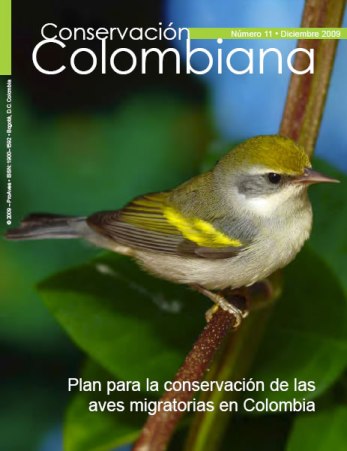
The Colombian Migratory Bird Conservation Plan is the result of three years of analysis completed by ProAves to provide the first comprehensive assessment as to the state of terrestrial Neotropical migratory birds on their non-breeding range in Colombia. Analysis highlights those species at greatest conservation concern and identifies priority areas for migratory birds in Colombia. This has allowed us to formulate a long-term conservation plan that was assessed and improved by experts and authorities at a workshop held in Bogota in 2009. The resulting National Migratory Bird Conservation Plan, published in the 11th journal of Conservación Colombiana , establishes priorities for the most efficient allocation of economic resources and efforts to save migratory birds in Colombia.

The Colombian Migratory Bird Conservation Plan contains the following sections:

1. Prioritization of migratory birds that breed in North America and reside in Colombia during the non-breeding season, based on a review of action plans and priority lists in North America.

2. A detailed analysis for each priority migratory species that covers aspects as distribution, population trends, migration, ecology, habitat-use, condition and proposed conservation actions.

3. A comprehensive migratory bird Conservation Plan that brings together actions for all species.

4. A regional analysis that identifies and targets areas for conservation for priority species, accompanied by a review of threats, conservation actions in each area and new initiatives.

This information is intended for scientists, academics, conservationists and government representatives responsible for managing the natural resources so that collectively they can consider actions and funding based on the proposed objectives. The Plan contributes to the initiative of the PIF (Partners In Flight), the Ministry of Enviroment of Colombia, and the Convention on biological Diversity and the Western Hemisphere Migratory Species Iniciative

It is up to all of us to make a difference and save the wonderful spectacle of migratory birds for future generations.

The 11th Conservación Colombiana journal as a PDF here.

usfish abc conservacioninternacionalcolombia worldlandtrust NMBCA


Categorías
News

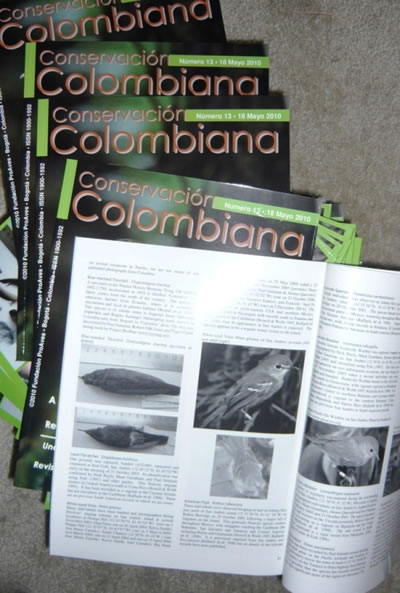
Conservación Colombiana #13 published

Tuesday 18 May 2010.

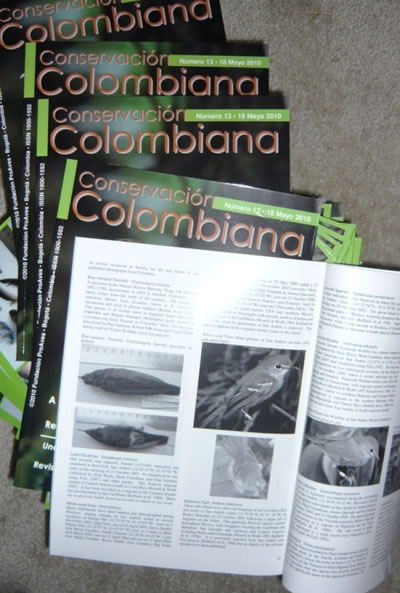
Today, 18 May 2010, the 13th volume of Conservación Colombiana is published and printed editions are available for sale at the ProAves offices in Bogota. The journal is available in the Biblioteca Nacional de Colombia and has been mailed to libraries and museums across Colombia, US and Europe. The publication contains various articles, including a paper updating the Colombian checklist of bird species, with a substantial review of records detailing new species for the country and taxonomic changes. It is now thought that 1,879 species occur in Colombia. The checklist and all the papers from the edition will be available online within two weeks. Conservación Colombiana is available for sale at US $13/$25.000 pesos at ProAves office at Cra 20 # 36-61, Bogota or email fundacion@proaves.org

portada-4

Categorías
News

Acciones en conservación, investigación y educación ambiental

En la Reserva Natural El Pangán, se adelantan estudios de investigación, acciones de conservación y campañas de educación ambiental, con el objetivo de lograr un compromiso de la comunidad hacía la reserva y su biodiversidad.


{{Conservación}}

Las acciones de conservación han estado ligadas al trabajo de educación ambiental y se ha enfocado en alternativas de desarrollo sostenible, que ayuden a disminuir el impacto ambiental que genera la agricultura verde. También se han realizado talleres teóricos – prácticos con temas de acuerdo a la necesidad de la comunidad y a la economía de la zona.

{{Investigación}}

En desarrollo de investigaciones científicas, además de reconocimiento básico y general de la fauna y flora de la reserva, se han adelantado los estudios “Aproximación al conocimiento de la herpetofauna de la reserva El Pangan”, “Comportamiento y estrategias alimentarias de las tángaras {Bangsia edwardsi y B. rothschildi} en el suroccidente colombiano”, y una investigación recién terminada sobre {Dendrobates histrionicus}. Además constituye una estación permanente y oficial de monitoreo de aves. Actualmente están iniciando los trabajos de estructura y composición de {Lepidopteros Rhopalocera} en un gradiente altitudinal en la reserva natural El Pangan, y {Melastomataceae y Rubiaceae} como indicadores de la riqueza y composición de árboles en la Reserva Natural del Chocó Biogeográfico.

{{Educación ambiental}}

El trabajo de educación ambiental con la comunidad ha sido enfocado a talleres de tipo informativo y educativo sobre la biodiversidad de la zona y la función que cumple una reserva con los recursos naturales. Se promueve a la apropiación y defensa de los recursos naturales por parte de la comunidad, principalmente de colonos.

Categorías
News

El Pangan Bird Reserve celebrates its 10th Anniversary

Wednesday 16 December 2009.

Established in 2000, El Pangán (indigenous name for the Long-wattled Umbrellabird) was the first Bird Reserve started by ProAves, with the goal of conserving one of the forests of high endemism of the southwest slopes of the Andes. It is located in the municipality of Barbacoas, Nariño Department.

It guarantees protected habitat for 48 bird species with restricted distribution and threats, while protecting a myriad of species of different orders, which heightens the need and urgency to strengthen conservation projects developed and projected into the future. The Reserve is today an example of conservation in the country.

collage-17

The fulfillment of many of the goals set year after year in the Reserve is the result of the work of a large group of responsible and committed people who work every day for the conservation of biodiversity in this zone, where they have consolidated an efficient method of control of hunters and illegal wood traffickers through constant vigilance of the areas around the Reserve, in addition to the permanent presence and constant contact with the community in the protected area by establishing different conservation initiatives.

Visiting and enjoying this landscape is easier today thanks to the improvement of a suitable infrastructure that in addition to facilitating the work of conservation, research and environmental education taking place in the Reserve, excellent care to all people who love nature and close contact with wildlife that decide to visit us.

afiche_pangan1-2

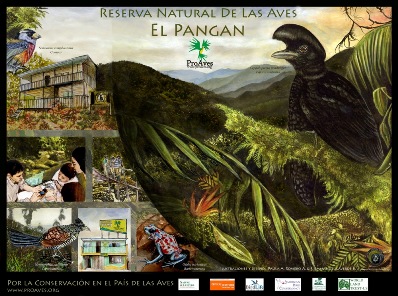
Piece of art made by plastic artists and illustrators Paula Laverde y Fernando Romero of the Conservation and Arts Foundation.

worldlandtrust rainforest Nature
Categorías
News

Grallaria fenwickorum: New species for Science

Friday 21 May 2010.

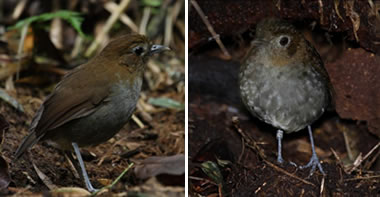
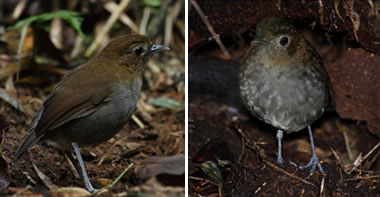
A new species of bird has been described for science and its name has been dedicated to an important family in conservation. The new species of antpitta, endemic to Colombia and South America, was called Fenwick’s Antpitta (Grallaria fenwickorum), in honor of the president of American Bird Conservancy (ABC) George Fenwick and his family for the unconditional and strong commitment for conservation of birds in Colombia.

After two years of research related to the discovery of the bird in 2008, the capture and evaluation process were outstanding, because it is one of the first times that a species is described solely with the capture of an individual which was banded, measured and photographed; also DNA samples were taken and it was later released safely to its habitat.

Collage_Grallaria
Tororoi de Urrao (Grallaria fenwickorum)

The habitat of this species is very restricted, characterized mainly by shrubbery composed of Chusquea bamboo in the less humid parts of the Eastern slope of the Western Cordillera. Sadly, the habitat of this species has been subject of an intensive deforestation in the past decades, reason why this bird has been proposed in Critical status according to the criteria of the IUCN-International Union for Conservation of Nature.

<

The habitat of this species is very restricted, characterized mainly by shrubbery composed of Chusquea bamboo in the less humid parts of the Eastern slope of the Western Cordillera. Sadly, the habitat of this species has been subject of an intensive deforestation in the past decades, reason why this bird has been proposed in Critical status according to the criteria of the IUCN-International Union for Conservation of Nature.

The article about the complete description of this species consists of 21 pages and is available at www.proaves.org. The authors give special recognition to the Fenwick Family- George, his wife Rita (Development Vicepresident for ABC) and their offsprings Cyrus, Sara and Raquel from The Plains, Virginia. It is important to highlight that the Fenwick family has dedicated personal resources to support Fundacion ProAves in the parchase and conservation of 731 hectares [1.820 acres] of the Paramo del Sol to perpetuity, establishing the Colibri del Sol Natural Bird Reserve, they also financed the research conducted to develop this important discovery.

The Grallaria Fenwickorum is a cinnamon-gray colored average size bird that weighs around 50 grams. This species is distinguished of its most near relative, the Grallaria Milleri, because it doesn’t have a brown band on its chest (this species chest is color grey uniform) and has a brown light plumage. The vocalizations of both species are different. The Grallaria Fenwickorum is a bird of shy character, forages insects in the verbiage and rarely ascends to sing in the bamboo.

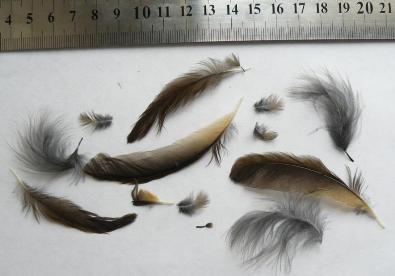
plumas

Feather samples of (Grallaria fenwickorum) on the Natural Reserve Colibri of the Sol in Colombia. It includes a combination of the wings, tail and especially of the body’s plumage.

Having described this species, we expect to promote more measures of conservation for Grallaria’s new species and its habitat.

{youtube}WHWD6-wC9Pw|425|344|1{/youtube}

Video Reserva Natural de las Aves Colibrí del Sol.
Imágenes de la Grallaria minuto 4:24

With the support of:

abc

Categorías
News

Conservationists Join Forces to Save Cerulean Warbler

ProAves and El Grupo Cerúleo have partnered with American Bird Conservancy to develop and published the Conservation Plan for the Cerulean Warbler on its Non-breeding Range in the journal Conservación Colombiana.

This comprehensive action plan details the current knowledge of the species to produce a blueprint that addresses the challenging issues involved in collaborative conservation of a species whose range spans many geographic and political boundaries.

Dowload the complete conservation plan in pdf

“This wonderful partnership will ultimately lead to more effective conservation efforts for a bird in real trouble. ABC and Fundación ProAves already have multiple projects underway that will benefit the Cerulean Warbler, and this new Conservation Plan will accelerate and guide these important efforts,” said George Fenwick, President of ABC.

One innovative project initiated by ABC and its partner Fundación ProAves has been the establishment of a pilot project in Colombia to demonstrate the potential for shade coffee and cacao plantings to provide habitat for Cerulean Warblers. The project works with private land owners and encourages them to maintain their lands as habitat for the warblers and other migrant and native species. The Conservation Plan for the Cerulean Warbler on its Non-breeding Range indicates many opportunities for similar conservation actions that can carried out for the conservation of the species.
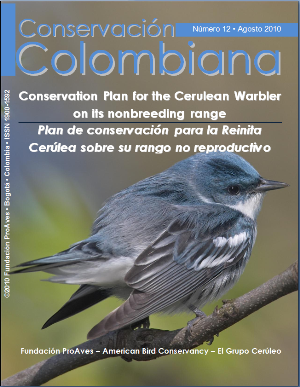
PortadaPeq

“We hope that, by identifying the threats to this bird and implementing mitigation strategies, we can help save one of the most spectacular migratory birds in the Americas,” said David Caro, Executive Director of Fundación. “This plan will not only assist and guide efforts by individuals, institutions and groups on behalf of the Cerulean Warbler, it will also benefit many other resident and migratory birds.”.

The Cerulean Warbler population is one fifth of what it was 40 years ago. It is our fastest declining neotropical migrant songbird and is one of the most threatened migratory birds in the Americas and considered Vulnerable under IUCN-World Conservation Union criteria. The species nests in deciduous forests in North America and inhabits montane forests and associated agroforestry systems in northern South America during non-breeding seasons. Few studies have been undertaken on the Cerulean Warbler’s non-breeding grounds, but there have been significant recent advances in the knowledge about the species’ geographical distribution, survival, and ecology, supported in part by ABC, the Neotropical Migratory Bird Conservation Act of USFWS, the National Fish and Wildlife Foundation, the USDA Forest Service, and others.

The Cerulean’s population decline has been attributed to habitat loss and fragmentation across its entire geographical range. The clearing of forests for agriculture and cattle pasture and conversion of traditional shade-grown coffee plantations to sun coffee plantations are among the main threats in the non-breeding range.

The main goals of the partners are to use diverse economic and ecological tools such as certification and economic incentives to reduce the loss of shade-grown coffee farms, to promote a protected areas network using the warbler as an umbrella species, and to restore and enhance habitats.

Los principales objetivos de los socios son usar diversos instrumentos económicos y ecológicos, tales como la certificación y los incentivos económicos para reducir la pérdida de cafetales con sombrío, promover una red de áreas protegidas usando la Reinita Cerúlea como una especie emblemática y de esta forma restaurar y ampliar sus hábitats.

American Bird Conservancy (www.abcbirds.org) conserves native birds and their habitats throughout the Americas by safeguarding the rarest species, conserving and restoring habitats, and reducing threats while building capacity of the bird conservation movement. ABC is a 501(c)(3) not-for-profit membership organization that is consistently awarded a top, four-star rating by the independent group, Charity Navigator.

ProAves (www.proaves.org) protects wild birds and their habitats in Colombia through investigation, directed conservation actions in collaboration with local communities.

El Grupo Cerúleo (www.grupoceruleo.org) is an international group of scientists dedicated to the study and conservation of the Cerulean Warbler.

Dowload the complete conservation plan in pdf.

With the support of:
usfish abc Grupo_Cerulea proaves


Categorías
News

Oil pipeline theft threatens biodiversity in the Nariño

Friday 8 October 2010.

The El Pangan Bird Reserve located in the municipality of Barbacoas, Nariño, is the most important protected area in the foothills of the Choco Hotspot. Over 20.000 acres of exceptionally diverse rainforests protect countless endemic and threatened species.

Unfortunately a major EcoPetrol oil pipeline flows beside the reserve on route from the Colombian Amazon to the Pacific coastal port of Tumaco. At particular points along the pipeline, especially in El Barro, Mirador de tajadas, Junín y la Guarapería, all close to the reserve, people have established illegal fuel extraction and trafficking sites.

Using crude facilities in the forest, the oil is processed to gasoline and sold to coca growers to process coca leaves into cocaine paste. Gasoline is much more expensive in Colombia than in the USA, so the profits are great and the problem is growing!

The environmental impact of this problem is growing fast, especially as side products from the rudimentary oil refining process in “kitchens” are released directly into streams and rivers.

collage1-3

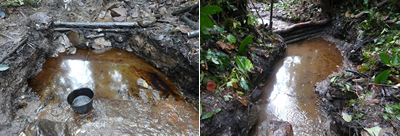
Traps to prevent the flow of oil.

Faced with his situation Ecopetrol and ProAves have joined forces for the recovery of several areas that have been damaged by oil spills. Ecopetrol has sealed off a number of points used for the extraction of oil, while going forward with recovery processes and impact mitigation in areas where leaks are found.

Among the measures mentioned are the installation of river traps that allow the passage of water, stopping the passage of oil and making it easier to collect and the affected land is treated with lime, which helps to partially recover the contaminated soil and vegetation.

collage2-3

Ecopetrol treated areas with lime to neutralize the oil.

It is important to emphasize the importance of creating, building and strengthening strategic alliances with organizations and the community, who with their commitment contribute to stopping the oil theft and the recovery of environment. Many people in the communities of El Barro, Mirador de Tajadas, Junín y la Guarapería have helped locate spills and acted promptly to mitigate further environmental impacts.

Categorías
News

World’s first Amphibian Reserve launched in Colombia

Tuesday 23 December 2008.

Despite 2008 being “The year of the frog”, there has been little to celebrate with news on the worsening plight of amphibians – an important indicator for the environment. As the year draws to a close, ProAves is proud to launch the world’s first amphibian reserve, the Ranita Dorada Amphibian Reserve, to protect a unique forest for amphibians in the Cordillera Central of Colombia.

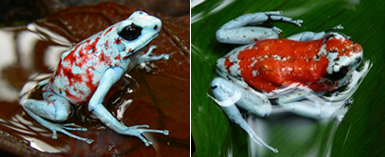
nuevo_mosaico_dos_ranas-4

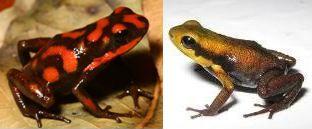
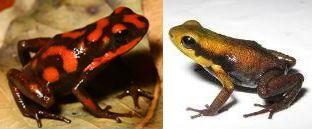
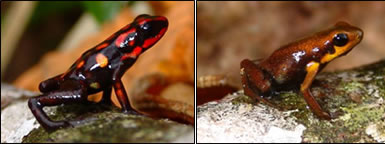
Swainson’s Poison Frog Ranitomeya doriswainsonae, described in 2006,and Little Golden Poison Frog Ranitomeya tolimense, described in 2007.


Responding to an emergency situation for two extremely endangered Poison-dart frogs, this exciting new initiative for amphibian conservation is born from a partnership between the IUCN Amphibian Specialist Group, IUCN Netherlands, Dendrobatidae Nederland, Conservation International, and Fundación ProAves, plus the support of Conservation International-Colombia and the Netherlands Postcode Lottery.

The new reserve encompasses an isolated wet subtropical forest fragment in a region dominated by coffee and pasturelands in the municipality of Falan, department of Tolima. The forest fragment was being cleared for agricultural uses in a region devoid of subtropical forest. The new reserve is the sole home to a large diversity of endangered amphibians, including two spectacular Poison-dart frogs; Swainson’s Poison Frog (Ranitomeya doriswainsonae), and the Little Golden Poison Frog (Ranitomeya tolimense) as well as other amphibian new to science and as yet undescribed.

This action comes at a crucial moment when conservation measures are urgently needed for this highly sensitive group. Amphibian’s dependence on clean freshwater and sensitivity to deforestation and climate change gives added urgency that we take greater care of them as our own health and survival depends on the same resources. We hope that heralding this new innovative conservation action – the world’s first Amphibian Reserve – will encourage others worldwide to help protect this group.

proaves conservacioninternacionalcolombia nationale
iucnnetherlands dendro asg
Categorías
News

Ranita Dorada Amphibian Reserve in DN Magazine

Thursday 26 November 2009.

The Dutch DN Magazine, specialized in the publication of Poison-dart frog news published an extensive article and video of the ProAves Ranita Dorada Amphibian Nature Reserve.

Dendrobatidae Nederland is an international association established and conformed by lovers of poison-dart frogs (Dendrobatidae), Mantella and other frogs. The main objective is to promote an appreciation of tropical forests of Latin America and Madagascar to promote the protection of frogs in their natural habitat and distribute as much information as possible regarding Dendrobatidaes and other tropical frogs. Currently, this entity supports conservation processes on the ProAves Ranita Dorada Amphibian Nature Reserve.

The association was established 20 year ago in 1989 to meet the growing interest in especially poisonous frogs and has over 1100 members worldwide.

Dendrobatidae Nederland publishes DN Magazine four times a year. It’s a magazine in full color directed not only at experts but at everyone who cares about nature and wants to know more about poison-dart frogs.

http://www.gifkikkerportaal.nl/

1_y_2
3_y_4
Edit_6

Ranita Dorada Amphibian Reserve, is the first amphibian reserve ever established and protects a unique forest for amphibians in the Cordillera Central of Colombia.

The Reserve encompasses an isolated wet subtropical forest fragment in a region dominated by coffee and pasturelands in the municipality of Falan, department of Tolima. The forest fragment was being cleared for agricultural uses in a region devoid of subtropical forest. The Reserve is the sole home to a large diversity of endangered amphibians, including two spectacular frogs; Swainson’s Poison-dart Frog (Ranitomeya doriswainsonae), and the Little Golden Poison-dart Frog (Ranitomeya tolimense) as well as other amphibian new to science and as yet undescribed.

Ranita Dorada Amphibian Reserve

{youtube}27f2nsypylc|425|344|1{/youtube}


Categorías
News

Illegal wildlife trafficking in Colombia

Thursday 1 July 2010.

The rich biodiversity of the country is situated among the first in biodiversity in the world, occupying first place in birds and amphibians and the second in flora and butterflies.

Unfortunately for Colombia, its diversity has been the target of illegal trafficking of wildlife, after drugs and the trafficking of arms; it is one of the most profitable economic activities and greatly harms wildlife populations, whereas at present nearly 2000 species of fauna are in danger of extinction. In Colombia, the illegal wildlife trafficking affects 234 species of birds, 76 mammals, 27 reptiles and 9 amphibians (www.minambiente.gov.co), ranking second in the trafficking of species globally (www.caracol.com.co).  

Illegal trafficking is like a pyramid, starting with the peasants or indigenous people who are responsible for removing species from their natural habitat, and forwarding them to an intermediary who carries them away and negotiates either within our country or makes contact with international traffickers who are ultimately responsible for making the sale abroad.

The situation is more critical because the people who traffic in biological species do not use techniques to ensure the welfare of animals, as reflected in forfeiture cases, where animals are malnourished, drugged, frozen, with fractures and in general with the consequences that imply illegal transport in the most unimaginable ways: engines, bags, tires, shoes, cylinders, etc., causing between 50 and 80% of these species to die in the long and painful journey.

collage2-13

As stated above, the picture you have is the following, there is a wildlife extraction pressure, product of the demand from individuals and/or products to address illegal trade both nationally and internationally, a situation aggravated when one considers the amount of animals to be removed to comply with this demand under the conditions described above, becoming another cause of extinction of species.

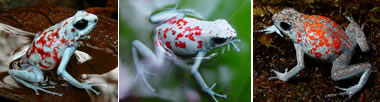
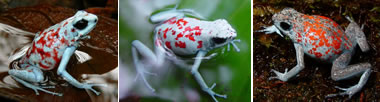
Recently the report of the unauthorized removal of the poison dart frog (Oophaga histrionicus) in the El Pangan Bird Reserve was presented, a protected area located on the western side of the Cordillera Occidental in the foothills in the municipality of Barbacoas, Nariño, an area rich in endemic species which is being the focus of the unscrupulous wildlife traders. The particular case of extraction of amphibians belonging to the family Dendrobatidae, is motivated not only by the showy skin of their species but also for the medicinal properties of substances in their skin. In the case of the poison dart frog (Oophaga histrionicus) it is an alkaloid known to secrete spirocyclic piperidine the Histrionicotoxin, which blocks the neuromuscular transmission, and has been investigated for the manufacture of medicines. Advances in knowledge about its application in the treatment of Alzheimer’s, Down syndrome and myasthenia gravis are being made; however, it is also required as a pet by collectors of species of foreign origin.

collage-25

It is necessary that we become aware of the damage being done to ecosystems supporting illegal trafficking of species; this behavior is not only depleting one of the global heritages of mankind, but the most important asset that the country has. They must begin to think and understand that wild animals cannot live in captivity, they are not conditioned to do so, and they need their space, their food and to interact with individuals of the same species. Thus many of us believe that we still have time to stop this illegal market which has long-term irreversible and incalculable effects in terms of loss of our biodiversity.

Come & visit the Reserva de Anfibios Ranita Dorada

{youtube}27f2nsypylc|370|270|1{/youtube}

proaves conservacioninternacionalcolombia nationale
iucnnetherlands dendro asg
Categorías
News

ALERT: illegal frog smugglers visiting Colombia

Friday 9 July 2010.

The great variety of exotic and rare frogs that exist in Colombia has attracted illegal fauna traffickers from Europe, coordinated by Mr. Daniele Buonvolere, a German living in the city of Cologne.

From direct and confidential informant in Germany, ProAves has been informed that a sophisticated network of illegal and unscrupulous collectors are planning to visit Colombia and illegally collect and export the rarest frogs found only in Colombia. Many are new species or recently discovered morphs that do not exist outside of Colombia.

Orders and money are being exchanged to collect the rarest species in the wild and illegally export them through the mailing system. Specifically we have learnt that the blue morph of the Harlequin Poison Frog Oophaga histrionicus in Narino are being targeted.

From the information we were provided with, we know that the trade in these species is coordinated by Mr. Daniele Buonvolere, a German living in the city of Cologne, who is known to engage in this deplorable practice.

Fundación ProAves has directly alerted officials in the Ministerio de Ambiente Vivienda y Desarrollo Territorial, Corporación Autónoma Regional de Nariño CORPONARIÑO and DAS (immigration agents) to alert the authorities to prevent the illegal capture of fauna.

Agencies in Europe and Germany have also been informed to be in close surveillance of Daniele Buonvolere and three other individuals of European origin.

We hope to curb the illegal trafficking of wildlife and to increase checks at airports, and call on communities to be vigilant in protecting our natural wealth.

collage-26
Categorías
News

ALERT: illegal frog smugglers visiting Colombia

Friday 9 July 2010.

The great variety of exotic and rare frogs that exist in Colombia has attracted illegal fauna traffickers from Europe, coordinated by Mr. Daniele Buonvolere, a German living in the city of Cologne.

From direct and confidential informant in Germany, ProAves has been informed that a sophisticated network of illegal and unscrupulous collectors are planning to visit Colombia and illegally collect and export the rarest frogs found only in Colombia. Many are new species or recently discovered morphs that do not exist outside of Colombia.

Orders and money are being exchanged to collect the rarest species in the wild and illegally export them through the mailing system. Specifically we have learnt that the blue morph of the Harlequin Poison Frog Oophaga histrionicus in Narino are being targeted.

From the information we were provided with, we know that the trade in these species is coordinated by Mr. Daniele Buonvolere, a German living in the city of Cologne, who is known to engage in this deplorable practice.

Fundación ProAves has directly alerted officials in the Ministerio de Ambiente Vivienda y Desarrollo Territorial, Corporación Autónoma Regional de Nariño CORPONARIÑO and DAS (immigration agents) to alert the authorities to prevent the illegal capture of fauna.

Agencies in Europe and Germany have also been informed to be in close surveillance of Daniele Buonvolere and three other individuals of European origin.

We hope to curb the illegal trafficking of wildlife and to increase checks at airports, and call on communities to be vigilant in protecting our natural wealth.

collage-26
Categorías
News

Commitment to threatened amphibians

Thursday 15 July 2010.

ProAves, with the support of important partners such as Conservation International, Nationale Postcode Loterij, Dendrobatidae Nederland and IUCN ASG Amphibian Specialist Group, has acquired the commitment of restoring the habitat of the golden frog.

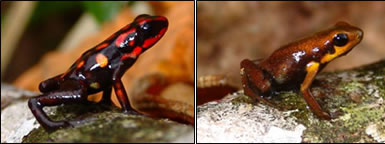
ranas

Swainson’s poison frog (Ranitomeya doriswainsonae) and golden frog (Ranitomeya tolimensis).

During the last decades, the transformation of native forests to pasture has become the main factor threatening endangered species such as the Little Golden Frog (Ranitomeya tolimensis) and Swainson’s Poison Frog (Ranitomeya doriswainsonae), there was no knowledge of these species until recently in this area of the country.

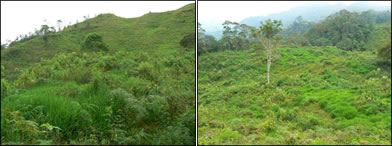
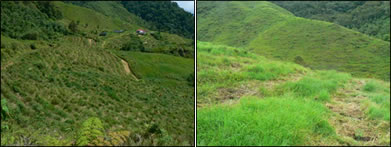
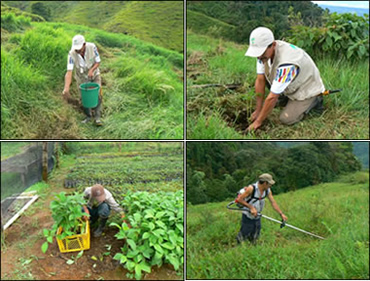
After six months of hard work implementing two nurseries with a capacity of 15,000 seedlings, seed collection in the relic forest inhabited by the species and planting of trees, we have initiated the recovery of these areas and taken the first steps to ensure the protection to perpetuity of this endemic and recently discovered amphibian in the Ranita Dorada Amphibian Reserve in Tolima. Besides this, ProAves has promoted the natural regeneration of the forest surrounding areas, contributing the changes in the vegetation cover within the protected area in approximately 40%.

reserva1

Areas with evidence of natural recovery.

reserva2

Reforested areas.

reforestacion

Main activities of reforestation.

With the support of:
conservacioninternacionalcolombia nationale iucn dendro asg
Categorías
News

Stronghold site for Fuertes’s Parrot saved

Monday 16 February 2009.

With the support of American Bird Conservancy, IUCN Netherlands/SPN, Netherlands Postcode Lottery and ProAves has established a 1,500 acre nature reserve, which is the first private protected area for the critically endangered and endemic Fuertes’s Parrot.

The species, whose population size is estimated at just 160 individuals, is restricted to a small area in the Cordillera Central of Colombia and is heavily impacted by deforestation. It was rediscovered by Fundación ProAves’ President Alonso Quevedo who found a flock of 14 Fuertes’s Parrots and confirmed the survival of a species that had last been seen in 1911, thanks to support from Fundación Loro Parque.

collage_reserva_loro_coro

The reserve in Quindío department is characterized by a spectacular landscape of montane forests and páramo, and is situated in the core of the species population – an area recognized as crucial for the species by the Alliance for Zero Extinction (AZE). It consolidates a zone of more than 5,000 acres with municipality of Génova land that ProAves manages. A strategic high elevation forest corridor is established to assist the Fuertes’s Parrot survival. The area is also extremely important for the Golden-plumed Parakeet (Vulnerable), and Rufous-fronted Parakeet (endemic, EN).

Reserve is situated in the western flank of the Central Cordillera, one hour from the town of Génova between the elevations 2,277-3,908 meters. Temperatures vary from 6° to 15° C and the area is often shrouded in dense cloud which promotes epiphytes that Fuertes’s Parrot feeds  Adopt a nest box   fundacion@proaves.org

With the support of:
abc iucnnetherlands nationale lpf
Categorías
News

New Reserve in defense of the Indigo-winged Parrot

Monday 9 August 2010.

For 91 years, the Indigo-winged parrot (Hapalopsittaca Fuertesi) was thought extinct, and then in 2002, the ProAves team rediscovered a colony of 60 individuals of these birds in an area of cloud forest in the central Andes of our country.

Collage_Fuertesi
(Hapalopsittaca fuertesi)

ProAves with the support of Fundación Loro Parque, Robert Giles, ABC, WLT-US and IUCN-Netherlands can still herald a critical success for this unique and fragile habitat and its threatened biodiversity.

In May of this year, after months of negotiations, we helped acquire and protect the 368-acre (149 hectare) fragment of cloud forest that contains a vital population of the remarkable Fuertes’ Parrot.

The main population of this parrot (approximately 30-40 pairs) was protected by ProAves within the 16,000-acre Parrot Corridor established in 2009. But the grave threat posed by mining activities spurred our support to protect this additional group of 5-10 breeding pairs.

Since its rediscovery, and thanks to strenuous conservation efforts, the total population of Fuertes’ Parrots has grown from 60 individuals to an estimated 150-200 birds. An extremely specialized species, the Fuertes’s Parrot feeds on mistletoe and other fruits. It cannot survive in captivity.

The new “Giles-Fuertesi Bird Reserve” is located two hours from the provincial capital of Tolima, Ibaque, and includes over 50 acres of pastureland that will be reforested by native trees while adjacent pasturelands will be fenced so that cattle cannot enter the forests and eat tree seedlings. Artificial nest-boxes will be installed to providing nesting sites for the Fuertes’s Parrot as many mature trees with natural cavities have been selectively logged for timber and firewood.

The property includes a traditional cabin for a reserve guard to be stationed to protect the reserve and allow researchers and visitors to be stationed. The reserve will be immediately registered for the national network of protected areas to ensure mining is prohibited. Other rare and endemic species found here include the endangered Mountain Wooly Tapir and the Spectacled Bear.

The Giles-Fuertesi Bird Reserve is located between 3,200 and 3,700 meters, with 149 has of highland and cloud forest with an average temperature of 11 degrees Celsius. Besides the Indigo-winged Parrot in the area you can observe other species of parrot like the Golden-plumed Parakeet (Leptosittaca Branicki) and the Rufous-fronted Parakeet (Bolborhynchus ferrugineifrons).

bosques

Artificial nests and cloud forest at the Giles-Fuertesi Bird Reserve.

The Giles-Fuertesi Bird Reserve has become a protected area in perpetuity for the conservation of the Indigo-winged parrot and the forests of the Central Cordillera and it will become the research center of the species, with the aim of expanding the knowledge of the natural history of this population, developing studies on habitat use, behavior and reproduction. In addition, the artificial nests program is being implemented. 20 artificial nests were placed in January 2010, in order to increase and stabilize the populations of parrots which are highly affected by the lack of natural nests in the area.

With the support of:

abc robert lpf nationale
iucnnetherlands worldlandtrust


Categorías
News Noticias El Paujil Noticias Pauxi Pauxi

New Reserve for threatened Helmeted Curassow

Thursday 6 March 2008.

In order to conserve the habitat of the Helmeted Curassow and other important endemic species of the Eastern Cordillera of Colombia, ProAves, thanks to the support of American Bird Conservancy (ABC), National Fish and Wildlife Foundation (NFWF) and ConocoPhillips, created the Helmeted Curassow Natural Bird Reserve in Cerro de la Paz, department of Santander.

Hembra_paujil_copete_de_piedra-3
A female Helmeted Curassow.

The Helmeted Curassow is a rain forest and cloud forest bird endemic to Colombia and Venezuela. In Colombia it only exists in the Perijá Mountains and the Eastern Cordillera. It is classified as vulnerable to extinction by IUCN.

The reserve is located in the municipalities of Betulia and San Vicente de Chucurí, with nearly 3,700 acres, 90% of them corresponding to tropical rain forest and 10% to coffee and cocoa plantations, and cattle grazing fields. The area has quite steep slopes, with many gullies and canyons. Among the most important birds there are Chestnut-bellied Hummingbird (EN), Blue-billed Curassow (CR), Safron-headed Parrot (VU), White-mantled Barbet (EN), Sooty Ant-Tanager (VU), Cerulean Warbler (EN), Wattled Guan, Black-mandibled Toucan, Citron-throated Toucan, and Beautiful Woodpecker.

Forests have a high diversity of mammals such as the endangered Spectacled Bear. Major attractions are the marvelous scenery, the large number of creeks and the historic Camino de Lenguerke (Lenguerke Road) built in stone in 1840.

abc conoco
Categorías
News

Critical expansion for the Pauxi pauxi Reserve

Monday 3 January 2011.

The site is located in el Cerro de la Paz, specifically in the municipalities of San Vicente, Zapatoca and Betulia (Santander); this a mountain system that is affected and threatened by intensive livestock activities developed in the buffer zone.

Activities such as hunting, subsistence and trapping, the opening of areas for crops such as cocoa, coffee, & to a lesser extent, of food crops, livestock and illicit crops have put great pressure on these forest fragments.

On the Cerro de la Paz 220 bird species have been registered, of which 15 are migratory species, 7 endemic, 9 near-endemic and 4 threatened, making the achievement of new lands for conservation and expansion of the protected area a priority.

rea_adquirida

Acquired area.

In recent reports from the CAS (Corporación Autónoma de Santander) it is estimated that the Santander forests are disappearing at the accelerated rate of 30 hectares a day, due to illegal timber trafficking, drug trafficking and agricultural sectors. In the past 10 years, 140 thousand hectares of forest were cleared and this trend will continue if nothing is done to done to stop the deforestation process.

For the above reasons and in addition to the inevitable current threats such as the damming of the river Sogamoso for the construction of a hydroelectric plant “Hidrosogamoso”, recent explorations for coal mining and oil drilling in nearby areas, making the region “a priority area for conservation.” The reserve includes areas of tropical moist forest life (Bh-T), average annual temperature of 27.8 ° C and a rainfall exceeding 2000 mm.

[slickr-flickr search=”sets” set=”72157625591212182″ items=”20″ type=”gallery”]

Fotos tomadas con cámaras trampa en la Reserva Natural de las Aves Pauxi-pauxi.

PROJECTS TO DEVELOP

Easements: ProAves as primary tool has created this project to promote conservation in the area with the help of the community. 7 legal ecological easements have been created for this reserve, with legalized commitments set and covenanted not to cut trees and forests on their land, making reseeding (native seedlings from our nursery) and not to carry out activities that threaten nature.
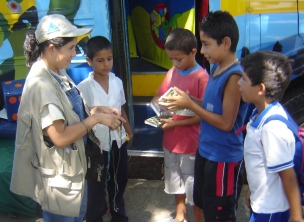
Corridor conservation: in agreement with the management plan of the reserve, ProAves has launched a conservation project which has as its main task to connect the mountain forests Cerro de la Paz (Pauxi Pauxi Bird Reserve) with the mountains of Yariguíes (Reinita Cielo Azul Bird Reserve) to allow movement of species between the two formations, ensuring genetic exchange, the survival of birds, amphibians, mammals etc. It also develops methods of planting native trees in the corridor of approximately 10 kilometers long by 1 kilometer wide.
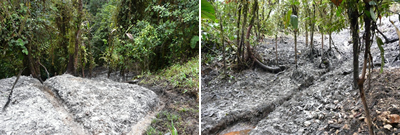
Environmental education: for the development of such projects, ProAves has held conferences, group discussions, visits, presentations to government and private entities, radio and television programs, festivals and parades, to make known to the community the importance of such projects and create local awareness to take a decisive attitude of support for the success of these programs.

Ecotourism: is one of the pillars of great interest to national and international communities interested in observing birds and their protection, regardless of the adverse features of the pathways leading to the reserve.

With this expansion project, ProAves ensures a better habitat winning a sheltered space to poor forestry practices that threaten the environment in the region.  

With the support of the following organizations:

abc conservationleadership Yar

Categorías
News

Yellow-eared Parrot added to municipality shield

Tuesday 24 November 2009.

In the last ten years, ProAves has had great achievements in conservation, research, and environmental education thanks to collaborative efforts with local communities. Our efforts are increasingly reflected in the changing attitudes within rural communities as the importance of protecting birds and wildlife are being recognized, especially the Yellow-eared parrot (Ognorhynchus icterotis) (CR) and its habitat, the Quindio wax palm tree (Ceroxylon quindiuense). Local people have a stronger connection to their biodiversity and are proud of it.

One recent great achievement was having the Yellow-eared Parrot made the official bird of the Municipality of Jardin, Department of Antioquia, and having it included on their shield. Fundación ProAves proposed this to the town council and today it has been officially approved.

escudo_antiguo_de_Jardin_svg
Previous.
edit_
Current.

During a town council meeting this year, various modifications were proposed for the shield, include the Yellow-eared Parrot to acknowledge its importance in the community; as well as replacing an orchid with a flower species endemic to the municipality, Pasiflora jardinensis; adding water between the Citara mountains; and making a new species of tree endemic to the area, Magnolia jardinensis, the official tree.

Thanks to the support of Loro Parque Fundacion, we can continue these activities and be one of the principal organizations working towards environmental conservation in the region.

{youtube}n72ADPjHmeI|425|344|1{/youtube}

lpf Jardin corantioquia
Jardín (Antioquia).
Categorías
News Noticias Hormiguero de Torcoroma

First published photos of the Recurve-billed Bushbird

Thursday 10 May 2007.

This male Recurve-billed Bushbird (Clytoctantes alixii) was photographed by ProAves staff, Adriana Tovar and Luis Eduardo Uruena. The publication of these photos represents the first time this globally Endangered species have been captured on camera.

foto_semi_completa_grande_hormiguero-2
Recurve-billed Bushbird.
Copia_de_Web_foto_pico_de_hacha_paul
Another image of the Recurve-billed Bushbird.

The Bushbird was observed in the 250 acre Hormiguero de Torcoroma Bird Reserve, by Ocaña, North of Santander – an area discovered by Thomas Donegan and Blanca Huertas after a ProAves EBA expedition. The population of the Bushbird was discovered by ornithologist Oscar Laverde during subsequent studies in the region in 2005-6. This Bushbird inhabits a relic dry premontane cloud forest and is a very unique area predominantly covered with bamboo forest. In December 2006, ProAves acquired this forest and established the reserve thanks to support from Robert Giles.

This Bushbird is found across the north of both Colombia and Venezuela and has a small distribution range. The species is known for its reclusive behavior and has therefore been difficult to observe. However, it has been seen in mixed flocks including the brush-finches Buarremon torquatus and Buarremon bruneinucha following ant trails and occasionally opening bamboo stems with its beak in the manner of an axe, to extract caterpillars, spiders and other insects.

The Bushbird only responds sporadically to “playback” of its vocalization, hence the difficulties encountered when trying to observe this species. In spite of these difficulties, it has been observed on several occasions in groups of three individuals made up of two males and one female. There is however a lack of knowledge regarding nesting and other ecological aspects. In order to support the conservation of this species, ProAves has initiated environmental education campaigns for the protection of the habitat, with children and young people in the local community of Ocaña. Due to the accelerated fragmentation of the habitat and lack of bordering forests in this region of Colombia, it is of great importance to know more about the biological aspects of the Bushbird and consequently to promote its conservation.

ProAves wishes to acknowledge and thank the people and organizations that have supported these conservation efforts. They have allowed us to immediately address the situation of a species facing extinction. Special thanks to Robert Giles, who has supported the protection of this unique habitat.