Fundación ProAves – por la conservación en el país de las aves

Categorías
News

More and more members join ProAves!

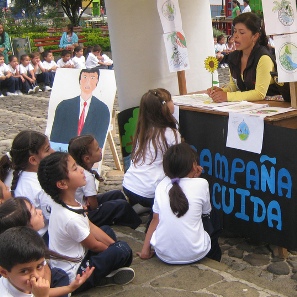
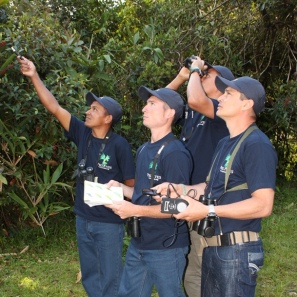
Our membership section is responsible for designing and supporting specific strategies to achieve the interaction with communities, which seeks, by conducting environmental education and communication activities, to link them to the membership that the foundation offers.

Categorías
News Noticias Cucarachero de Chicamocha

Niceforo’s Wren back to its natural habitat

This important finding demonstrates that transformed ecosystem management through the implementation of conservation tools such as reforestation of native species, conservation easements and working hand in hand with communities allows the repopulation of historic areas by species with restricted ranges of distribution.

Categorías
News

In 2013, Colombia was Reconciled with Nature!

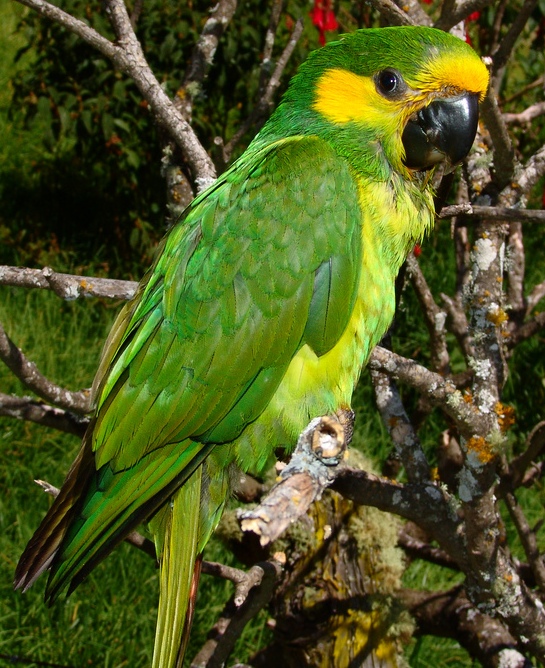
It is a pleasure for ProAves and all the organizations involved to supporting this initiative each year, and we were proud to once again fulfill our commitment to support the conservation of the Wax Palm (our national tree) and the Yellow-eared Parrot, both endangered species.

Categorías
News

Annual staff planning meeting 2013


The planning meeting consisted of the evaluation of the Strategic Plans 2012 and feedback from all the teams involved, a review of the most significant achievements of the previous year and the design of the new Strategic Plan, setting goals and priorities to develop during the next year.

Categorías
News

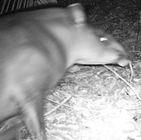
Colombian Tapir reappears in Central Colombia


One of the largest and least known of South American mammals, the Critically Endangered Colombian Tapir (Tapirus terrestris columbianus), has been almost completely exterminated by hunting and the loss of 97% of its habitat. For a decade it was considered almost extinct in the center of the country due to heavy hunting pressure and forest clearing in central Colombia, with only a few remaining individuals left.

Categorías
News

Twelfth “Reconcile with Nature” Campaign

Every year during Holy Week (Easter), Colombians meet to celebrate Holy Week, a rite of spiritual reflection looking to renew their hearts. The use of Wax Palm branches has been customary for the congregation at the beginning of this celebration on Palm Sunday, the symbolic representation of welcoming Jesus Christ to the city of Jerusalem.

Categorías
News

Engaging with the community of the Paujil Bird Reserve


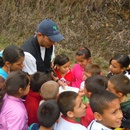
As part of the membership and environmental education strategy that ProAves implements and which seeks to develop activities that encourage communities living in the areas where our reserves are located to get to know and support the work done in each region, a visit to the inhabitants of the village of Puerto Pinzon, buffer zone of the The Paujil Bird Reserve, took place last November.

Categorías
News

Conservation Corridor protects birds in Colombia

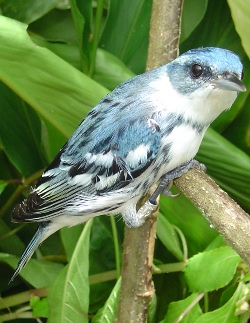
The Cerulean Warbler Conservation Corridor, established by ProAves in 2008, aims to protect the habitats of resident endemic and endangered species, which also provide wintering grounds for and allow the passage of migratory birds such as  Cerulean Warblers (Dendroica cerulea) and Golden-winged Warblers (Vermivora crisoptera).

Categorías
News

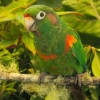
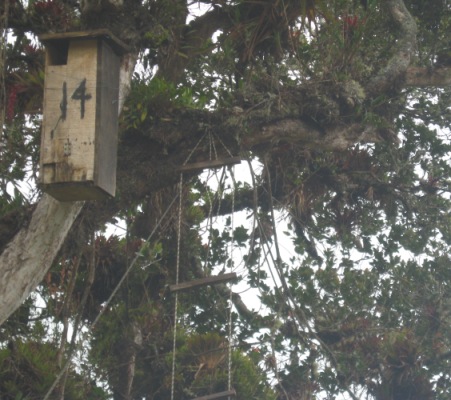
Artificial nestboxes provide hope for the conservation of the Rusty-faced Parrot

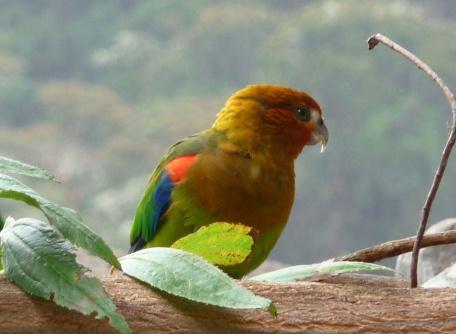
The Rusty-faced Parrot (Hapalopsittaca amazonina) is categorized as Vulnerable, primarily due to the small size of its population and the loss and fragmentation of its habitat caused by the expansion of the agricultural frontier in the Andean forest.

Categorías
News

Sites for Super Deadly Frog, Flying Fox, and Mystery Owl Named to 7 Wonders of Endangered Species


aze_cabezote

The Alliance for Zero Extinction (AZE) is a network of 88 prominent conservation groups from 35 countries that is calling for support from the global community to protect “AZE sites”, which are locations identified by conservation scientists where Endangered or Critically Endangered species are known from only one place on Earth.

Categorías
News

New Conservation Leadership in ProAves

Alonso was one of the founders of ProAves and has provided invaluable and ceaseless support to the organization throughout its history; he is also an accomplished conservationist and ornithologist, having rediscovered the Yellow-eared Parrot in Colombia in 1999 and the Fuertes’s Parrot in 2000 after 91 years.

Categorías
News Noticias Pauxi Pauxi Noticias Reinita Cielo Azul

Cerulean Warbler to Benefit from Acquisition of Key Colombian Habitat

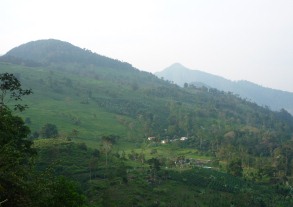
The conservation effort resulted in the acquisition of nine new properties that total about 672 acres. Those new properties now make up the western flank of the Pauxi Pauxi Reserve that was established in 2007 by the same partner groups and now totals about 4,470 acres. The purchased area is located in north central Colombia, about 150 miles north of Bogota in an area of lush tropical vegetation.  The newly acquired land is part of an imposing, mountainous outcropping called Cerro de la Paz along the Magdalena River Valley west of the chain of the Andes Mountains, an area that has been heavily deforested due to agricultural and urban expansion.

Dendroica_cerulea_niciocct

“As migratory birds head south through the degraded river valley, the Pauxi Pauxi Reserve is a forested haven. We are thrilled to expand available habitat for these weary avian travelers”, said David Younkman, Vice President for Conservation at ABC.

“Cerro de la Paz and the Pauxi Pauxi Reserve may be one of the best migrant hotspots in Colombia based on our surveys,” said Alonso Quevedo, Executive Director of ProAves. “It is fantastic that our conservation efforts to protect endangered resident species, such as the Helmeted Curassow, can also ensure vital habitat for dozens of migratory species.”

The Cerulean Warbler was formerly one of the most abundant breeding warblers in the Ohio and Mississippi River Valleys in the U.S., but is now one of the country’s most imperiled migrant songbirds. Overall, Cerulean Warbler numbers have plummeted by almost 70% since 1966. This elusive bird winters in the northern Andes, breeds from the Great Lakes region to Georgia, and west from Wisconsin to Louisiana, with particular concentrations in the Appalachians and Central Hardwoods region. Both its breeding and wintering habitat are being lost.

ReinitaReserva

In addition to providing habitat for the Cerulean Warbler, these properties represent a crucial area of wintering habitat for numerous other neotropical migrating birds, such as Tennessee, Black-and-white, Mourning, Canada, Blackburnian, and Black-throated Blue Warblers, American Redstart, Northern Waterthrush, and Rose-breasted Grosbeak.  The Critically Endangered Blue-billed Curassow and Endangered Helmeted Curassow are also reported from this area in recent years, although confirmation is pending.

In addition to protecting key wintering habitat, the Pauxi Pauxi Reserve also provides another strategic function – it anchors the northern end of the Cerulean Warbler Corridor in Colombia. This is an area that is seeing increased agricultural expansion and ProAves is assisting local farmers in reducing deforestation and promoting shade coffee and cacao, both which benefit migratory birds. For example, ProAves owns and operates small coffee and cacao farms that demonstrate to neighboring farmers some ways to enhance wildlife conservation and maximize profits.

Current conservation efforts in the reserve include reforesting habitat by building a tree nursery on the property. Local residents have been hired to help find seeds, maintain saplings and will begin planting by mid-2013.To protect the area from logging and unauthorized farming, a guard has been hired, and an existing structure is being renovated to serve as a guardhouse. Two small cacao farms (16 acres) on the property will provide ongoing income to sustain the management (guard salary). Also camera traps are being installed on the property to confirm the presence of Helmeted, and possibly Blue-billed, Curassow among other important wildlife.

This region faces other threats as well: an enormous hydroelectric dam on the Sogamoso River is underway which will flood a large tracts of forest, and the company is buying land and relocating families upslope.  This will bring, increased pressure on the reserve’s buffer zoneand drive wildlfieinto the refuge, making the protected habitat even more important.

With the support of

abc

Categorías
News

Génova celebrates its natural heritage

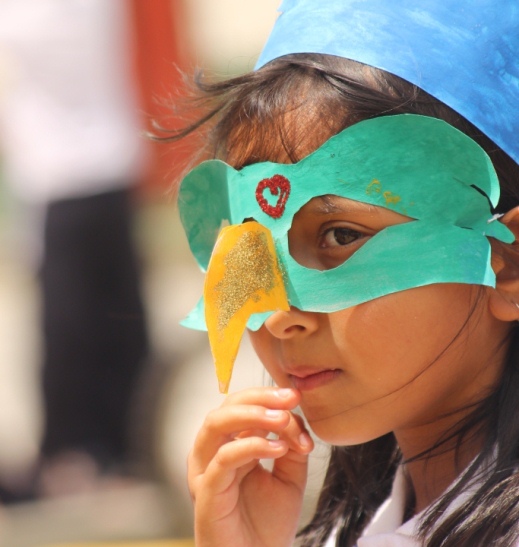
ProAves together with the local authority conducted the eighth version of this beautiful environmental fete which consisted of a parade through the streets of the town, where more than 700 people with banners, masks, hats and costumes representing the Fuertes Parrot and the Migratory Birds.

During the event the First Environmental Fair also was held which had stands by Parques Naturales Nacionales (National Parks), environmental projects by colleges in the town, the Regional Corporation of Quindío CRQ, Nepsa del Quindío (the local waste management company), the Torrefactora de Café Municipal (ranked as the third best specialty coffee in the world) and others, along with a photo and art exhibition.

During the festival the community participated in various recreational activities such as a Flagship Challenge where awards were given, a Myths and Legends Theme Night, a magical night where through a play, dance, rock and costumes, the importance of oral tradition in the recognition of the conservation was highlighted. About 500 people pretended to be enchanted and frightened by children embodying different myths and legends specific to the region, who also took home baskets and school kits for their effort in preparing their costumes. The community also enjoyed wildlife films, park, nature walks and more.

[slickr-flickr search=”sets” set=”72157632233796008″ items=”20″ type=”gallery”]

Also, in the Municipal Administrative Centre photographs were on show in the environmental photo contest in which youth from the town participated.

It is important to point out that environmental education workshops have been held throughout the year with local schools where more than 1,300 children and young people have been made aware of the importance of these ecosystems in their quality of life.

It was also very gratifying to have the support of all the children who are members of the Los Polluelos (“the nestlings”) in this event, demonstrating the commitment of teachers, aware that early childhood should be the first opportunity to introduce an awareness of conservation.

We are thankful for all the support provided by the Municipality of Génova, Quindío; Quindío Regional Corporation CRQ, colleges, primary schools and other local institutions that are enabling us to get this message to more and more people in this beautiful department of Quindío, declared a World Heritage Site in 2011.

Some Interesting Facts:

More than 500 masks and visors were produced symbolizing the Fuertes Parrot and the Migratory birds.

More than 80 children between 3 and 5 years marched hand in hand with their parents, through the main streets of Génova.

Mr. Alberto Garay was presented with a plaque of appreciation, a recognized municipal photographer who has photographed the wilderness for 30 years, managing to capture our natural beauty.

With the support of:


lpf Gnova


Categorías
News

More protection for the Helmeted Curassow

In 2011, with support from American Bird Conservancy, the process of expansion of the Reserve began. With the acquisition of an additional 540 acres the reserve now has more than 5300 acres of tropical rainforest.

Conserving this habitat is very important. The Pauxi Conservation Corridor Project is currently being developed, which includes strategies for restoration and reforestation with native species produced in our nurseries and ongoing monitoring of key species. In the catchment area of the reserve agroforestry and silvopasture  have been implemented underpinned by an awareness campaign in the community.

The Helmeted Curassow Bird Reserve was created in 2007 to preserve remnants of rainforest, the habitat of the Helmeted Curassow (Pauxi Pauxi), a bird listed as vulnerable to extinction by the IUCN and endemic to Colombia and Venezuela, which is reported only in the Cordillera Oriental and the Serranía del Perijá. This forest is threatened by logging and cattle ranching, and the use of chemicals by cocoa and coffee plantations.

[slickr-flickr search=”sets” set=”72157632195364348″ items=”20″ type=”gallery”]

The reserve is located in the Serranía de la Paz, in the municipalities of San Vicente de Chucuri, Betulia and Zapatoca, Santander department, and bathed by five brooks: la Llana, the Putana, the Boquerona, the Mantecosa, the Aguamieluda and Vergela. This is an undulating terrain of steep slopes and gullies between 200 and 1,350 meters above sea level, which provides passage routes for mammals such as bears, pumas, ocelots, howler monkeys, agoutis, armadillos, and good etc. as well as habitat for amphibians and reptiles.

Among the bird species are: Chestnut-bellied Hummingbird (Amazilia castaneiventris), the critically endangered Blue-billed Curassow (Crax alberti), Saffron-headed Parrot (Pionopsitta pyrilia) VU, the White-mantled Barbet (Capito hypoleucus), EN, the Sooty Ant-tanager (Habia gutturalis), VU , Cerulean Warbler (Dendroica cerulea), VU, and Golden-winged Warbler (Vermivora Crysopthera), among others.

With the support of:

abc

Categorías
News

9 new bird species for Colombia

Published edition Conservación Colombiana No. 15. The PDF is available here.

Fundación ProAves publishes, annually since 2007, the List of birds of Colombia by the same author since the first edition in 2001. The number of bird species recorded in Colombia has increased from 1,869 in 2007 to 1,871 in 2009 and from 1,879 in 2010 to 1,889 in 2011 and 1,897 in 2012.

Colombia officially remains the most diverse bird country on the planet, followed by Peru and Brazil with 1834 and 1785 species, respectively.

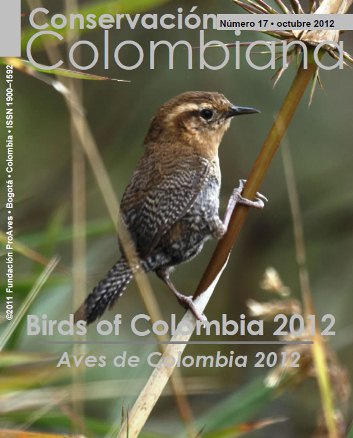
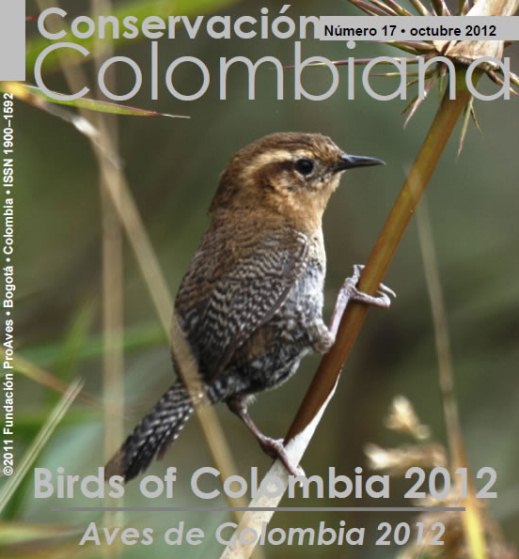
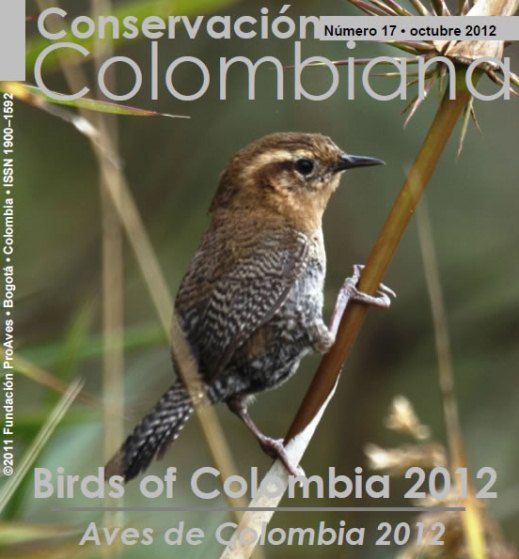
The 17th edition of the Conservación Colombiana journal  presents the first pictures of the Santa Marta Wren (Troglodytes monticola) in the wild, along with details of the first sighting in more than a decade of this Critically Endangered (CR) species. The species is extremely rare and local and found in a remaining small wilderness area at 3,250 meters on the western flank of the Sierra Nevada de Santa Marta.

portada_big

The List of birds in Colombia included in the Conservación Colombiana journal  provides comprehensive and current information on birds in Colombia since the publication of the Field Guide to the Birds of Colombia which ProAves published in 2010. 9 new species were recorded in Colombia, which include: the Crimson Fruitcrow (Haematoderus militaris) and the Varzea Thrush (Turdus sanchezorum),the Antioquia Wren (Thryophilus sernai) and the Spotted Tanager (Tangara punctata) are new records for Colombia, also Snowy Plover (Charadrius nivosus), Marbled Godwit (Limosa fedoa) and Worm-eating Warbler (Helmitheros vermivorum) all become confirmed species, in the latter case to the mainland.  Sulphur-crested Cockatoo (Cacatua galerita) is a new exotic species and Budgerigar  (Melopsittacus undulates) becomes confirmed species in addition to escaped.

Likewise, this edition the threat status of several species was updated and various modifications were made to genus and species names, English names and list order. Following these changes, the new Colombian listed species increased to 1,897.

If you want to contribute information to the List of birds of Colombia next year or have new records of bird species in Colombia, you can write to the following email: foundation @proaves.org

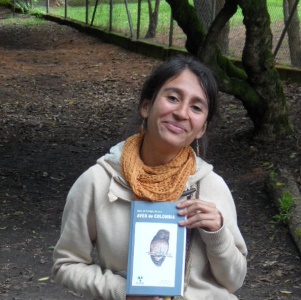
You can also purchase a printed List of birds of Colombia 2010 entering the following address: https://www.proaves.org/guide.

Published edition Conservación Colombiana No. 15. The PDF is available here.

lpf abc iucn
proaves worldlandtrust


Categorías
News

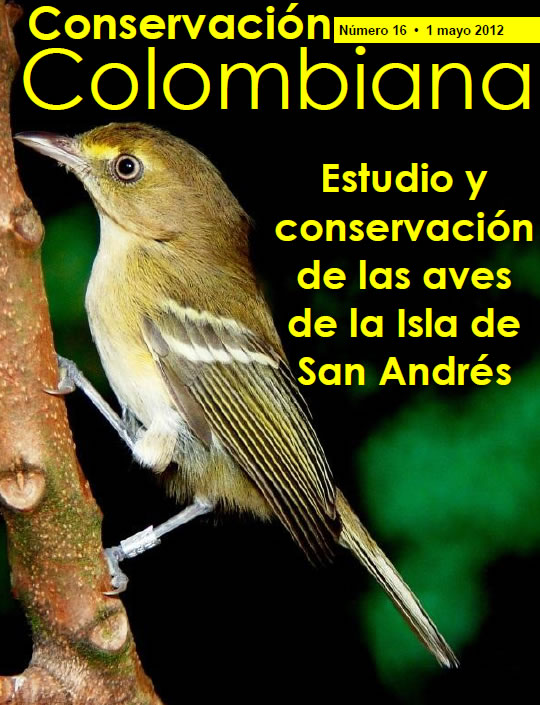
The Study and Conservation of Birds of San Andres Island


The study includes a detailed description of the area, its location, geomorphologic aspects, climate, soils, ecosystems and population. It also explains the methodology used and the results obtained over seven years of constant monitoring conducted on the island. There is a detailed description of priority ecosystems for birds and the major threats they face.

Among the results, 119 species of wild birds were recorded on the island of San Andres. 26 species were resident birds and 93 species were boreal migrants, some with migration patterns unique to San Andres and different to the rest of the country (Salaman et al 2008). Of the 119 species recorded for the island in this study, only two species are categorized as vulnerable (VU), the endemic San Andrés Vireo Vireo caribaeus and the migratory Cerulean Warbler  Dendroica caerulea. In addition, three species have been listed as Near Threatened (NT), 112 species are in the Least Concern category of threat (LC) and two have not been evaluated because they are not yet recognized as a species.

portadaN16big

The publication presents a timely conservation plan for the bird species in the archipelago, both migratory and residents.

Finally, the study proposes an action plan for research and conservation at the regional level, which specifies the necessary actions for priority ecosystems to have better opportunities in terms of environmental protection. The plan includes specific objectives for research, conservation and improvement of public health, concise actions to achieve the objectives, estimated timescales and the possible actors in each process.

Find here the PDF file to view and download for free

Conservación Colombiana is published with the support of:


lpf abc iucn
proaves worldlandtrust


Categorías
News

Conservation of the Magdalena Spider monkey

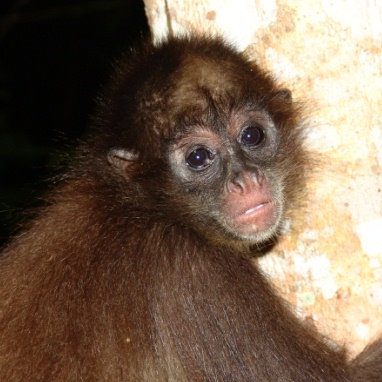
The Magdalena Spider Monkey (Ateles hybridus) is a Neotropical primate species almost endemic to Colombia and listed as one of the 25 most endangered primate species in the world, and unfortunately falls into the category of critically endangered according to the International Union for Conservation of Nature (IUCN).  Historically it was widely distributed in the Magdalena river valley and the mountains bordering NE Colombia and NW Venezuela.

The IUCN publishes its Red Data list every two years, where the Magdalena Spider monkey now appears for the fifth time after being first included in 2004. View report.

Conservation

In November 2003, with the support from the American Bird Conservancy and the Global Conservation Fund, ProAves established the El Paujil Bird Reserve located in the departments of Boyacá and Santander. The reserve has over 7,900 acres of primary forest, the natural habitat of the spider monkey, where, thanks to the implementation of conservation strategies, environmental education and research projects, hunting has been eliminated.

By permanent monitoring a recovery has been demonstrated, not only in population but also in range, which had declined in recent years due to the expansion of the agricultural frontier and selective logging. All this is possible thanks to the implementation of various programs of community inclusion among which highlight the annual reforestation with approximately 5000 plants  associated with the monkey’s biology.

[slickr-flickr search=”sets” set=”72157624616431422″ items=”20″ type=”gallery”]

ProAves, under its policy of inter-institutional cooperation, continues supporting academic institutions and NGOs to develop specific research on species of different orders that are endangered on its nature reserves. An example is Foundación Primates, led by Dr. Andres Link, who completed more than five years of study on the ecology of this species of primate. This cooperation between institutions and individuals seeks to dispel the specter of impending extinction, not only of the Magdalena Spider Monkey, but also of other species dependent on this fragile and important ecosystem.


abc global Healthy_Planet_Logo


Categorías
News Noticias Reinita Cielo Azul

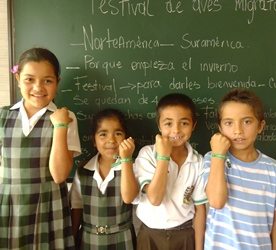
ProAves celebrates the Ninth Migratory Bird Festival

During the celebration of the Ninth  Migratory Bird Festival, ProAves carried out events in the municipalities of San Vicente de Chucurí (Santander); Jardín (Antioquia); Génova (Quindío), Roncesvalles (Tolima) and Bogotá. In these the community had the opportunity to participate in several academic, cultural and recreational activities oriented towards the awareness of the importance of and threats to migratory birds, some of the most important birds that come to Colombia were showcased, with ideas of how we can contribute to their protection.

 Mural_edit

A DIFFERENT WORLD – Replica, Artist: Christian Ferrada Soto – Chile

Actions Taken

This year the epicenter  of the Festival was the municipality of San Vicente Chucurí, Santander, where several  activities and workshops in Bird Friendly Schools where  held in order to promote the children’s interest in learning about the migratory birds that come to Colombia and especially to their municipality, their importance, the major threats they face and the ways we can protect them.  In this same town, pupils of the Nuestra Señora de la Paz College painted a mural as a visible manifestation of the Ninth Migratory Bird Festival.

Meanwhile each of the cities of Jardín and Génova information and entertainment booths were set up to raise awareness of the program of activities planned for the municipalities during the Festival.

“Focus on birds” competitions were held, with prizes such as mini-guides, posters, bracelets and T-shirts, for children and adults who came to see the stands.

[slickr-flickr search=”sets” set=”72157631946430927″ items=”20″ type=”gallery”]

Observation courses for children and youths

In the town of Jardín, Antioquia, there were two observation courses, one for children and one for youths. For both initiations were made through visits to educational institutions of primary and secondary education. The objective of this activity was to promote to participants through tests of agility, speed and knowledge, an interest in migrating birds arriving in Colombia.

Neighborhood Roadshows

 The neighborhood roadshows’ aim is to have a more direct approach with the community in different municipalities, through visits to each of the neighborhoods and each of the educational institutions of the municipality, during these visits fun and educational activities are carried our that promote awareness of these birds.

The closing parade

The closing parade was held through the main streets of the town of San Vicente de Chucurí. In the main square of the town were presented the awards for best groups based on an evaluation of their knowledge about birds; the winner was the school carnival Valentín Gonzales Rangel from Nuestra Señora de la Paz College, which received school kits, bracelets, Field guides to the Birds of Colombia and mini guides.

As a final act were two dances with the theme of migratory birds, and the launch of a song dedicated to extreme travelers called “Star Color” by singer-songwriter Jorge Luis Real.

Thanks to the participation and engagement of communities of different municipalities, the Ninth Migratory Bird Festival closed successfully, and it is clearly important to recognize that these activities have developed a real significance for people in municipalities where the festival has been celebrated continuously for nine years.

The Migratory Bird Festival IX was carried out with the support of:

abc

Categorías
News Noticias Loro Orejiamarillo Noticias Reinita Cielo Azul

IX Migratory Bird Festival 2012


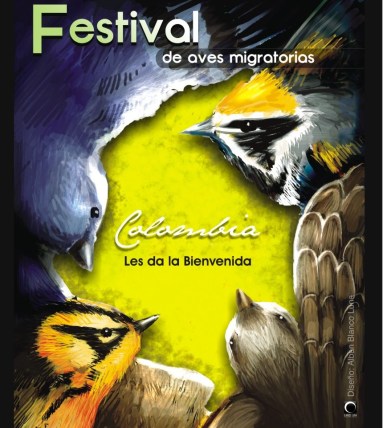
The Festival will be held in 4 regions of the country: Roncesvalles (Tolima); Jardín (Antioquia), Génova (Quindío) and San Vicente de Chucurí (Santander); a variety of activities have been scheduled within which we will have observational outings, workshops, lectures, neighborhood outlets, radio programs, cultural performances and parades all framed within the objective of generating knowledge about these beautiful and important visitors.

Since 2004 Fundación ProAves has held the Migratory Bird Festival continuously for the sole purpose of making known to the communities the importance of preserving the habitats of our guests of honor, trying to ensure the habitat of hundreds of birds that travel each year from North America to southern South America.

ProAves recognizes the importance of taking actions to achieve behavioral changes aimed at conservation which is why the Festival of Migratory Birds symbolically contributes to the promotion, recognition and interest in providing responsible actions and solidarity of the people in relation to the biodiversity of our country and the entire continent.

Afiche_ProAves

Poster: Alban Banco Luna

During the festival we expect the participation of more than 5,000 people including adults, children and young people from all parts of Colombia, especially in the municipality of San Vincent de Chucurí in the department of Santander, where the Cerulean Warbler Bird Reserve is located, the first Reserve created in South America for the conservation of a migratory bird.

On October 20 there will be an observational walk along the Reserve trails, where we will have the involvement of the San Vicente community, including several educational institutions and the Mayor of the municipality; during the walk we hope our migratory friends will give us a chance to admire them in all their splendor, beauty and strength.

On Saturday October 27 the closing parade, whose central theme is the habitat of migratory birds during their stay in the tropics, will close with decorated floats adorned as coffee trees, water sources, forests and birds which will roam the main streets of town, likewise, with different costumes, large banners, dances and plays by children, young people and adults around the town saying “Welcome traveling friends”

Join us in the celebration.

With support from:


abc

Escudo_jardin San_Vicente_Chucur roncesvalles genova_bandera


Categorías
News

Second Membership and Environmental Education Meeting 2012

The meeting was attended by the entire team of Environmental Education and ProAves Membership including: Yulied Bautista, Fernanda Martínez, Ana Velásquez, Juliana Toro, Leidy Pérez, Leidy Alarcón y Alejandro Grajales, also with the participation of our executive director Lina Daza Rojas; the event began with an overall presentation of the Chestnut-capped Piha Bird Reserve by Johanna Villa, Assistant Director Northwest Region.

During the meeting there was a presentation by the Membership and Environmental Education sections, and on educational processes developed in the municipalities of Jardín, department of Antioquia, Génova in Quindío and Roncesvalles, Tolima
.
With the assessment of the Strategic Plan and Annual Operating Plan for these areas and the activities undertaken in 2012, development plans were created and the goals to meet during the year 2013 were set; these objectives include significantly increasing the number of municipalities where ProAves conducts environmental education and therefore the number of people sensitized to these issues.

Additionally the Reciprocal Water Agreements Project (ARA’s) was explained and the role environmental groups play in different areas where ProAves is present and the importance of youth participation was analyzed and finally the methods of assessment of strategies to improve educational processes were set out.

[slickr-flickr search=”sets” set=”72157631293978054″ items=”20″ type=”gallery”]

The community also participated in the meeting. During the event recreational activities took place with members of the village of Roble, a buffer zone of the Chestnut-capped Piha Bird Reserve; a general presentation on the work of ProAves to raise awareness and knowledge about importance of protecting natural resources was made. Also, after an invitation extended to the women in the community to participate in the project “Women for Conservation”, a training workshop was held demonstrating the interest of women wishing to join in these activities.

The meeting ended with an excellent balance “we ended up very pleased with the work done and the achievements, we are sure they will be a great motivation to continue with this important work of environmental education,” Rojas Lina Daza, Executive Director.

Categorías
News

ProAves at the World Conservation Congress of IUCN

The World Conservation Congress is the largest and most diverse conservation event in the world. It is held every four years and aims to improve the way we manage our natural environment for human, social and economic development.

Government leaders, public sector organizations, NGOs, corporates, UN agencies, and social organizations attended the event to discuss, debate and decide solutions for the most pressing issues of the world in terms of environment and development.

Discussions by participants from government, business and civil society in the Congress defined the measures necessary to conserve the biodiversity of the Earth which was divided into four main areas: Conservation on a larger scale; Sustainability in action for our Common Future; Closing the gap in the governance of the use of nature, The way forward from Jeju. See the full document Jeju Declaration.

[slickr-flickr search=”sets” set=”72157631495991176″ items=”20″ type=”gallery”]

During the congress, our Director made a presentation of the work of ProAves over the last 13 years, the formation of nature reserves and the impact in Colombia of the initiative of the Alliance for Zero Extinction to a specialized and multicultural audience, this experience gives us more opportunities and opens doors to complement our conservation experience with best practices from around the world.
Likewise, Dr. Lina participated by voting in the election of President of the Union, the Council and Regional Councilors.

For ProAves and our Executive Director this is a great experience. Having had the opportunity to participate in this important event has provided a large number of tools and information that will be taken into account in the development and implementation of our mission.

“It is our commitment to work and our passion that defines our role in the protection of the invaluable natural wealth of our country, in accordance with the policies established in Congress we will work to synch “towards a new era of conservation, sustainability and nature based solutions.” Our director added.

Supported by:

iucn

Categorías
News

Jardin, a showcase for Conservation in Colombia.

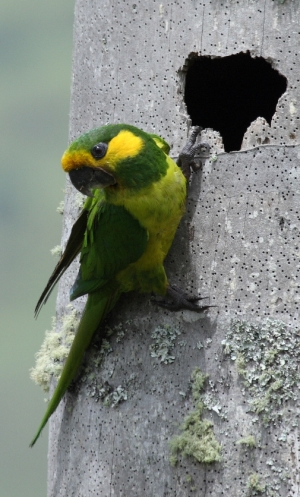
In 2006, after working seven years for the conservation of the Yellow-eared Parrot (Ognorhynchus icterotis), the ProAves Bird Reserve Loro Orejiamarillo was established and then supported by the Loro Parque Foundacion. Over these 13 years we have achieved remarkable results, most notably leading to the change in the parrot’s threat category, but also the selection of the species as the bird emblem of the municipality and its inclusion within the coat of arms of the municipality.

Today we celebrate the establishment of the conservation strategy ARA’s – (Reciprocal Water  Arrangements) – and its inclusion in the Municipal Development Plan, which was an initiative led by ProAves as a municipal policy for the 4 year plan. This ensures the conservation of the watersheds of Quebrada La Bonita and La Mendoza, which was accomplished after a strong lobbying effort with institutions that have an impact on decision-making in environmental matters such as the Mayor’s Office and Town Council, CORANTIOQUIA, Unidad Agroambiental and the Jardín community who participated in all the activities.

The importance of this agreement lies in the benefit that the water users in the town receive in terms of water quality and quantity, whilst the environmental services providers receive incentives for conservation. Additionally through this agreement the concepts of Voluntary contribution, Conservation Fund and the Committee for the Protection and Conservation of watersheds and endangered species will be created that allow the active involvement of the users of environmental services.

“From the beginning we have been perfectly willing to support this initiative, which as well as creating Reciprocal Agreements for Water also creates the program … we are ready to support such initiatives over others which are trying to threaten our natural resources, such as the issue of mining and in that the city administration has a very clear position” added the Secretary of Government of Jardín City Hall, Dr. Johan Uribe Palacio.

[slickr-flickr search=”sets” set=”72157631296204018″ items=”20″ type=”gallery”]

This great achievement would not have been possible without the tireless awareness campaign ProAves and colleagues have developed over the last 13 years in the town. Currently they are developing a variety of environmental education campaigns and festivals under 5 programs: Bird Friendly Schools, Ecological Group Friend of Birds, Sister Schools, Social Services and Youth researchers.

In these weekly activities about 1,000 people are involved, including children, youths and adults, in environmental education, cultural and recreational activities whose primary purpose is to encourage behavioral changes, generating knowledge, a sense of belonging, and respect for the  biodiversity of the region and thus ensuring its protection, in this specific case the protection of the two areas mentioned above.

Actions taking place in Jardín have shown the institutional will to address the concern for preserving and protecting environmental services, thus ensuring resources for future generations and improving the quality of life of its inhabitants; also demonstrated was the high commitment and interest of landowners and the sustained effort in environmental, social and community work by ProAves with the essential support of Loro Parque Fundación during these 13 years.

lpf

Categorías
News

Conservation

Ognorhynchus_icterotis-RoncesvallesProAves is a purely conservationist NGO, which for more than 10 years has been implementing and developing tools and conservation activities, in order to mitigate the impact caused by the man on the habitats of endangered species.

The ProAves conservation area works to contribute to maintaining the quality and availability of habitat for conservation of priority bird species through the establishment and management of nature reserves in civil society and to develop other forms of protection supported by a concept of self-sustainability and community integration, influencing local, regional and national environmental protection.

Its objectives are:

  • To establish, expand and manage comprehensively the protected areas of the Foundation, ensuring compliance of the function in perpetuity.
  • To implement, evaluate and strengthen programs and tools for conservation in nature reserves and areas of influence.
  • To promote and develop self-sustaining actions to ensure the perpetuity of the reserves.
  • To participate in and influence the formulation, management and implementation of conservation policies.

We have thus managed to retain under our Natural Bird Reserves 30,503 hectares of various kinds of ecosystems, and restore and reforest 1,200 hectares and establish 3,600 hectares under figures of Payments for Environmental Services.


Related news


Inicio_ecoguas

A new generation of Eco-Guides in Colombia
Thursday 2 August 2012.

The 3rd Eco-guide Training Course was undertaken by professional guides from 13-21 June in the Las Tangaras Bird Reserve with rural community citizens and Reserve Rangers. A new generation of highly trained guides in birding and nature guiding will provide outstanding services.


Nota_Johanna_2

Biodiversity of Antioquia presented in Jardín
Friday 27 July 2012.

At the Regional Meeting “Southwestern Antioquia: the Biodiversity Jardín” with around 200 participants took place in May in Jardín, where ProAves presented “Bird Reserves: a strategy for the conservation of biodiversity in southwestern Antioquia”.


Grallaria

Conservation Success for three Endemic and Threatened Colombian Birds
Tuesday 3 July 2012.

The recent change in the threat category for three Colombian endemic bird species – now no longer in imminent danger of extinction – is in large part thanks to the conservation and research efforts of ProAves, particularly with its strategic network of 21 Bird Reserves across Colombia.


sloth_realease_el_pangan

Sloth rescue in Colombia’s threatened forest
Wednesday 14 December 2011.

Generous donations to rangers help protect the forest home of the Two-toed sloth and a multitude of other threatened species.


Colombia reaffirmed as #1 nation for birds
Wednesday 19 October 2011.

ProAves published the 15th issue of its journal Conservación Colombiana, which includes five articles related to new bird records for Colombia plus the annual review of the national list of birds. To date, we confirm a total of 1,889 bird species occurring in Colombia to reaffirm that Colombia is the #1 nation of birds on earth.


Roncesvalles

Roncesvalles, pioneer town for the signing of Reciprocal Water Agreements
Thursday 29 September 2011.

In September, ProAves assisted two property owners in Roncesvalles, Tolima, to commit to preserving the majority of their land that is within the town’s watershed. As agreed, for at least ten years, the total of 3,200 acres will be saved and restored for natural habitat conservation.


inicioRonces

ProAves establishes Colombia’s first joint Municipality Environmental service agreement
Thursday 4 August 2011.

The Municipality Council of Roncesvalles approved ProAves Environmental Service Agreement to create the first joint program, funded by water users, to protect watersheds and endangered species.


Inicio_1

The wetlands of Bogotá – critical habitat for birds
Monday 1 August 2011.

At the invitation of the Association EcoVida, our collaborator Monica Parada gave a Talk: “The wetlands of Bogotá and Cundinamarca, an important habitat for waterfowl in Colombia”, in the Wetlands Course with the lakeside community of Santa Maria del Lago.


inicio-4

ProAves at the IUCN Regional Forum
Thursday 21 July 2011.

ProAves Executive Director, Lina Daza, attended the first South American Forum of Members of the International Union for Conservation of Nature (IUCN) in Lima, Peru, from 13-15 June.


Inicio-9

Fifth protected areas management course
Wednesday 29 June 2011.

The 5th meeting of protected area managers from 15 protected areas from across Colombia was held from 3-11 June, 2011 in El Paujil Bird Reserve thanks to NMBCA. Training included monitoring biodiversity, camera trapping, management planning, mapping and constructing platforms.


Heidy

ProAves presents to the GEF Council in Washington DC
Wednesday 15 June 2011.

ProAves presented its progress on establishing some of Colombia’s first environmental service agreements in Tolima to the Global Environment Facility (GEF) Council between 23 to 26 May 2011 in Washington DC.


gente

ProAves helps protect Paramo del Sol in Antioquia
Tuesday 4 January 2011.

To socialize the actions and strategies undertaken at local level aimed at the protection and management of the Páramo del Sol, on 9th December ProAves held a workshop on “Management, Conservation and Protected Areas of the Páramo del Sol”. ProAves is working to protect this highly vulnerable AZE site.


inicio-3

Life Distinction Award for Fundación ProAves
Monday 25 October 2010.

The Corporación Autónoma Regional CorAntioquia, celebrated its 15 years of work with a ceremony in which it acknowledged ProAves with a Life Distinction, the highest award given to organizations who have worked diligently and consistently for the preservation of natural resources in Antioquia.


inicio-29

Pride Campaign in Roncesvalles, Tolima
Monday 2 August 2010.

Under an agreement established with the Conservation Organization RARE and through Pride Campaign, ProAves is promoting actions aimed at the conservation of ecosystems that offer environmental goods and services to generate environmental awareness in communities.
Categorías
Colombian Conservation Journal News

Nº 16 Study and conservation of the birds of San andrés Island

portada

Fundación ProAves has publishes the 16th volume of its scientific journal Conservación Colombiana, this edition includes a monitoring of the avifauna of the island of San Andres conducted by ProAves between November 2003 and April 2010. During this period we conducted regularly for about 20 days every month variable radius point counts, transects and mist-netting in a variety of habitats present in the island. All of the above with the aim of increasing the knowledge of the avifauna of the archipelago.


Find here the PDF file to view and download for free.

pdf-distConservación Colombiana Nº 16 Estudio y sonservación de las aves de la Isla de  San Andrés

Categorías
News

“Zero Extinction” Seven Wonders Campaign Announced


Wonders

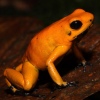
Vote for the Golden poison frog by ProAves here

AZE has posted a list of 20 candidate sites from which voters can select their choice of seven. The 20 shortlisted sites were chosen from among 587 sites around the world identified by scientists working with AZE; sites that are the last refuges for one or more endangered species. The 20 sites represent a variety of taxonomic groups, including birds, mammals, amphibians, and reptiles, as well as diverse geographies. Voting will be open through November and can be carried out at the campaign website: www.AZE7Wonders.org

Golden poison frog

Golden Poison frog by ProAves.

Fundación ProAves has been a member of the Alliance for Zero Extinction for 7 years, and uses the AZE list of threatened sites and species to prioritize its work. ProAves has established 10 nature reserves in areas classified as AZE by global committee, in order to preserve forever AZE species found there.

Vote for the Golden poison frog by ProAves here

“The world rallies to preserve the heritage of priceless historical places like the Great Pyramid of Giza or the Colosseum, and we should also protect the places on Earth that harbor the most endangered species,” said Mike Parr, AZE Chair and Vice President of American Bird Conservancy. “By highlighting seven places out of the 587 sites that are most important to the preservation of the Earth’s biodiversity, in the tradition of the ‘Seven Wonders of the World,’ we can help draw attention to the importance of saving these sites.”

“The idea is to stimulate interest in – and hence action to save – threatened species that only occur in one place. Local pride will go a long way towards protecting these species,” said Tom Brooks, AZE Steering Committee member and Vice President for Science and Chief Scientist at NatureServe.

The campaign was launched today at the World Conservation Congress, which is being hosted by the International Union for the Conservation of Nature (IUCN), and where some 8,000 people have gathered to address global conservation issues. The IUCN Red List of Threatened Species was used by AZE to help identify the 920 Endangered and Critically Endangered species restricted to 587 single sites worldwide.

“These species have lived on Earth longer than any man-made structure, and we cannot allow them to disappear in the shadows, unnoticed,” said Parr. “We hope citizens feel a sense of pride and vote for the charismatic species found only at the unique places in their country.”

The following 20 sites (in random order) and their endangered species were selected for voting in the AZE’s 7 Wonders campaign:

1. Gough Island, UK – Tristan Albatross

2. Isla Robinson Crusoe, Chile – Juan Fernandez Firecrown

3. Abra Patricia, Peru – Long-whiskered Owlet

4. Raso da Catarina, Brazil – Lear’s Macaw
5. Hellshire Hills, Jamaica – Jamaican Ground Iguana
6. Anhui Chinese Alligator Nature Reserve, China – Chinese Alligator
7. Roti Island, Indonesia – Roti Island Snake-necked Turtle
8. Baly Bay National Park, Madagascar – Angonoka Tortoise
9. Yadua Taba Island, Fiji – Fiji Crested Iguana
10. Río Saija, Colombia – Golden poison frog

11. Bale Mountains, Ethiopia – Malcom’s Ethiopia Toad
12. Morningside and Handapan Ella Plains, Sri Lanka – Shrub Frog
13. Manas National Park, India – Pygmy Hog
14. Menabe – Andranomena, Madagascar – Madame Berthe’s Mouse Lemur
15. Helan Shan Nature Reserve, China – Helan Shan Pika
16. Rodrigues Mainland, Mauritius – Rodrigues Flying Fox
17. Massif de la Hotte, Haiti – La Hotte Glanded Frog
18. Lower Tana River, Kenya – Tana River Mangabey (monkey)
19. Chatham Islands, New Zealand – Shore Plover
20. Poyang Hu, China – Siberian Cran

The campaign is sponsored by AZE member, American Bird Conservancy. AZE (www.zeroextinction.org) is a joint initiative that aims to prevent species extinctions by identifying and safeguarding key sites, each of which is the last remaining refuge for one or more Endangered or Critically Endangered species. AZE’s goal is to create a frontline of defense against extinction by protecting as many of these sites as possible. Data are available on all AZE sites and an accompanying map graphically illustrates the location of each of the sites around the world.

abc aze


Categorías
News

Birding Guide for Colombian Bird Reserve

The Colombian charity Fundación ProAves owns and manages the 2,600 acre El Dorado Bird Reserve with excellent ecotourism facilities perched on the Sierra Nevada de Santa Marta Mountains – the highest coastal mountain on earth. This reserve is fast becoming the top birding site the entire tropics – 22 endemic birds (not to mention many endemic amphibians, plants, etc.) within a stones throw of a wonderful birding Eco-Lodge and two hours from Caribbean beaches. ProAves has recently upgraded facilities with over 26 beds and high-speed internet and has a constant stream of birding and nature groups staying.

We are seeking a birder that can live at the El Dorado Eco-Lodge from Oct/Nov 2012 until April 2013 (with the possibility of an extension) to guide birders and naturalists. We would offer accommodation and other benefits, plus payment for each day of guiding. Candidates must be experienced birders (although not necessarily experienced in Colombia) and hard-working, often guiding for long hours over many days. Experience with ecotourism and/or conservation is useful. A US or other driving license is essential.

How to apply?

Send cover letter explaining why you would be the ideal candidate and resume to the following email address: fundacion@proaves.org


Categorías
News

Spectacular images from the Amazon

ProAves has used this technique for many purposes, from identifying individual species to assessing population size and various aspects of their ecology and behavior, the use of trap cameras is one of the most important and versatile methods for biological research for conservation purposes; they allow behavioral studies, activity patterns and population estimate, among others to be made.

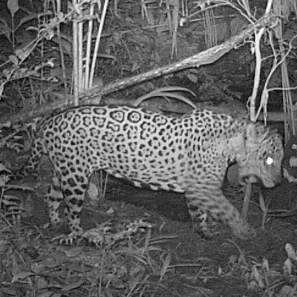
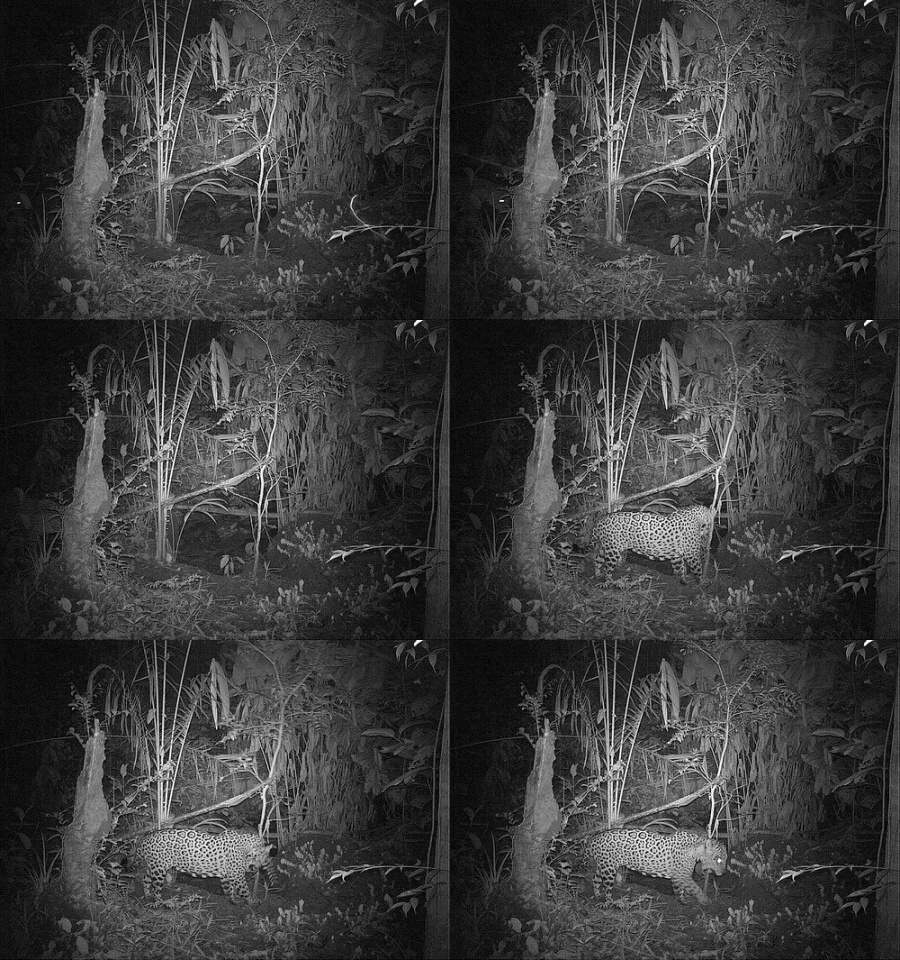
The trap cameras were installed in July and during the 20 days spent capturing photographic records it was possible to identify a female deer (Mazama americana), apparently pregnant, while we also got a spectacular record of a Jaguar (Panthera onca), almost extinct in the department of Casanare, which shows the importance of ProAves conservation actions in transitional forests of the Orinoco to the Amazon.

Jaguar
Register with camera traps a Jaguar (Panthera onca).
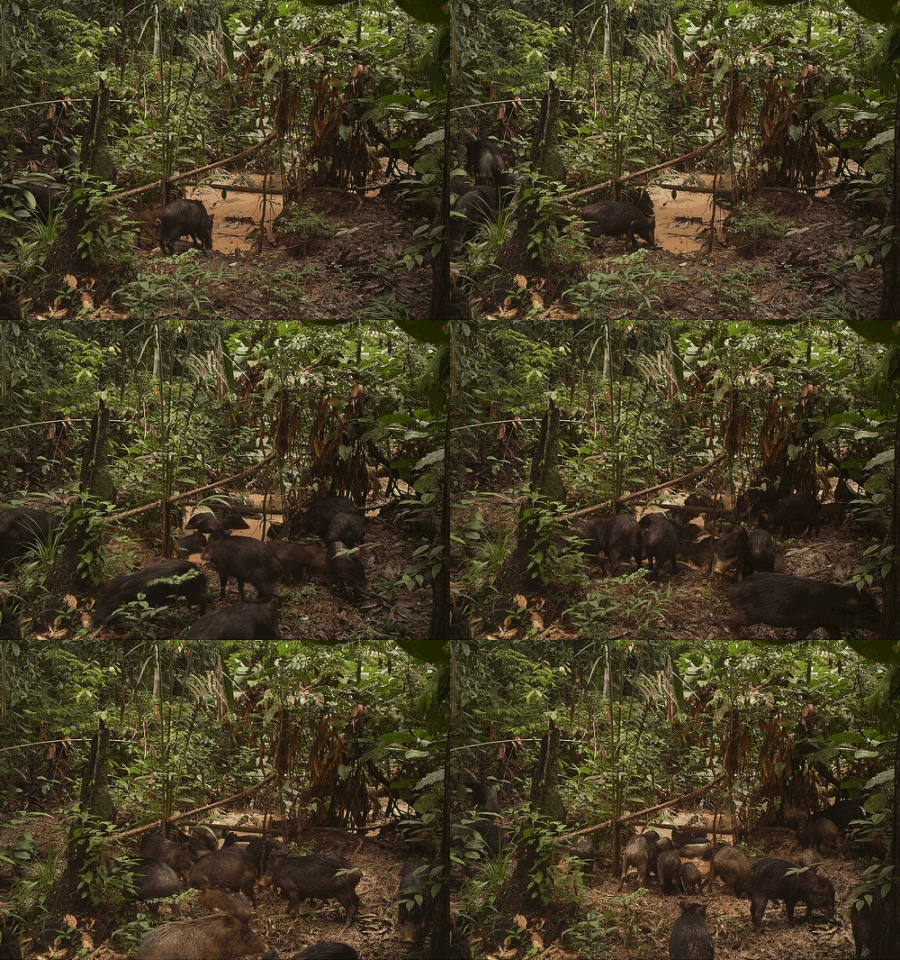
cajuches
Register with camera traps individuals Cajuches (Tayassu pecari).
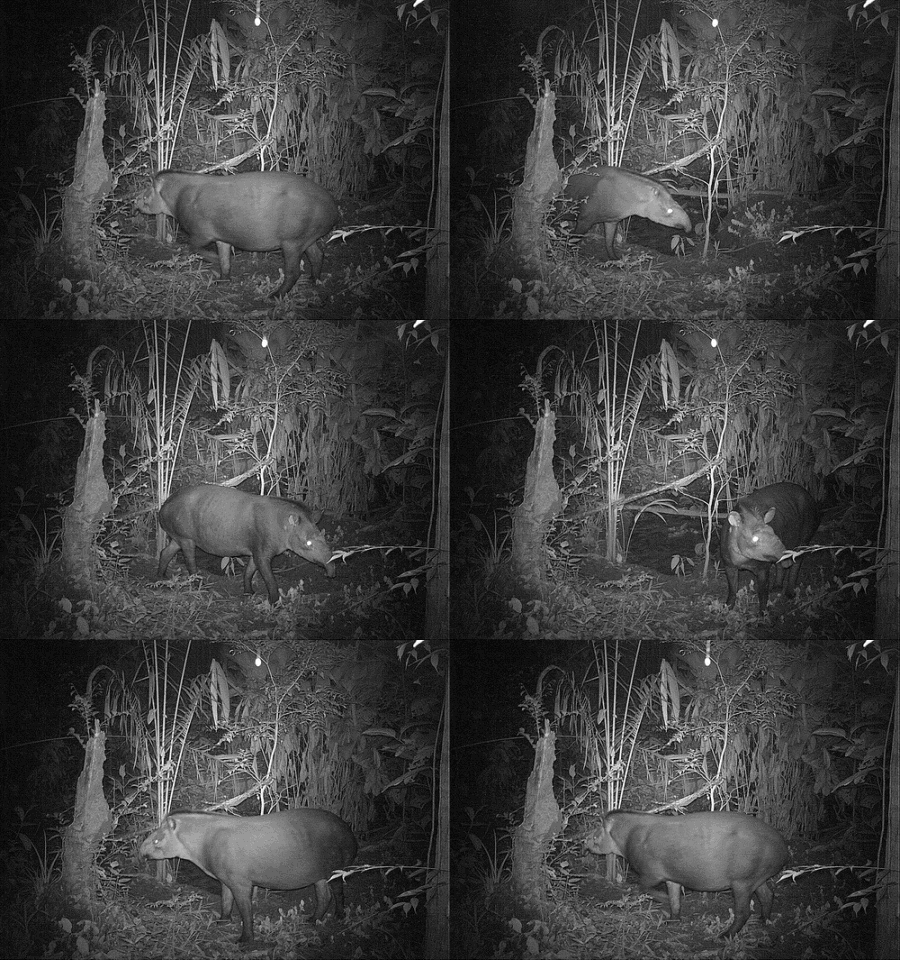
Danta
Register with camera traps of Danta (Tapirus terrestris)

A herd of Collared Peccary (Tayassu pecari) of around 150 individuals, among adults and juveniles, was identified for the first time; likewise a very important register of a Crestless Curassow (Mitu tomentosum) was made.

This time the cameras were installed in lakesides or salty wetlands, a favorable environment where these species find vital nutrients and minerals.

This tool has been used by ProAves in studies while monitoring the population of Crax Alberti, Ateles hybridus and Tremarctos ornatus, among others and to check for the presence of other species of mammals and birds in protected areas located in the most threatened ecosystems in our country.

Thanks to its implementation, at least 40 species, between birds and mammals, have been registered, the majority of special interest for their conservation status or level of endemism, and others for their scarce records and being considered as rare species.

At ProAves we hope to continue to use this method in studies of biodiversity, abundance and population monitoring and of special interest for the conservation of several species of flora and fauna in our country.

Categorías
News

ARA’s and Pride campaigns now in Génova and Jardín

“If you want to have a future, forests and water you must protect” – that accompanies the campaign slogan in Jardín, Antioquia.

The objective of the campaign is to encourage high mountain farmers to conserve their sources and other natural resources, especially the basins Quebrada La Bonita and La Mendoza.

Past June we launched the Pride Campaign in the town of Jardín, Antioquia, which included the active participation of the public institutions of the town like the Town Hall, Undersecretary of Rural Development and Environment, DMI cuchilla Jardín-Támesis, Public Companies, City Council, the Caramatarruba Indigenous Community and urban residents.

With the delivery of the project according to the Mayor of Jardín in May, great buzz and interest was created in implementing the Reciprocal Water Agreements (RWA/ARAS) as a key measure for the town, one of the activities that raised most motivation among the inhabitants of Jardín was the development of the logo and the slogan that champion the campaign, this activity helped to promote pride and awareness to help the conservation of flagship species such as the Yellow-eared Parrot.

[slickr-flickr search=”sets” set=”72157630275105524″ items=”20″ type=”gallery”]

ProAves Foundation has developed a strong working socialization with institutions that have an impact on decision-making in environmental matters, as in the case of the Mayor and City Council, and CORANTIOQUIA & the Agri-environmental Unit who were present during the activities.

“If you take care of Río Gris, Génova will be happy “- slogan that accompanies the campaign in the town of Genova, Quindío.

During the month of May we make the official launch of the Pride Campaign in this county with the slogan “If you take care of Río Gris, Génova will be happy.” Event allowed the community to socialize and institutions the project by presenting cultural events (puppet plays, spots and banners); in addition to encouraging, motivating and initiating actions for the conservation of biodiversity in the town.

Likewise, a consensus workshop was established with the High mountain inhabitants of the villages of Río Gris which identified what kind of incentive landowners required to conserve waterbasins and watersheds that supply municipal aqueduct. Among the inhabitants interest was perceived in participating in the process to improve and recover their natural resources.

The event was attended by the Mayor of Génova Mr. Albert Cañas, City Council members, some educational institutions, the Environmental Police and Community officials of the Autonomous Regional Corporation of Quindío (CRQ), members of the Avizor Foundation, and owners of high mountain farms, the Civil Defense and representatives of Community Action Committees, among others.

Actions in the two municipalities have shown institutional willingness to address the concern of preserving and protecting environmental services and resources and ensure future generations and improve the quality of life of its inhabitants also demonstrated high commitment and the interest of landowners and hard work of environmental work, social and community that ??ProAves has made supported by Loro Parque Fundación over these 13 years.

Supported by:

lpf Gnova Escudo_jardin


Categorías
News

Ranita Dorada Amphibian Reserve Reforested

For the past three years the restoration and reforestation in Ranita Dorada Amphibian Reserve has been developed with the aim of promoting connectivity, recovery of open areas and to provide plants used for foraging wildlife, especially birds.

Located in the department of Tolima, the Amphibian Reserve Ranita Dorada is the first Reserve in the world created for the conservation of threatened species belonging to this order.

Thanks to the work done so far, a remarkable regeneration of native plant species can be seen in primary and secondary succession in what were previously pastures, recovering part of the habitat for several species of amphibians including two spectacular endemic and endangered frogs, and Ranitomeya doriswainsonae and Ranitomeya tolimense found here.

[slickr-flickr search=”sets” set=”72157631198764082″ items=”20″ type=”gallery”]

With these activities, ProAves is meeting the objectives in establishing silvopastoral systems, implementing hedges, reforestation at water sources, along the banks of rivers and streams, natural regeneration of stocks in pastures, coffee and cocoa shade plantations, working with the community and towns for the recovery of watersheds and the donation of trees for meeting the commitments in the easements.

Finally, during these years of work over 1,850 acres of pastures, margins of streams and rivers in different parts of country have been replanted and restored, not only giving proper management of these areas but also providing food supply for wildlife.

Supported by:

dendro NMBCA


Categorías
News

Climate change study on Colombian birds highlights the need for new protected areas

Climate change is expected to cause shifts in species distributions worldwide, threatening their viability due to range reductions and altering their representation in protected areas. Biodiversity hotspots might be particularly vulnerable to climate change because they hold large numbers of species with small ranges which could contract even further as species track their optimal habitat.

In July 2012, Stony Brook University PhD student and ProAves founder member Jorge Velásquez-Tibatá together with Drs Catherine Graham of Stony Brook University and Paul Salaman of World Land Trust-US and an advisory council member of ProAves published an article titled “Effects of climate change on species distribution, community structure, and conservation of birds in protected areas in Colombia ” in the journal Regional Enviromental Change. Copies are available on email request fundacion@proaves.org.

Using field data shared by ProAves, together with publically accessible data from BioMap data containing 230,000 records of Colombia bird specimens, together with field data compiled by Dataves, eBird, and xeno-canto, the extent to which climate change could cause distribution shifts in threatened and range-restricted birds in Colombia was analyzed. The online Darwin Database by Project BioMap was a collaboration of over 70 bird collections across the world, and lead by The Natural History Museum (UK), Instituto de Ciencias Naturales de la Universidad Nacional de Colombia, and Conservación Internacional-Colombia.

Mapa_2

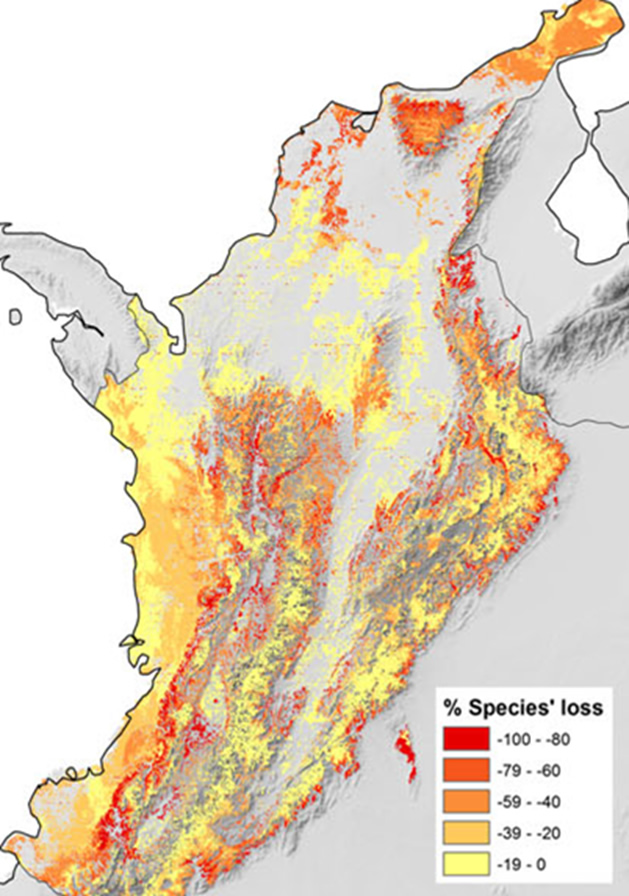
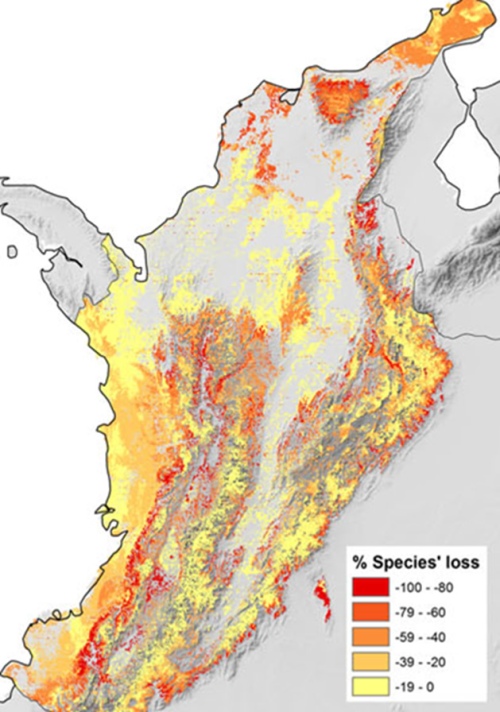
Results highlighted that threatened and range-restricted birds in Colombia are projected to lose on average between 33 and 43 % of their total range under future climate, and up to 9 Colombian endemic species may lose their climatically suitable range completely and therefore could go extinct. Worryingly, 8 of the 9 species that could go extinct are endemic to the Sierra Nevada de Santa Marta and represent almost half of all the endemic bird species restricted to the Sierra Nevada de Santa Marta, including the spectacular Santa Marta Parakeet Pyrrhura viridicata.  An important population stronghold for many of the eight Santa Marta endemics is in the El Dorado Bird Reserve, but this 2,500 acre reserve is inadequate to sustain populations and greater efforts are needed to connect this reserve and the San Lorenzo ridge to the main National Park some 5 km away which holds higher elevations that could temporarily buffer the impacts of climate change.

Furthermore, one of those species at risk of extinction from the effects of climate change is the Endangered Chestnut-capped Piha Lipaugus weberi from the northern slopes of the Central Cordillera – with the core surviving population contained within the ProAves reserve “Arrierito Antioqueño Bird Reserve”.

The article predicted that in the future, potentially between 5 to 70% of threatened and range-restricted birds in Colombia will be inadequately represented is protected areas.

This article provides recommendations for future research and conservation needs in Colombia, including:

(1) monitoring populations of birds for which future suitable climate is predicted to completely disappear;

(2) conducting field surveys, especially aimed toward species known in few locations, to improve distribution models;

(3) including predictions of the effect of climate change on species distribution as part of IUCN assessments of species extinction risk, and

(4) identifying sites that would complement the current protected area network to meet species representation targets.

It is critical that existing reserves, parks and other protected areas be better protected and expanded, while new protected areas be established in the most under-represented regions and ecosystems, particularly the Sierra Nevada de Santa Marta, the Chocó, northern slope of the Western and Central Andes and the northern half of the Eastern Cordillera.

Overall, the article lays an important foundation for scaling up conservation efforts in the race to combat the effects of climate change on Colombian birds.

Citation:

Velásquez-Tibatá, J., Salaman, P., y Graham, C. (2012) Effects of climate change on species distribution, community structure, and conservation of birds in protected areas in Colombia. Regional Environmental Change. Vol. 12, 329-342.

Alianza BioMap (Museo de Historia Natural del Museo Británico, Instituto de Ciencias Naturales de la Universidad Nacional de Colombia, y Conservación Internacional) 2006. Base de Datos Darwin: Proyecto BioMap base de datos de distribución de la avifauna Colombiana. http://www.biomap.net.

Figure 3 on page 8: Future pattern of species richness, under climate scenario A2: predicted percent of species’ losses relative to current richness (Velásquez-Tibatá et al. 2012).


Categorías
News

Please support the conservation work of ProAves

piha_low


Why Support ProAves:

ProAves has dedicated 15 years to saving the most endangered habitats and species in Colombia.

Our science-based targeted actions have saved 627,773 acres across Colombia, including the direct acquisition of over 66,718 acres of forests at imminent risk of destruction, now protected forever.

We are saving the planet’s most imperilled biodiversity. We work with rural communities to develop sustainable economies and improve livelihoods.

When you support us you are supporting real conservation actions

100% of your donation will buy and save critical habitats:

$1,000 will save 435,000 sq feet (10 acres)

$100 will save 43,500 sq. feet (1 acre)

$50 will save 21,780 sq. feet

$25 will save 10,890 sq. feet

Donate online here: through our partner Rainforest Trust (U.S. tax deductible)Follow this link if you prefer to make a donation online through our partner American Bird Conservancy.

Thank you for donating to ProAves and making a difference for biodiversity in Colombia.

Please contact ProAves Executive Director for assistance in English or Spanish:

Telephone: (57-1) 340-3261 or (57-1) 340-3229 (Bogotá, Colombia) 

Email: fundacion@proaves.org


Categorías
News

First nest box occupied by the Rusty-faced Parrot

intro_1


We celebrate the first nest attempt of the Rusty-faced Parrot (Hapalopsittaca amazonina) in a nest-box provided by ProAves in the Colibri del Sol Reserve.

The nest box was occupied by a pair of Rusty-faced Parrot who laid a single egg on April 11, and then raised the single chick until 13 July when the chick successfully fledged from the nest.

“The first record of the use of nest-boxes provided by ProAves for the Rusty-faced Parrot is of great importance and provides hope for the conservation of the Rusty-faced Parrot. With the support from Fundación Loro Parque, we implemented the program of artificial nest boxes in the Colibrí del sol Bird Reserve with the intention of assisting the species recovery through providing optimal conditions for breeding.” said Lina Daza, Executive Director of ProAves.

ProAves created the Artificial Nest box Program in 2003 with the support of Fundación Loro Parque as a conservation initiative, which is a response to the lack of natural cavities for threatened parrots across Colombia as mature trees and palms with cavities are often cut down for timber and firewood. ProAves has been developing the Program as a means to increase potential nesting sites for endangered parrots.

With the occupation of the nest boxes the reproductive behavior of each species can be studied.

Many individuals of the Rusty-faced Parrot made explorations of the 41 nest boxes provided, so perhaps more pairs of the species could occupy nests in the next breeding season.

Fundación ProAves performs monthly activities of Conservation, Research and Environmental Education in the Colibrí del Sol Bird Reserve for the Hapalopsittaca amazonina to raise awareness in the community regarding the protection and conservation of the species.

The Colibrí del Sol Nature Reserve was created in 2005 with the support of American Bird Conservancy, and is located in the municipality of Urrao, Antioquia, with and an area of 1,800 acres of high Andean forest and páramo habitat for the Dusky starfrontlet (Coligena orina) and Fenwick’s Antpitta (Grallaria fenwickorum), which are both Critically Endangered.

Adopt a nest

To prevent the extinction of a species of parrot in Colombia, you can support us through your donation online to Adopt a nest, which is sponsoring the exploration, construction, monitoring and evaluation of natural and artificial nests for a year of some of the most endangered parrot species in the country. To donate, simply click Here to complete the adoption form.

Home and visits:

Contact EcoTurs headquarters in Carrera 20 No. 36 – 61, Bogotá, phone (57) (1) 245-5134 and ( 57) (1) 340-3285, email e-info@ecoturs.org or visit www.ecoturs.org

With support from:

lpf FbP SPS ZGAP
Categorías
News

Extinction crisis predicted for Colombian birds

Article principal:

Climate change is expected to cause shifts in species distributions worldwide, threatening their viability due to range reductions and altering their representation in protected areas. Biodiversity hotspots might be particularly vulnerable to climate change because they hold large numbers of species with small ranges which could contract even further as species track their optimal habitat.

In July 2012, Stony Brook University PhD student and ProAves founder member Jorge Velásquez-Tibatá together with Drs Catherine Graham of Stony Brook University and Paul Salaman of World Land Trust-US and an advisory council member of ProAves published an article titled “Effects of climate change on species distribution, community structure, and conservation of birds in protected areas in Colombia ” in the journal Regional Enviromental Change. Copies are available on email request fundacion@proaves.org

Using field data shared by ProAves, together with publically accessible data from BioMap Data, containing 230,000 records of Colombia bird specimens, together with field data compiled by Dataves, eBird, and xeno-canto, the extent to which climate change could cause distribution shifts in threatened and range-restricted birds in Colombia was analyzed. The online Darwin Database by Project BioMap was a collaboration of over 70 bird collections across the world, and lead by The Natural History Museum (UK), Instituto de Ciencias Naturales de la Universidad Nacional de Colombia, and Conservación Internacional-Colombia.

Mapa

Furthermore, one of those species at risk of extinction from the effects of climate change is the Endangered Chestnut-capped Piha Lipaugus weberi from the northern slopes of the Central Cordillera – with the core surviving population contained within the ProAves reserve “Arrierito Antioqueño Bird Reserve”.

The article predicted that in the future, potentially between 5 to 70% of threatened and range-restricted birds in Colombia will be inadequately represented is protected areas.

This article provides recommendations for future research and conservation needs in Colombia, including:

(1) monitoring populations of birds for which future suitable climate is predicted to completely disappear;

(2) conducting field surveys, especially aimed toward species known in few locations, to improve distribution models;

(3) including predictions of the effect of climate change on species distribution as part of IUCN assessments of species extinction risk, and

(4) identifying sites that would complement the current protected area network to meet species representation targets.

It is critical that existing reserves, parks and other protected areas be better protected and expanded, while new protected areas be established in the most under-represented regions and ecosystems, particularly the Sierra Nevada de Santa Marta, the Chocó, northern slope of the Western and Central Andes and the northern half of the Eastern Cordillera.

Overall, the article lays an important foundation for scaling up conservation efforts in the race to combat the effects of climate change on Colombian birds.

Citation:

Velásquez-Tibatá, J., Salaman, P., y Graham, C. (2012) Effects of climate change on species distribution, community structure, and conservation of birds in protected areas in Colombia. Regional Environmental Change. Vol. 12, 329-342.

Alianza BioMap (Museo de Historia Natural del Museo Británico, Instituto de Ciencias Naturales de la Universidad Nacional de Colombia, y Conservación Internacional) 2006. Base de Datos Darwin: Proyecto BioMap base de datos de distribución de la avifauna Colombiana. http://www.biomap.net.

Figure 3 on page 8: Future pattern of species richness, under climate scenario A2: predicted percent of species’ losses relative to current richness (Velásquez-Tibatá et al. 2012).

Categorías
News

University training and research in our reserves

mapa

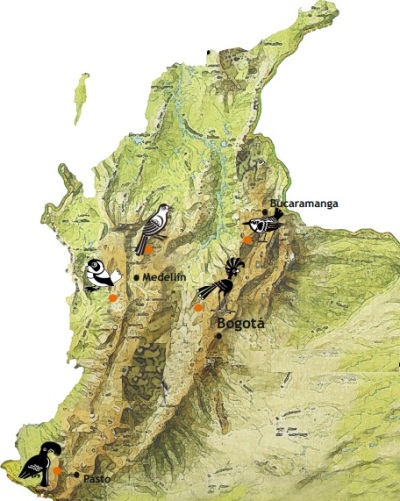
ProAves has 5 reserves open to the public and placed in several of the most important maintained ecosystems in Colombia.

These reserves have excellent accommodation, meeting rooms, canteens, electricity, mobile communication and trails; besides it is also possible to observe species of several orders in different degrees of threat, allowing researchers, academia and visitors to increase logistically knowledge of biodiversity in the environment as a formative experience.

It is a target for ProAves to make available and provide the best conditions for the academic community to develop university practices and field research for undergraduate work, master’s or doctoral degrees, with subsidized entry costs and all-risk insurance.

We want this opportunity to be the beginning of investigations of flora and fauna that contribute to the knowledge of our biodiversity and academic practices that facilitate the training of future professionals.

Research interest: ecology, biology and inventories of all Infrastructure orders

Infrastructure:

Rooms / beds Hiking / Km Camping Meeting workspace
El Paujil Bird Reserve
6/32 8 Yes Yes
Las Tángaras Bird Reserve
8/22 5 No Yes
Chestnut-capped Piha Bird Reserve 4/12 6 Yes No
El Pangán Bird Reserve
12/45 12 No Yes
Cerulean Warbler Bird Reserve
6/25 5 No Yes


Costs:

Income (including insurance)*
Group 4 – 10* $15.000 x night 
Researchers $35.000  x week / min 4 weeks
Food
Groups (with remittance) $30.000 x group / max 10
Researches / groups (no remittance) $20.000 day / night

All bookings include:

  • Services like electricity, water, 3G internet
  • Research permits

Description of the Birds Nature Reserves

Paujil Tángaras Chestnut-capped Piha
Pángan Cerulean Warbler
Habitat Rain forest to tropical rain forest Super-tropical montane tropical Premontane rainforest   Very wet tropical basal forest to premontane   Premonate rainforest
Location
Eastern Cordillera, Magdalena River valley of Boyacá and Santander West of the western range of the central area high Atrato, Chocó Northeast of the central mountains of Antioquia South Pacific slope, Nariño Mountains of Yariguíes, western slopes of the Cordillera Oriental of Santander
Elevation 623-3116 6223-12467 4921-6233 1640-6223 4412-6561
T max and min 91ºF y 71ºF 66ºF y 51ºF 68ºF y 53ºF 71ºF y 59ºF 60ºF y 82ºF
320 sp of birds (8 endemic and 8 threatened) 250 sp of birds (7 endemic and 15 threatened) 216 sp of birds (5 endemic and 8 threatened) 369 sp of birds (49 endemic and 19 threatened) 297 sp of birds (8 endemic and 9 threatened)
Biodiversidad 43 sp non-flying mammals (18 threatened) and 24 sp mammals 24 sp of mammals 36 sp non-flying mammals (10 threatened)
32 sp of amphibians and 46 reptiles 16 sp of amphibians and 9 reptiles 20 sp of amphibians and 9 reptiles 21 sp of amphibians and 17 reptiles

For more information contact:

Research Director: Alexander Monsalve

ProAves, Cra 20 No. 36-61, Bogota, DC

Tel: (57-1) 3403229 / 340326 Fax (57-1) 3403285

Email: amonsalve@proaves.org

Categorías
News

Mayors from across Chocó visit Las Tangaras

This activity was performed as a closure to the summit, thanks to the invitation by the Mayor of Carmen de Atrato after the official launch of the Las Tángaras Reserve in the Republican Congress and the Council of Bogotá, this important event became the best opportunity to show the natural riches of the Reserve, its invaluable biodiversity and the tourism opportunities it provides to the region.

During the visit, the Executive Director Lina Daza Rojas, Director of Conservation, Luis Felipe Barrera, and Deputy of Protected Areas northwestern region of ProAves, Johanna Villa, presented the objectives of the Foundation to the participants, the new portfolio of services and activities that are being developed in el Carmen de Atrato and the rest of the country for the benefit of birds and their habitat.

Similarly, Summit attendees learned about the facilities and other attractions of the Reserve, where they were able to check their potential and the ecological importance it has for the Chocó and the country, besides the attraction for bird watchers, ornithologists and nature tourists.

[slickr-flickr search=”sets” set=”72157630515001224″ items=”20″ type=”gallery”]

Finally, the Conservation Director of ProAves, Luis Felipe Barrera, gave the presentation of the Alliance for Zero Extinction Colombia – AZE and as a result of the exposition several mayors signed the covenant, promising to preserve and protect one of the most diverse and important sites on the planet like the rainforests of Chocó.

The Natural Bird Reserve Las Tángaras is located between 1,380 and 3,419 meters above sea level, it protects the Atrato River basin (the most important river of the Chocó) , has a high diversity index with 250 species of birds registered so far, highlighting the Golden-ringed tanager (Bangsia aureocinta),the Black-and-gold tanager (Bangsia melanochlamys) , The Chocó Vireo (Vireo Masteri), Purplish-mantled Tanager (Iridosornis porphyrocephala), the Indigo Flowerpiercer (Diglossa indigotica) and the Pearled Treerunner (Margaronis stellatus) and several species of hummingbirds like Coeligena wilsonii, Boissaneaua Jardini and Heliodoxa Imperatrix.

Home address and visits:

Contact headquarters EcoTurs, Carrera 20 No. 36-61 Bogotá, phone (57) (1) 245-5134 and (57) (1) 340-3285, email e-info@ecoturs.org or visit www.ecoturs.org


Categorías
News

National Protected Area training course held

The meeting was also attended by Executive Director Lina Daza Rojas, Director of Conservation and Protected Areas, Luis Felipe Barrera, the regional vice-principals of the different protected areas as well as representatives from the administrative area.

This time the Rangers were trained in various topics related to the conduct of protected areas such as signaling pathways, management of snakebite accidents, mowers and chainsaw management and repair of roads.

Meanwhile, the Executive Director, Lina Daza Rojas, presented the information portfolio on the work done by ProAves, she welcomed the Las Tángaras Bird Reserve and presented the annual report to all attendees which will be delivered to the Board.

At the same time she gave field work clothing to the Rangers and deputies of the reserves composed of a waterproof suit, pants, shirt, cap and shirt. Additionally, rangers were trained in office IT, the training was to perform clerical duties such as typing, file management, documents, etc. Similarly, ??a list of needs was made for security features and the administrative area provided advice on topics such as pension and severance pay, contract renewal letters and holidays, and resolved administrative issues concerns.

[slickr-flickr search=”sets” set=”72157630395026392″ items=”20″ type=”gallery”]

Also, the Antioquian Civil Defense attendants at the meeting were trained in first aid procedures which were to be performed immediately in an emergency, also the new Joint Committee on Occupational Health (Copaso) was elected composed of ProAves Rangers Carlos Julio Rojas, Gonzalo Cardona and Administrative Coordinator, Anyesul Anzola.

During the meeting, approximately 1 km of landslides on the road leading to the Guaduas in the municipality of Carmen de Atrato was improved, with the hard work of over 20 people, directly benefiting the community located in the area of influence of the Las Tángaras Reserve.

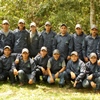
This event was the perfect platform for exchanging experiences and feedback processes in each of the reserves by rangers and other staff, stimulating a better attitude towards the methods of biodiversity conservation of Colombia strengthening our corporate identity.

Thus ProAves continues in its efforts for the conservation of bird habitats in Colombia by training their protected areas team in order to ensure proper management of their reserves.
With the support of:

Healthy_Planet_Logo

Categorías
News

A new generation of Eco-Guides in Colombia

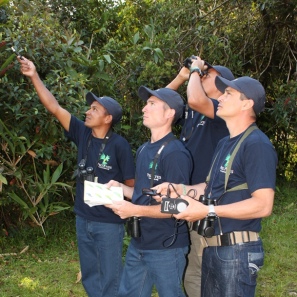
With the attendance of 9 rangers and the participation of Juan Carlos Luna and Miles McMullan as instructors, the third version of this activity was held which discussed topics such as: importance of birds, identification of different families and species in the field, capabilities and skills of a guide, group management and use and maintenance of equipment for observation.

Also, the instructors taught our rangers on how to lead people, how to display birds in a  simple way, list of reserve birds, management of large groups and management of the equipment needed to guide (MP3, speakers, laser, binoculars, bird songs and the field guide).

Similarly, there were other exercises to attract tourists among which included the installation of drinkers for hummingbirds, troughs for fruit feeders and the knowledge of other fauna and flora found in the reserves was emphasized.

During the 9 days of the course also the list of birds observed by the participants was shared, there were several English practice sessions (names of birds in English, body parts and colors of birds) and to describe the specific spot where a bird is located.

[slickr-flickr search=”sets” set=”72157630641088138″ items=”20″ type=”gallery”]

Finally an introduction about the geographical location of each reserve in the country was given, thermal floors and the living area, generalities of the reserves, residents of areas surrounding the reserves and the economy of the towns where protected areas are located.

At the end of the Ecoguide training course our rangers were very satisfied with what they learned and expressed interest in participating in more training and thus contribute to the conservation of the species of our country.

With the support of:

Healthy_Planet_Logo

Categorías
News

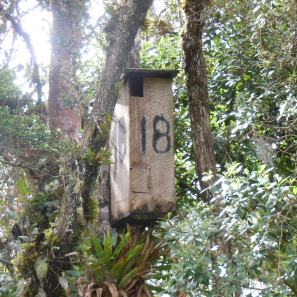
New artificial nests for Fuertes’s Parrot

In 2010, 20 artificial nests were installed in the Natural Bird Reserve Giles-Fuertesi in order to study and preserve the Fuertes’s Parrot (Hapalopsittaca fuertesi) endemic and Critically Endangered.

During the first half of 2012, 12 artificial nests were located in the reserve, it was decided to install them in two different types of areas: first, in the interior of the forest looking for pristine conditions, and the second in the first few meters from the edge of the forest looking for the best light conditions. The installation was made between 5 and 8 meters in Guayaba trees that met the required height and diameter. It took into account a distribution of nests that were close together & others that were further apart.

Habitat_Loro_C
Fuertes’s parrot (Hapalopsittaca fuertesi) habitat in the Giles Fuertes’s Parrot Bird Reserve.

These activities are expected to enhance and encourage the use of artificial nests by the Fuertes’s Parrot and thus gain new knowledge about the habitat preferences and breeding habits of the species to enable and enhance conservation actions.

Installation and relocation of artificial nests are still an immediate alternative to the limited supply of nests, meanwhile their habitat is being recovered, it is currently affected by different factors such as deforestation, agricultural activities and logging which have contributed to the diminishing supply of natural nests.

Nido_Artificial
Installation of artificial nest.

Program adopt a nest

You can help prevent the extinction of a species of parrot in Colombia through the Adopt a nest Program, which is sponsoring the construction and installation of an artificial nest, its monitoring and maintenance for one year. You can support us through your donation online.

With the support of:

lpf abc Robert