Fundación ProAves – por la conservación en el país de las aves

Categories
News Proyecto Santander Proyecto Santander

Protecting the Colombian Oak (Quercus humboldtii)

The “Colombian White Oak” (Quercus humboldtii), is an arboreal species belonging to the Fagacea family, which is currently on the IUCN red list (2021) in the category of Least Concern (LC), while according to the Red Book of Plants of Colombia this species is in the Vulnerable (VU) category (Cárdenas & Salinas 2006). 

The origin of the genus Quercus spp is very old, with fossils dating back to the Lower Cretaceous and which dispersed in America with an approximate diversity of 400 species distributed in different forest ecosystems, from Canada to the Andes of Colombia where only one species could prosper (Aguilar 2006). In accordance with the above, authors such as Van der Hammen 1974 estimate that the Quercus humboldtii (Bonpl 1805) species was established in the Colombian Andes approximately 300,000 years ago, the eastern mountain range being its main area of occupation, where it probably replaced other plant communities and became established with other tree species forming dominant associations that are generally called “Robledales”.

Habitat of the Colombian oak

The Colombian Oak (Quercus humboldtii) is a species that is considered endemic to the mountains of Colombia, however, it is also present in the Panamanian Darién (GBIF 2021). It is distributed in an altitudinal range between 750 to 3.450 meters above sea level along with the three mountain ranges and some isolated massifs of the Colombian Caribbean, while the forest covers known as “Robledales” are observed from 2000 meters above sea level (Lozano & Torres 1974; Avella & Rangel 2017).

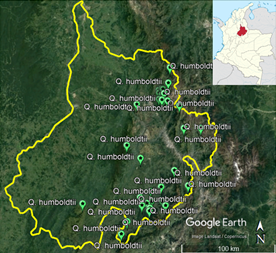
In this sense, most of the reports of the species occur mainly in the departments of Boyacá and Santander due to the fact that the most representative “Robledales” of Colombia are found in these areas (Garavito & Cárdenas 2017). With the information obtained from the database “The Global Biological Information Facility (GBIF)”, in the Santander department, the species has been reported in the municipalities of Onzaga, Charalá, Encino, El Peñón, Tona, California, Bucaramanga, Piedecuesta and Floridablanca between 1600 and 3270 meters above sea level (map 1).

Map 1: Historical records of "Roble Blanco" Q. humboldtii in the department of Santander.
SEARCHING FOR ENDANGERED SPECIES IN SANTANDER
Figure 1

With the execution of this project, a series of expeditions began with the specific objective of knowing the state of conservation and distribution of the populations of this species. To date, 7 localities have been visited in search of Q. humboldtii and an approximate area of 4000 m2 has been sampled in transects of 50×2 m² and approximately 50 km have been traveled in plant-free collections during 47 effective field days.

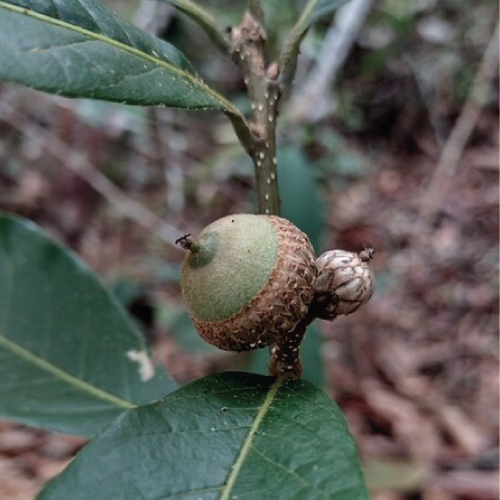
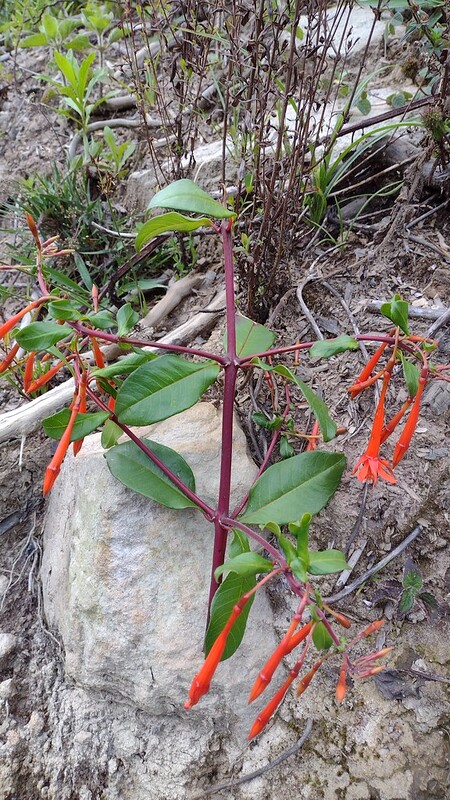
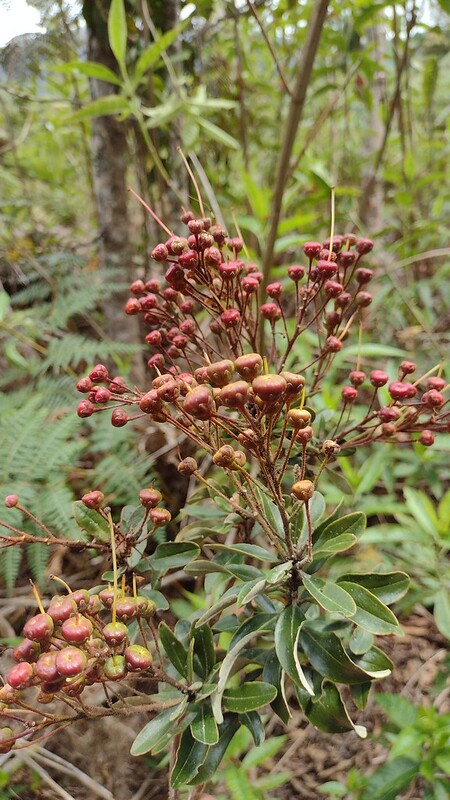
According to the established transects, a total of 1154 arboreal individuals have been registered, of which 18.5% (213 individuals) correspond to Q. humboldtii. As a result of these expeditions, it has been observed that Q. humboldtii exhibits high morphological plasticity, in terms of growth forms such as the branching or not of the main stem, or the size of the vegetative and reproductive organs, and even the abundance and size of lenticels. and stipules on young stems, both of male and female individuals (Figure 1).

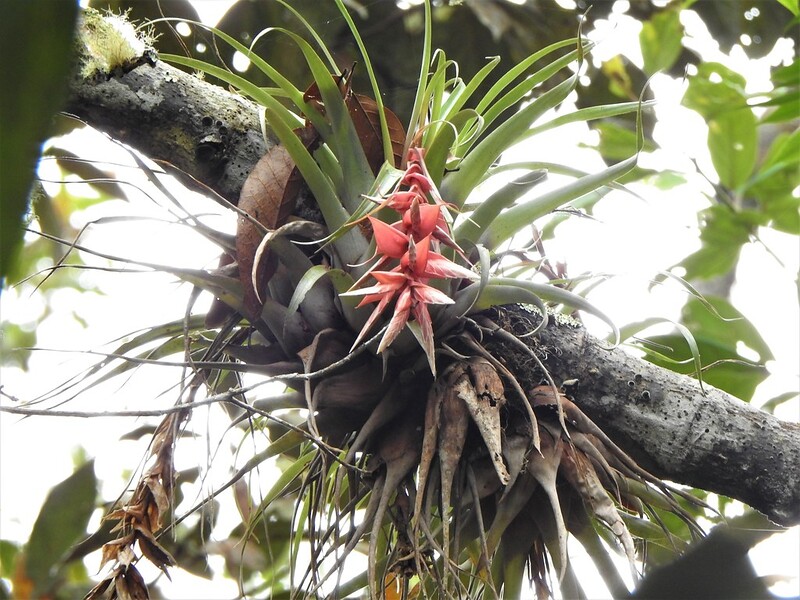
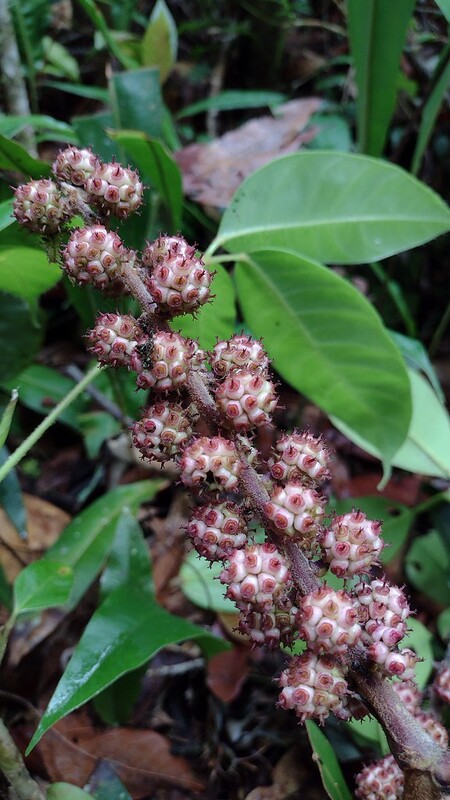
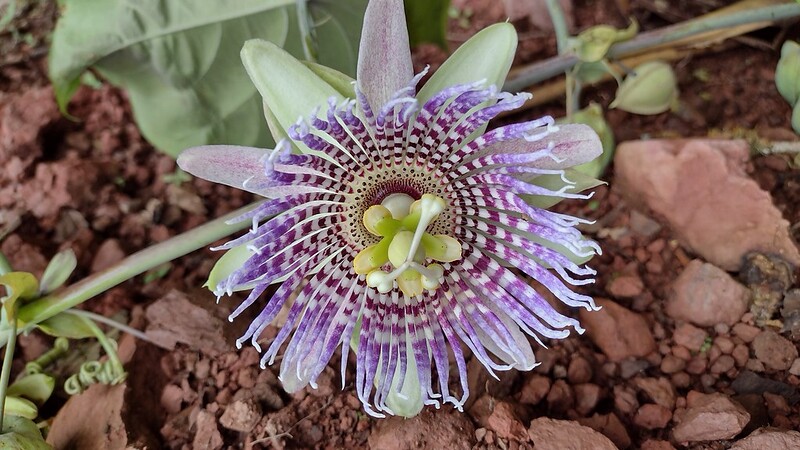
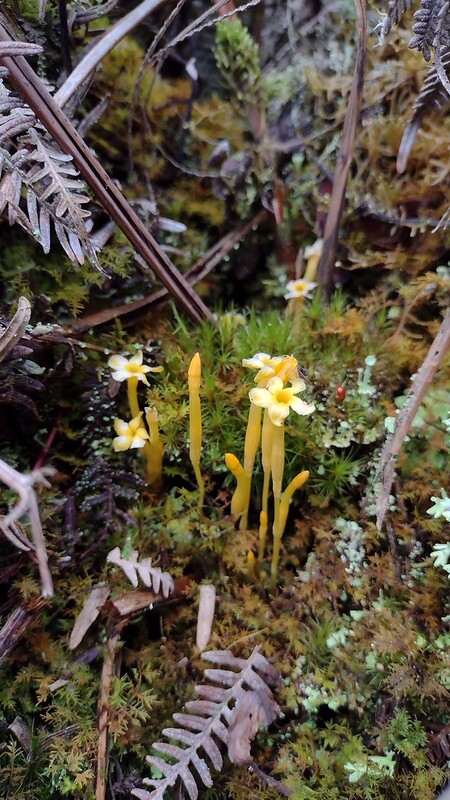
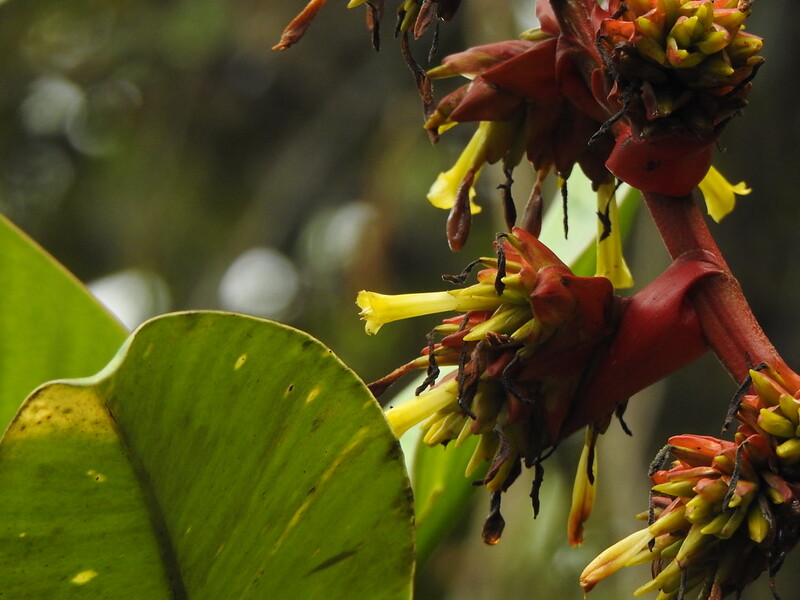
Figure 2: Flora associated with oak trees.

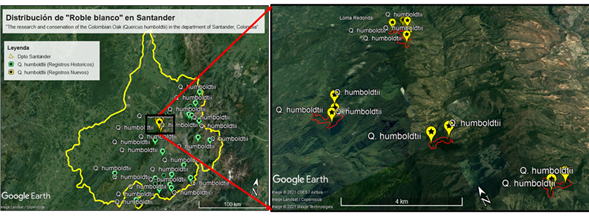
Finally, according to the information collected during the field work and that available in the GBIF, we conclude that: 5 locations within the visited areas (Reinita Cielo Azul ProAves Reserve and Chanchón village in the municipality of San Vicente de Chucuri and Veredas San Javier, La Cacica and Palo Blanco in the municipality of Zapatoca) constitute areas where the species Q. humboldtii had not been recorded, which represents new records and the area of ​​distribution of the species is expanded for the Santander department (map 2).

Map 2: Historical records (green points) and new records (yellow points) of Q humboldtii for the department of Santander.

Find more pictures of the species recorded during this expedition here.

Aguilar, M. (2006). Plan De Restitución Poblacional De Quercus humboldtii Bonpl. En La Reserva Forestal Protectora El Robledal, Cundinamarca. Universidad de Alcalá. Colombia.


Avella, A., y Rangel, O. (2017). Los Robledales. Diversidad y Conservación. En Moreno, L. A., Andrade, G. I., y Ruiz-Contreras, L. F. (Eds.). 2016. Biodiversidad 2016. Estado y tendencias de la biodiversidad continental de Colombia. Instituto de Investigación de Recursos Biológicos Alexander von Humboldt. Bogotá, D. C., Colombia.


Cárdenas, D & N. Salinas. (2006). Libro rojo de Plantas de Colombia: Especies maderables amenazadas. Instituto de Investigaciones Amazónicas (SINCHI). Bogotá.


Garavito Guerrero, B. A., & Bossa Cárdenas, R. F. (2017). Plan de Conservación del Quercus Humboldtii en la Jurisdicción CORPOGUAVIO.


GBIF.org (2021), https://www.gbif.org/species/2880642. Disponible en: https://www.gbif.org [21 Dic 2021].


IUCN (2021); https://www.iucnredlist.org/


Lozano, G & J. Torres. (1974). Aspectos generales sobre la distribución, sistemática, fitosociológica y clasificación ecológica de los bosques de Roble (Quercus) en Colombia. Ecología Tropical 1. Colombia.


Van Der Hammen, T. (1974). The Pleistocene Changes of Vegetación and Climate in Tropical South America. Journal of Biogeophy.1:3-26.

Categories
Noticias Women for Conservation (Mujeres por la Conservación)

Reconocimiento a Sara Lara en el festival “Por las mujeres en la ciencia” de L’Oréal-UNESCO

Con la convicción de que el mundo necesita la ciencia y la ciencia necesita a las mujeres, la fundación L’Oréal y la UNESCO realizaron la primera edición del festival #ForWomenInScience, donde invitaron a 40 brillantes investigadoras procedentes de diferentes lugares del mundo, entre las cuales se encuentra nuestra directora ejecutiva, Sara Inés Lara, para compartir sus inspiradoras historias sobre cómo están cambian al mundo a través de su amor por la ciencia, la investigación y el medio ambiente.

Gracias a su arduo trabajo, resiliencia y enorme pasión, Sara ha logrado romper las brechas de género en el sector y se ha convertido en ejemplo para las próximas generaciones. Bajo su liderazgo, ProAves y Women for Conservation han empoderando a las mujeres rurales de las zonas de amortiguación de las Reservas Naturales de la Fundación, para que sean guardianas de la conservación, y emprendan el hermoso reto de proteger el medio ambiente y sus especies.

El planeta está siendo devastado, los ecosistemas más biodiversos del mundo corren un gran peligro de desaparecer. Y hoy, más que nunca, la naturaleza necesita a las mujeres. Nuestra capacidad de gestión y protección de los recursos naturales es un tesoro que aún está por ser descubierto. Por esto, es momento de que las mujeres alcemos la voz y seamos escuchadas, expresa Sara.

A pesar de los inmensos obstáculos y disparidades que enfrentan diariamente las mujeres en la protección de la naturaleza, su fortaleza y determinación las ha convertido, cada vez más, en la voz de la esperanza de la conservación.

Agradecemos a la Fundación L’Oréal y a la UNESCO por resaltar la admirable labor de las mujeres en la ciencia y  mirar hacia un futuro incluyente.

  • La Fundación ProAves está comprometida con las mujeres en la conservación, conoce más sobre nuestro proyecto aquí.

Categories
News Women for Conservation (Mujeres por la Conservación)

Sara Inés Lara recognized at L’Oréal-UNESCO’s For Women in Science festival

With the conviction that the world needs science and science needs women, the L’Oréal Foundation and UNESCO held the first edition of the #ForWomenInScience festival, where they invited 40 brilliant female researchers from different parts of the world, including our executive director, Sara Inés Lara. These innovators were part of last Tuesday’s virtual event, sharing their inspiring stories about how they are changing the world through their love for science, research and the environment.

Thanks to her hard work, resilience, and incredible passion, Sara has managed to bridge the gender gaps in the conservation sector and has become an example for future generations. Under her leadership, ProAves and Women for Conservation have empowered rural women in the buffer zones of the Foundation’s Nature Reserves to become guardians of conservation, and undertake the important challenge of protecting the environment and its species.

The planet is being devastated, and the world’s most biodiverse ecosystems are in great danger of disappearing. Today, more than ever, nature needs women. Our ability to manage and protect natural resources is a solution that has yet to be discovered. This is why it is time for women to raise their voices and be heard,” says Sara.

Despite the immense obstacles and disparities that women face daily in the protection of nature, their strength and determination have increasingly made them the voice of hope for conservation.

We thank the L’Oréal Foundation and UNESCO for highlighting the admirable work of women in science, and working towards a more inclusive future.

  • The Fundación ProAves is committed to women in conservation, learn more about our project here.
Categories
News

Elevated Bridges: Safe Crossing for Wildlife

Overpasses have been used across the world to minimize the impact of roads on wildlife, and their use is becoming increasingly common in our country. On the road that passes through Arrierito Antioqueño ProAves Reserve, located in the municipality of Anorí, Antioquia department, 8 elevated bridges have been installed thanks to the Government of Antioquia, the department of transportation, the municipality and CORANTIOQUIA. The aim of these bridges is to protect the lives of the wildlife that calls Antioquia home.  

In addition, the community and visitors of the municipality of Anorí have been informed about the importance of conserving nature and being respectful of all kinds of life– not only our fellow human beings, but also the wild animals that share the lands we live on.

WILDLIFE CROSSINGS IN ARRIERITO ANTIOQUEÑO PROAVES RESERVE

In November 2006, ProAves created Arrierito Antioqueño ProAves Reserve with the aim of protecting the habitat of the Arrierito Antioqueño (Lipaugus weberi), a species of bird endemic to the country and in critical danger of extinction. To create the Natural Reserve (a critical habitat for hundreds of plant and animal species) ProAves acquired eight properties, several of them adjacent to the road that connects the head of the municipality with the city of Medellin. Being nearby a major metropolitan area, the natural area is intersected by 6km of this route.

Until a few years ago, the section of road to Anorí was very narrow, with sharp, unpaved curves, making travel difficult and slow. Given these conditions, cars needed to travel slowly, and didn’t pose a large threat to crossing wildlife. However, between 2018 and 2020, the Government of Antioquia conducted a highway expansion project, repaving the highway to Anori. This project completely changed the road– turning it from an underdeveloped roadway to a modern, high-speed thoroughfare. Not only has the speed of the traffic increased, but the volume as well. Additionally, the road is now accessible to municipalities that previously were unable to access it.

These route changes have created high risk conditions for wildlife collisions. However, from the very beginning, the Government of Antioquia and partners undertaking the project have kept the ProAves Reserve at the forefront of their minds.

They have implemented measures to minimize the impact of the work on Arrierito Antioqueño ProAves Reserve, and on its wildlife. These measures include excellent demarcation and signage around the protect area, as well as the strategic construction of underpasses and 8 elevated bridges for safe animal crossing. Upon entering the Natural Reserve, passersby instantly see signs indicating their entry into a protected area. The impressive elevated bridges also stand out in the landscape. The beautiful, state of the art infrastructure is juxtaposed with the beauty of 6km of pristine tropical forest.

We greatly appreciate the support of the Government of Antioquia, the department of transportation, the Mayor’s Office of Anorí, CORANTIOQUIA and the community for helping us protect our beautiful wildlife.

Categories
News

Training Children as Leaders in Conservation

Children and young people in the surrounding areas of Reinita Cielo Azul Pauxi Pauxi ProAves Reserves, located in the municipality of San Vicente de Chucurí, Santander department, are strengthening their birding abilities and learning to understand the biodiversity of the region.

As part of its conservation strategies, the Fundación ProAves has implemented study and research groups with children and young people in the area, where the rangers and the Deputy Director teach them to identify and recognize different species of mammals, frogs, snakes, plants and birds.

Through different activities such as tree planting, vegetable plot maintenance, drawing workshops, environmental education, recreational and sports activities, children and young people have learned to love and take care of our greatest treasure: the planet and all its forms of life.


Likewise, the study group of the surrounding areas of Reinita Cielo Azul ProAves Reserve participated in the Global Bid Day 2021, where around 170 species of birds were sighted in their wild state, greatly motivating the various communities to implement conservation strategies from their homes.

usfish

We are very grateful to the Neotropical Migratory Bird Conservation Act (NMBCA) for their support in reaching out to communities and, especially for their help with the migratory bird program in the ProAves Reserves.