Fundación ProAves – por la conservación en el país de las aves
Categories
Annual Reports

Annual report on the management of Fundación ProAves 2011

2011 was a year of many achievements in favor of conservation; began with extraordinary news: the rediscovery of the Bull of Santa Marta, after 113 years of being missing, which was observed in the El Dorado Bird Nature Reserve, a Reserve that in this same year we managed to expand and thus expand the range for the protection of this species. 

Learn about our entire 2011 annual report here.


Categories
Annual Reports

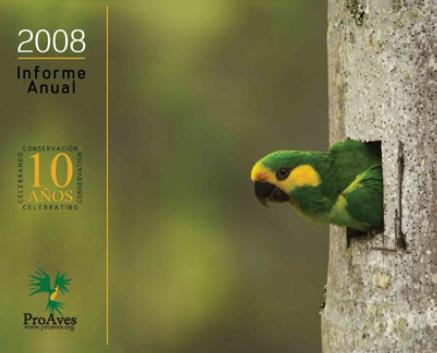
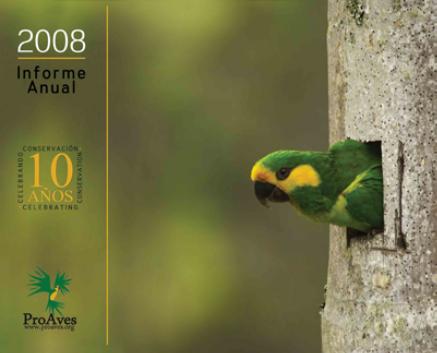
Annual Report 2008 published

Wednesday 15 April 2009.

ProAves has published its 2008 Annual Report, summarizing its main achievements during 2008 and its first decade of work, including the establishment of 15 Bird Reserves, protection of threatened birds in Colombia and a significant contribution to the recovery of many species, such as the Yellow-eared Parrot.

In Protecting critical habitat section, ProAves shows how, among other great achievements, owing and protecting 42,575 acres of montane, paramo, subtropical, tropical rainforest and dry forest, and mangrove and coastal zone, together with other conservation activities, ProAves is helping to protect 78% of threatened bird species in Colombia.
informe

Sections include: Saving endangered species, with aspects such as the artificial nests program has successful fledged 239 individuals of threatened parrots; Science for conservation highlights the discovery of 3 bird species for science, and Conserving with the community displays actions such as 74 Bird Friendly Schools. Finally, Institutional strengthening, presents several factors that have helped ProAves develop in 2008.

ProAves wishes to thanks its many partners that made possible these activities and the dedicated and committed staff of ProAves that made so many achievements possible.

Download the annual report in Spanish (as PDF) at the end of this note.
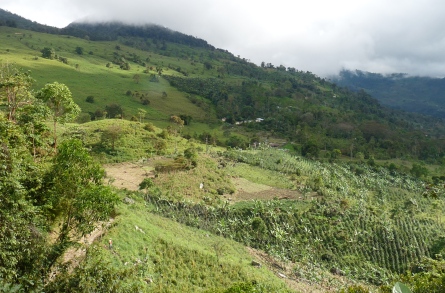
image1 Informe Anual ProAves 2008
PDF – 4.2 MB

Categories
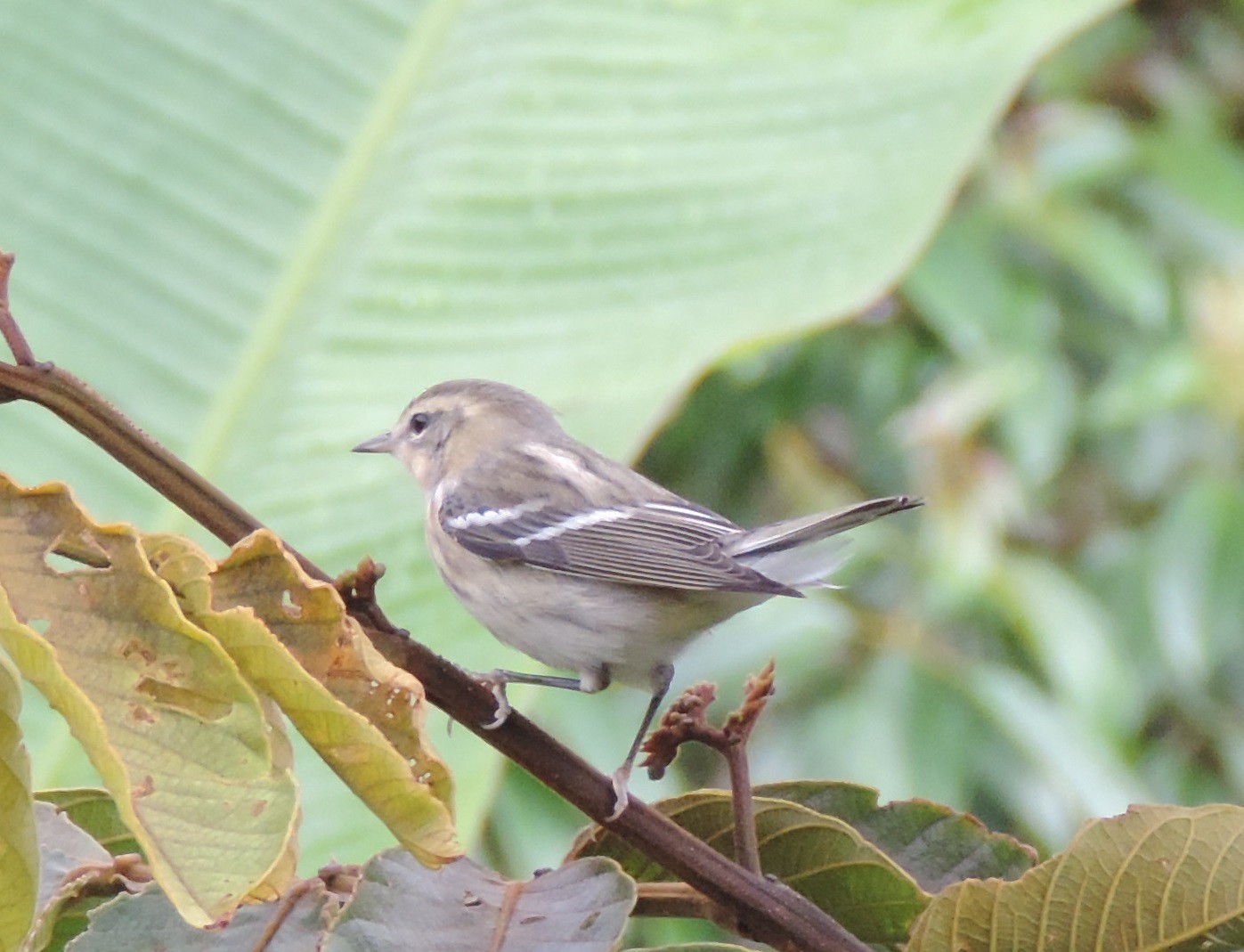
Noticias Reinita Cielo Azul

Cerulean Warbler Conservation Corridor

P1130108
Conservation Corridor Cerulean Warbler ProAves Reserve

The Cerulean Warbler Corridor was designed and established in 2008 in the town of San Vicente de Chucuri to join the Cerulean Warbler ProAves Reserve  located in the Serranía de los Yariguíes on the western slopes of the Cordillera Occidental in Colombia in the department of Santander, it has 209 hectares of high Andean forest and is surrounded by pasture, coffee and cocoa crops and the Helmeted Curassow Bird ProAves Reserve located at Cerro de la paz on the eastern slopes of the Andes in the towns of San Vicente de Betulia and Chucurí (Santander).

It has more than 1,500 acres between about 650 and 1,400 m in altitude, although its average altitude is between 800 and 900 m, of which approximately 90% is tropical rain forest. 10% of the area has coffee, cacao plantations (small scale) and pastures.

Objective:

The corridor was established to allow the passage of migratory species Dendroica cerulea and Vermivora crisoptera, and in general, all migratory and native species joining the Natural Bird Reserves of Reinita Cielo Azul and Pauxi Pauxi, which are located between café and cocoa plantations and are frequently visited by migratory species, and to create community awareness about the importance of conserving natural areas on their farms.

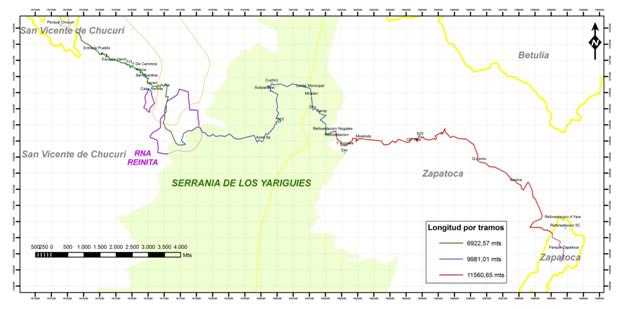
This initiative was established with support from American Bird Conservancy, Robert Giles and NMBCA who led the establishment of the reserves and the corridor which is 10 km long and 1 km wide with an altitudinal limit of 800 to 2,000 m through three production systems (coffee, cocoa and livestock). Within the corridor several conservation strategies such as reforestation focused on coffee and cocoa under native shade, establishment of Silvopastoral systems promoting connectivity between the lands. To this end, we have established three nurseries distributed within the corridor and the development of Ecological Easements.


mapa_reinita
Cerulean Warbler Conservation Corridor

At the end of 2010, the corridor was extended to the Cucarachero de Chicamocha ProAves Reserve in the town of Zapatoca (Santander) to the project YARÉ with support from Conservation Leadership Programme, which aims to recreate the path of Lenguerke and through this, join the corridor thus conserving the dry forest ecosystem and endangered bird species in this place.

With support:

Categories
Noticias Uncategorized Uncategorized @en

Andean Parrots Corridor

Actividades_Gonzalo_005
Reserva ProAves Loros Andinos

This corridor was designed and established since 2004 after having established the El Mirador Municipal Reserve as a loan, in order to give it adequate management and thus annotate efforts for the conservation of the Coroniazul Parrot (Hapalopsittaca fuertei) in the municipality of Génova, Quindío.

There they have worked with the community, developing conservation tables in order to involve the inhabitants close to the reserve so that they understand the importance of not taking their livestock to the reserve; A high mountain nursery was also established with which reforestation has been carried out, recovering the pastures that existed on the reserve’s properties. All this work has been carried out thanks to the support of the Loro Parque Fundación, the Alcaldía de Génova and the Corporación Autónoma del Quindío (CRQ).

The corridor extends towards the municipality of Roncesvalles in the department of Tolima, passing from the western slope of the central mountain range to the eastern one, characterized by the páramo ecosystem down to 2,800 meters; finding the high Andean forest and the characteristic wax palm (Ceroxilum quindiuense) where the populations of the Yellow-eared Parrot (Ognorhynchus icterotis) nest. Although this sector has been working since 1999, only the union of the corridor with the Loros Andinos ProAves Reserva was completed until 2010.


Objectives:

The Andean Parrot Corridor was established in order to connect two work areas of great importance for the conservation of 5 species of threatened parrots for Colombia: Hapalopsittaca fuertei (Loro Coroniazul), Hapalopsittaca Amazonina (Loro Multicolor), Bolborhynchus ferrugineifrons (Periquito Cadillero), Leptosittaca braniki (Yellow-eared Parrot) and Ogorhynchus icterotis (Yellow-eared Parrot).

After the support and effort of several previously mentioned institutions, two Natural Reserves were established: the Loro Coroniazul ProAves Reserve continues to the El Mirador Municipal Reserve in Génova (Quindío) and the Loros Andinos ProAves Reserve located in Roncesvalles (Tolima).

 
P1100695
Corredor de Conservación Reserva ProAves Loros Andinos

With the support of:

Corpoquindio
Categories
Noticias Uncategorized Uncategorized @en

El Pangán Corridor

Reserva_El_Pangan

This corridor had its beginnings with the establishment of the El Pangán ProAves Reserve in 2005 with the support of BirdLife International and Conservation International, in the Fund for the Strategic Ecosystems Alliance program. However, the maintenance and expansion process continues thanks to the great support of Rainforest Concern.

This initiative arose to offer sustainable alternatives (training, support and management) and environmental awareness to the neighboring communities of the reserve, as a strategy to link the community to the appropriation and care of the natural resources of the area.

This place has been considered one of the most biodiverse areas in Colombia, since 21 threatened bird species and 48 endemic bird species with restricted distributions have been registered in the area of ​​Endemic Birds of Chocó (EBA 041-Stattersfield et al. 1998) . No other protected area of ​​comparable size within this EBA is home to populations of so many species of birds with restricted distribution; which makes it one of the highest priority ecosystems for conservation.

The El Pangán Corridor is located on the Pacific slope of the Andes in the department of Nariño, Colombia, at 01 ° 21’N, 78 ° 04’W; 10 km north of the Junín district, Barbacoas municipality; at an altitude of between 550 to 1,900 masl and 1,900, represented by lowlands and tropical humid forests. Holdridge (1967) classifies this area into two life zones: tropical rain forest (bp-T) at an altitude between 550 and 1,100 meters above sea level and pre-montane rain forest (bp-PM) at an altitude between 1,100 and 1,700 meters above sea level.

Objective:

The main objective was to establish a biological corridor between the El Pangán ProAves Reserve and the Camawari and Unipa indigenous reserves. Thus protecting 15,000 ha of tropical rain forest between an altitude strip of 1,300 m (600-1,900) as a representative forest ecosystem that conserves biodiversity and ensures in particular the survival of a good number of endemic species and globally threatened species.

Conservation actions are currently being carried out in the area thanks to the constant management that has been given to the El Pangán ProAves Reserve. This is the oldest corridor that Fundación ProAves has established and managed, as it takes 6 years of hard work and positioning.

Ro_amb_RNA_Pangan

With the support of:

birdlife
rainforest
Categories
Annual Reports

ProAves 2006 Annual Report: Great achievements

ProAves se complace en presentar su Informe Anual 2006, el cual reúne los logros más importantes de la Fundación el año pasado en sus tres áreas de trabajo: Conservación, Investigación y Educación Ambiental.

Entre las principales realizaciones en ese periodo están el establecimiento de cinco nuevas reservas naturales, la producción del café amigable con las aves Reinita Cerúlea, la descripción de la subespecie Gorrión Montes de los Yarigüíes (Atlapetes latinuchus yariguierum) y la sensibilización directa de 72.000 personas por medio de actividades de educación ambiental.
Encuentre el documento en versión en pdf al final de esta nota.

Las realizaciones de ProAves en el 2006 contaron con el apoyo de numerosas instituciones y personas, a las cuales ProAves agradece, como American Bird Conservancy, Fundación Loro Parque, US Fish and Wildlife Service y Conservation International, Robert Giles, Fondo para la Acción y la Niñez, Ministerio de Ambiente, Vivienda y Desarrollo Territorial y corporaciones autónomas regionales de Colombia, entre otras.
image1 ProAves Informe Anual 2006
PDF – 2 MB

Categories
Articles

Payments for Environmental Services (PSA)

In the world all ecosystems provide a wide range of services to humanity, from the oxygen generated by forests, through streams of clean water, productive soils to carbon sequestration. Individuals, businesses and society, depend on these services to survive, besides being their inputs.

However many of these services are currently undervalued or have no financial value and that is why, forest owners do not pay attention because the forest does not generate profits but losses, they pay taxes on land that is not ” productive”.

Pagos
Payments for Environmental Services (PSA)

Alluding to this, since 2006 the ProAves has generated knowledge in the community about the value of their resources and about their importance to their quality of life and the economy itself, knowing that this conservation strategy is not designed to reduce poverty but to provide economic incentives to promote more sustainable and efficient use of environmental services and the ecosystems that generate them.

servidumbre
Easement (Jardín, Antioquia)

Currently 8 RAW Reciprocal Agreements for Water have been signed which protect 2,650 hectares of moor and forest habitat of the Yellow-eared Parrot. These were signed for an average of 15 years of commitment under the provision of incentives as inputs to the farms.

The Foundation has developed the following PSA:

1. The Conservation Easement Program. Developed in the towns of Jardín (Antioquia), San Vicente de Chucurí (Santander) and Roncesvalles (Tolima).

2. Reciprocal Agreements for Water (ARAs). Developed in Roncesvalles and El Espinal (Tolima).